
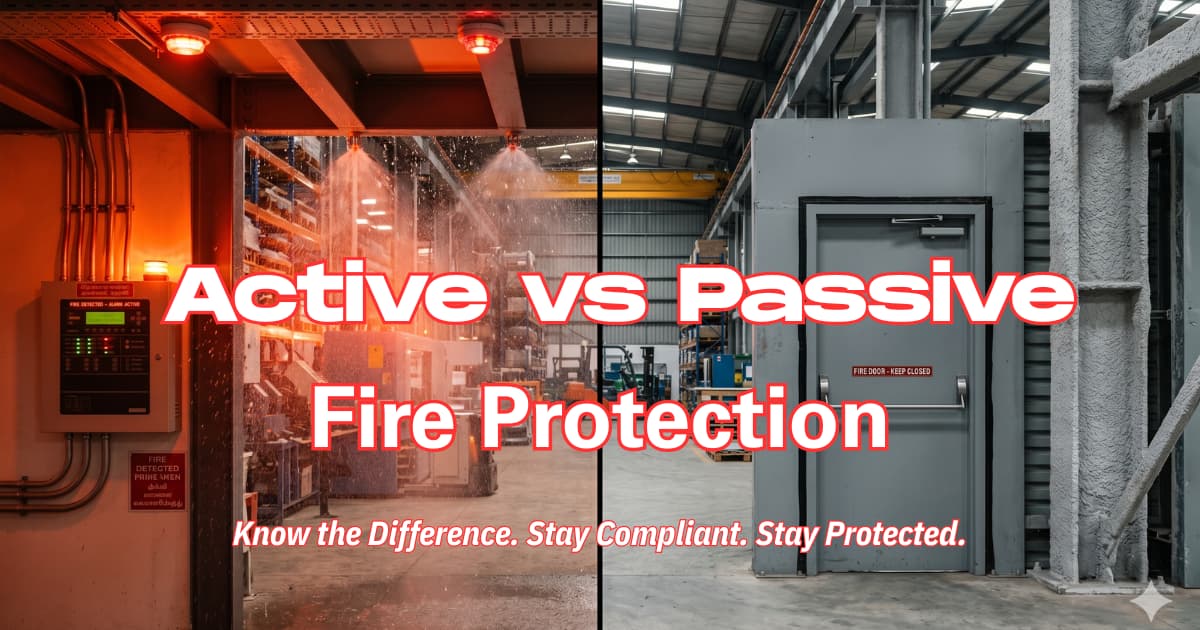
Active vs Passive Fire Protection: Key Differences Every Indian Business Owner Must Know
Learn the key differences between active and passive fire protection, Indian compliance requirements, costs, and how to protect your Hosur industrial facility.
India records over 1.2 lakh fire incidents every year, causing losses that cross ₹5,000 crore. Yet fewer than 40% of industrial facilities in Tamil Nadu maintain a compliant dual-layer fire protection setup, according to NCRB and TAC data. For businesses operating in Hosur's fast-growing industrial corridor, that gap between what the law demands and what facilities actually have is not just a compliance problem. It is a serious operational and financial risk.
Fire protection is not a single switch you flip during a building inspection and forget about. It is a layered system built on two distinct pillars: active fire protection, which detects and responds to a fire once it starts, and passive fire protection, which slows the spread of fire using the building's own structure.
This post breaks down both systems in plain terms. You will learn what each one does, how they differ, what Indian regulations require, what they cost, and how to deploy both correctly - whether you run a manufacturing shed in SIPCOT Hosur, a logistics park in Krishnagiri, or a pharma unit in Dharmapuri.
What Are Active and Passive Fire Protection? (Definitions)
What Is Active Fire Protection?
Active fire protection (AFP) refers to systems that detect, alert, or suppress a fire when it is triggered. These systems do not work until a fire event activates them - and that is precisely what makes them "active." They respond.
Common active fire protection systems include:
- Automatic sprinkler systems - discharge water when heat reaches a set threshold
- Fire alarm panels and smoke detectors - detect smoke or heat and trigger an audible/visual alert
- Clean agent suppression systems - used in server rooms and chemical storage areas where water would cause secondary damage
- Gaseous suppression systems (CO₂, FM-200, Novec 1230) - flood-and-discharge systems for enclosed spaces
- Fire hydrant systems and hose reels - manual but classified as active because they require human intervention to respond to a fire event
Active systems are effective at stopping a fire from growing out of control. But they depend on proper installation, regular maintenance, and functioning sensors. If a detector fails or a sprinkler head is blocked, the response is compromised.
What Is Passive Fire Protection?
Passive fire protection (PFP) refers to built-in structural measures that contain or slow the spread of fire without needing to be triggered. These systems are always "on" - they work through the fabric of the building itself.
Common passive fire protection measures include:
- Fire-rated walls and floors - compartments that restrict fire to one zone for a defined time period (30, 60, 90, or 120 minutes)
- Fire doors and fire-rated shutters - prevent fire and smoke from travelling through openings
- Intumescent seals and collars - expand when heated to seal off gaps around pipes, cables, and ducts
- Fire-resistant coatings and boards - applied to structural steel or concrete to slow heat transmission
- Compartmentation - the architectural strategy of dividing a building into fire-isolated zones
The National Building Code of India 2016 (NBC 2016) mandates passive fire protection in all buildings above 15 metres in height. Yet surveys from CII and BIS suggest over 60% of industrial sheds in Tier-2 cities like Hosur lack compliant compartmentation. That is a significant liability sitting quietly inside factory walls.
How Do They Work Together?
Think of active and passive fire protection as two lines of defence. Passive systems buy time - they slow the spread of fire and smoke, keeping occupants safe long enough to evacuate and giving active systems the chance to respond. Active systems then suppress or extinguish the fire before it overwhelms the structure. Neither is complete without the other. A building with only sprinklers and no fire-rated walls can still lose an entire wing to a fire that spreads before suppression kicks in. A building with excellent compartmentation but no detection system may see a fire grow undetected until it is out of hand.
Why Fire Protection Matters for Indian Industries in 2025
The Regulatory Landscape
India's fire safety framework draws from several layers of regulation. The National Building Code 2016 sets the baseline for structural and system requirements across occupancy categories. The Tariff Advisory Committee (TAC) guidelines influence insurance rates based on fire protection compliance. OISD standards (Oil Industry Safety Directorate) apply specifically to petroleum and chemical facilities. The Central Electricity Authority (CEA) regulations govern electrical fire risks, and the Tamil Nadu Fire Service Act mandates fire NOC (No Objection Certificate) approval before a business can operate.
Non-compliance is not just a fine risk. It can result in operational shutdowns, insurance claim rejections after a fire incident, and personal liability for promoters and directors under the Factories Act.
Why Hosur and the Surrounding Belt Face Higher Risk
Hosur has emerged as one of South India's most important industrial towns. The Hosur-Krishnagiri-Dharmapuri belt hosts automotive OEM suppliers feeding Hyundai and Toyota plants, electronics manufacturers supplying the Samsung and Foxconn ecosystem, pharmaceutical units, and large-format logistics parks. Many of these facilities handle flammable materials, high-voltage equipment, or temperature-sensitive goods - all of which amplify fire risk.
Tamil Nadu accounted for approximately 12% of India's industrial fire casualties between 2019 and 2023. The Krishnagiri-Hosur industrial corridor recorded a 27% increase in reported fire incidents since 2020, according to the Tamil Nadu Fire and Rescue Services annual report. These are not abstract statistics. Every facility in this belt operates in an environment where a fire incident is a realistic operational scenario — not a remote possibility.
Key Differences Between Active and Passive Fire Protection
1. Response Mechanism
Active systems are reactive. Passive systems are inherent.
Active fire protection systems wait for a trigger - heat, smoke, or a manual alarm pull - and then respond. Passive systems are built into the structure of the building and work continuously without any triggering event. This means passive protection cannot fail to "activate" because it does not activate at all. It simply exists.
2. Primary Purpose
Active systems suppress or alert. Passive systems contain and delay.
Active fire protection is designed to detect a fire quickly and either alert occupants or suppress the fire before it spreads. Passive fire protection is designed to compartmentalise a building so that even if a fire starts and grows, it cannot spread beyond a defined zone for a defined period. Both roles are critical — detection without containment means a fast-spreading fire; containment without detection means a hidden fire that eventually overwhelms a compartment.
3. Maintenance Requirements
Active systems require ongoing, scheduled maintenance. Passive systems require periodic inspection.
A sprinkler system needs quarterly flow tests, annual full inspections, and component replacements based on IS 15683 and IS 2189 standards. Smoke detectors need sensitivity testing every six months. A fire alarm panel needs annual panel tests and battery checks. Passive systems - fire doors, intumescent seals, coatings - need periodic visual inspections to confirm they have not been damaged, bypassed, or altered during renovation work. In practice, passive system inspections are often neglected because these elements are invisible and do not sound alarms when they degrade.
4. Cost Model
Active systems carry higher ongoing costs. Passive systems are primarily a one-time capital investment.
Active fire protection involves upfront capital cost plus recurring annual maintenance contracts (AMCs), periodic component replacement, and testing costs. Passive fire protection costs are largely front-loaded at the construction or fit-out stage. Retrofitting passive systems into an existing building is significantly more expensive and disruptive than building them in from the start.
5. Applicable Standards in India
Both systems are governed by BIS, NBC, and sector-specific standards.
Key Indian standards for active systems include IS 2189 (fire detection and alarm systems), IS 15683 (sprinkler systems), and NBC 2016 Part 4. For passive systems, IS 3614 covers fire check doors, IS 1641 covers fire-resistant coatings, and NBC 2016 Parts 3 and 4 govern compartmentation requirements and structural fire resistance periods.
6. Failure Modes and Redundancy
Active systems can fail silently. Passive systems degrade gradually.
An active fire protection system can fail due to power outages, sensor drift, blocked sprinkler heads, depleted suppression agent, or corroded pipework. These failures may not be visible during normal operations. Passive fire protection degrades through physical damage (holes drilled through fire walls, fire doors wedged open, intumescent seals damaged during renovation) - and these breaches are equally invisible unless inspected specifically.
7. Integration Requirements
Both systems must be designed together, not independently.
One of the most common mistakes in industrial fire protection is designing active and passive systems in isolation - the architect specifies compartmentation walls, the fire engineer designs sprinklers, and nobody checks whether a suppression zone aligns with a fire compartment boundary. Effective fire protection requires the two systems to be co-designed so that active response zones, passive compartment boundaries, and evacuation routes all reinforce each other.
Active vs Passive Fire Protection — Full Comparison Table
|
Criterion |
Active Fire Protection |
Passive Fire Protection |
|
Definition |
Systems that detect, alert, or suppress fire when triggered |
Structural measures that contain or slow fire without activation |
|
Trigger Mechanism |
Activated by heat, smoke, gas, or manual input |
Always present; no trigger required |
|
Examples |
Sprinklers, fire alarm panels, suppression systems, smoke detectors, hydrants |
Fire-rated walls, fire doors, intumescent seals, fire-resistant coatings, compartmentation |
|
Applicable IS/NBC Standard |
IS 2189, IS 15683, NBC 2016 Part 4 |
IS 3614, IS 1641, NBC 2016 Parts 3 & 4Maintenance |
|
Frequency |
Quarterly to annual testing; AMC mandatory |
Periodic visual inspection; post-renovation check |
|
Typical Cost Range (Indian Market) |
Sprinklers ₹80–200/sq. ft; alarm panels ₹1.5–5L; clean agent ₹8–25L |
Intumescent coating ₹40–120/sq. ft; fire doors ₹15,000–60,000/unit |
|
Key Advantage |
Responds to fire events; reduces injury, asset loss |
Works independently; contains spread without power or activation |
|
Primary Limitation |
Dependent on maintenance, power, and correct calibration |
Can be compromised by building modifications; often overlooked post-construction |
|
Best For |
High-occupancy areas, suppression of fast-developing fires |
Structural protection, smoke control, protecting escape routes |
|
Combined Deployment |
A dual-layer approach is best practice and mandatory in NBC 2016 for buildings above 15m — active and passive systems must be co-designed |
|
How Technique Engineers Designs Integrated Fire Protection Solutions
A fire protection system is only as good as the methodology behind it. At Technique Engineers, every project begins with a thorough site risk assessment - not a template checklist, but a detailed walkthrough of your facility that accounts for occupancy type, materials stored or processed, structural layout, existing fire separations, and the nearest Tamil Nadu Fire and Rescue Services (TNFRS) response point.
From that assessment, our PESO-approved engineers design a dual-layer system: an active layer that detects and suppresses, and a passive layer that contains and delays. Every material specified - from fire-rated board to intumescent collars - carries BIS marking, ensuring your system holds up to third-party inspection and your fire NOC application does not get rejected on materials grounds.
Our process runs through six clear stages:
- Site risk assessment - occupancy classification, hazard category identification, identification of compliance gaps
- System design - active and passive layers co-designed as one integrated system
- BIS/NBC - compliant material specification - all passive materials BIS-marked; all active system components meeting IS standards
- Certified installation - supervised installation by trained technicians with PESO-approved engineers on-site
- Commissioning and handover - full system test, documentation package, and staff training
- Annual maintenance contract - scheduled testing, inspection reports, and NOC renewal support
In a recent project at a sheet metal fabrication facility in SIPCOT Phase III, Hosur, our audit found that the existing fire doors in the production hall were non-rated wooden doors - they would have failed within minutes of a fire event. We replaced these with IS 3614-compliant fire check doors and installed an addressable fire alarm system with zoning that aligned with the facility's compartment boundaries. The client's insurance renewal came in 22% lower than the previous year.
Fire Protection Costs and ROI in India: What to Budget in 2025
Active System Cost Breakdown
- Sprinkler systems: ₹80–200 per Sq. ft depending on hazard classification (light, ordinary, or extra hazard per IS 15683). A 5,000 Sq. ft ordinary-hazard facility typically costs ₹6–12 lakh for a full wet pipe system.
- Fire alarm panels and detection: ₹1.5–5 lakh for a mid-size industrial facility with an addressable panel; conventional panels are cheaper but offer less zone-specific information.
- Clean agent suppression (FM-200 / Novec 1230): ₹8–25 lakh for a protected enclosure of 50–150 cubic metres, depending on agent type and cylinder count.
- CO₂ suppression systems: ₹5–15 lakh for similar enclosure sizes; lower agent cost but higher safety risk in occupied spaces.
- Fire hydrant systems: ₹3–10 lakh depending on facility size and yard coverage requirements.
Passive System Cost Breakdown
- Intumescent coatings for structural steel: ₹40–120 per sq. ft of steel surface; dry film thickness and fire resistance period (30–120 minutes) determine the cost.
- Fire-rated doors (IS 3614-compliant): ₹15,000–60,000 per door depending on size, rating, and glazing requirements.
- Compartmentation works (fire-rated walls and floors): ₹200–600 per sq. ft for new construction; significantly higher for retrofits where existing structures must be modified.
- Intumescent pipe collars and cable transit seals: ₹500–3,000 per penetration point, depending on pipe diameter and rating required.
Hidden Costs to Plan For
- Fire NOC application fees (Tamil Nadu Fire and Rescue Services) and third-party inspection charges
- Commissioning and testing costs if not bundled with installation
- Annual Maintenance Contract (AMC) - budget 8–12% of active system installation cost per year
- Documentation and as-built drawing preparation for NOC and insurance purposes
ROI Calculation Framework
Facilities with compliant dual-layer fire protection can negotiate 15–35% lower fire insurance premiums with Indian insurers, according to GIC Re and TAC guidelines. For a facility paying ₹8 lakh per year in fire insurance premium, a 20% reduction saves ₹1.6 lakh annually. Against a combined active-passive installation cost of ₹25–40 lakh, the payback period purely on insurance savings falls under three years - before accounting for the far larger cost of an uninsured or under-insured fire incident.
The real ROI of fire protection is not the premium saving. It is avoiding the ₹2–15 crore cost of a major industrial fire that destroys equipment, inventory, and stops production for months.
Fire Protection Solutions in Hosur and the Surrounding Industrial Belt
Hosur
Hosur's industrial identity is built on automotive components and electronics manufacturing. SIPCOT Phase I, II, and III collectively host hundreds of units supplying to OEMs and Tier-1 suppliers. Many of these plants handle coolants, lubricants, and solvents - materials that accelerate a fire dramatically. The TNFRS Hosur Division requires a fire NOC for all industrial buildings above 500 sqm and for all multi-storey commercial buildings. Common compliance gaps seen in Hosur units include non-rated fire doors, absent compartmentation between production and storage areas, and inadequate sprinkler coverage in high-rack warehousing zones.
Krishnagiri
Krishnagiri's industrial mix includes agro-processing, mango pulp units, logistics warehouses, and cold chain facilities. Cold storage units carry a specific fire risk from refrigerant systems and insulation panels (PIR/PUR sandwich panels, which are combustible). Many cold chain operators in Krishnagiri operate with fire alarm systems that were installed a decade ago and have never been tested under current IS 2189 standards. Passive compartmentation is particularly important in these facilities because fire spreads rapidly through insulated panel systems.
Dharmapuri
Dharmapuri's industrial base includes textile processing units and an emerging pharmaceutical cluster. Textile units carry high fire loads from raw material storage and processing chemicals. Pharmaceutical units increasingly require clean agent suppression in API storage and documentation rooms, combined with fire-rated construction for hazardous material areas. TAC guidelines apply specific loading factors to both sectors, and compliant fire protection directly impacts premium calculations.
Attibele Belt (Bangalore Periphery)
The Attibele–Anekal–Electronic City fringe hosts IT parks, light manufacturing, and cold chain hubs. These facilities often span the Karnataka-Tamil Nadu state boundary, creating jurisdictional questions about which fire NOC authority applies. Facilities physically located in Tamil Nadu, regardless of their business registration state, fall under TNFRS jurisdiction. IT park facilities in this zone typically require clean agent systems for data rooms and adequate passive protection for high-occupancy office floors.
Thally and Denkanikottai
The granite quarrying and processing belt around Thally and Denkanikottai involves heavy equipment, diesel storage, and processing facilities with significant electrical fire risk. Many units here are relatively small (under 2,000 sqm) and fall below the mandatory NOC threshold - but that does not mean fire risk is low. PESO regulations apply to any facility storing diesel above 2,500 litres, requiring specific suppression provisions.
Step-by-Step: How to Implement a Compliant Fire Protection System in India
Step 1 - Conduct a Fire Risk Assessment
Begin with a formal fire risk assessment per NBC 2016 and IS 15683 guidelines. The assessment must identify ignition sources, fuel loads, and structural vulnerabilities. This is not a walk-through - it requires documentation of every fire hazard category present on site.
Step 2 - Classify Your Occupancy and Hazard Category
NBC 2016 classifies buildings by occupancy (industrial, storage, assembly, educational, etc.) and hazard level (light, ordinary, extra). Your hazard classification determines the sprinkler density, compartment size limits, fire resistance periods required for walls and floors, and the type of detection system needed.
Step 3 - Design the Active Suppression and Detection System
Based on hazard classification, design your sprinkler layout to IS 15683, your detection zoning to IS 2189, and your suppression agent selection (water, clean agent, CO₂) based on the materials present. Active system design must be stamped by a PESO-approved engineer for NOC submission.
Step 4 - Plan Passive Compartmentation and Specify Materials
Define your fire compartment boundaries. Every wall, floor, door, and penetration that forms a compartment boundary must achieve the required fire resistance period. Specify BIS-marked materials: IS 3614 fire doors, IS 1641-compliant coatings, and certified intumescent products. Ensure that compartment zones align with your active system zones.
Step 5 - Apply for Fire NOC from Tamil Nadu Fire and Rescue Services (TNFRS)
Submit your fire protection system drawings, risk assessment report, materials list with BIS certifications, and site plan to the TNFRS Hosur or district office. TNFRS conducts a physical inspection before issuing the NOC. Common rejection reasons include non-compliant drawings, missing BIS documentation, and insufficient hydrant yard coverage.
Step 6 - Commission the Installation with BIS-Marked Materials
All installation must be supervised, with a commissioning test report generated for every system component. Keep as-built drawings updated - these are required for NOC renewal and insurance survey.
Step 7 - Schedule Annual Maintenance and Testing
Annual maintenance is not optional. IS 2189 requires periodic testing of all fire detection components. IS 15683 requires annual full inspection of sprinkler systems. TNFRS increasingly checks AMC records during NOC renewal visits. A signed AMC with a qualified fire engineering firm is now considered a baseline expectation by most insurers.
FAQs: Active vs Passive Fire Protection in India
Q1: What is the main difference between active and passive fire protection?
Active fire protection systems detect, alert, or suppress a fire when it occurs - they respond to the event. Examples include sprinklers, alarms, and suppression systems. Passive fire protection works through the building's structure - fire-rated walls, fire doors, and intumescent seals - to contain and slow fire without needing to be triggered. Both are required for a compliant fire protection strategy in India.
Q2: Which fire protection system is required by NBC 2016 in India?
NBC 2016 mandates both active and passive fire protection, with requirements varying by building height, occupancy type, and hazard classification. Buildings above 15 metres must have compliant passive compartmentation. Most industrial and storage occupancies above a defined floor area require automatic sprinkler systems and fire detection systems in addition to passive measures.
Q3: Is a fire sprinkler system active or passive fire protection?
A sprinkler system is active fire protection. It remains inactive until a fire event causes a sprinkler head to reach its rated activation temperature, at which point it discharges water. Because it requires a trigger to function, it is classified as an active system under both Indian standards and internationally.
Q4: What are examples of passive fire protection materials used in India?
Commonly used passive fire protection materials in India include IS 3614-compliant fire check doors, intumescent paint and board coatings applied to structural steel, intumescent pipe collars and cable transit seals, fire-rated gypsum board partitions, and calcium silicate-based fire protection boards. All materials used in compliant installations should carry BIS marking.
Q5: How much does it cost to install a fire protection system for a factory in India?
For a mid-size industrial facility of 5,000–10,000 sq. ft, a combined active and passive fire protection system typically costs between ₹20–60 lakh depending on hazard classification, materials specified, and site conditions. Active systems (sprinklers, alarms, suppression) account for the majority of upfront and ongoing cost. Passive measures (fire doors, coatings, seals) are a one-time capital investment. These are indicative ranges; actual costs depend on a detailed site assessment.
Q6: Do I need both active and passive fire protection in my Hosur facility?
Yes. NBC 2016 and TNFRS NOC requirements for most industrial facilities in Hosur require both active and passive systems. SIPCOT-operated industrial parks have additional internal guidelines that typically require compliant compartmentation, fire alarm systems, and hydrant coverage as minimum conditions for NOC approval. A single-system approach — only alarms, or only fire-rated walls — will not pass a TNFRS inspection.
Q7: What are the fire safety regulations for industrial buildings in Tamil Nadu?
Tamil Nadu industrial buildings are governed by NBC 2016 (national baseline), TAC guidelines (for insurance), and the Tamil Nadu Fire Service Act (for NOC). TNFRS administers the fire NOC process and conducts physical inspections. OISD standards apply to petroleum and chemical units. The Factories Act imposes fire safety responsibilities on factory occupiers. Pharmaceutical units additionally follow Schedule M and CDSCO guidelines that include fire protection requirements.
Q8: How do I get a fire NOC from Tamil Nadu Fire and Rescue Services?
Submit your application to the nearest TNFRS district office (Hosur or Krishnagiri, depending on your location) with the following: site plan, building plan with fire system layout, fire protection system drawings stamped by a PESO-approved engineer, BIS certification copies for all passive materials, and a commissioning test report for active systems. TNFRS will schedule a physical inspection. After passing inspection, the NOC is issued and must be renewed annually for most occupancy types.
Q9: What is intumescent coating and when is it required?
Intumescent coating is a fire-resistant paint or board material applied to structural steel beams, columns, and other load-bearing elements. When exposed to heat, it expands dramatically - typically 50 to 100 times its original thickness - forming an insulating char that slows heat transfer to the steel beneath. It is required wherever structural steel must achieve a specific fire resistance period (30, 60, 90, or 120 minutes) per NBC 2016. In industrial facilities, it is commonly required on exposed steel columns, mezzanine structures, and roof trusses.
Q10: Can passive fire protection replace active fire suppression systems?
No. Passive fire protection is not a substitute for active suppression. Passive systems contain and slow fire - they buy time. Without active detection and suppression, a fire will eventually overcome compartment boundaries, particularly in high-fire-load industrial environments. NBC 2016 and TNFRS regulations both require active systems in most occupancy types above a minimum size or height threshold. The two systems are complementary and both are needed for a compliant, effective fire protection strategy.
Get Your Hosur Facility Audited - At No Cost
India's fire incident statistics are not going to improve by themselves. Every year, industrial facilities that run without compliant dual-layer fire protection are one electrical fault, one solvent spillage, or one overloaded panel away from a catastrophic loss. And when an incident happens in an under-protected facility, the financial consequences are almost always compounded: insurance claims get disputed, regulatory investigations find compliance gaps, production halts for months, and the cost of rebuilding - physical, financial, and reputational - is far higher than the cost of getting protected in the first place.
Three things to take away from this post: active and passive fire protection are not interchangeable - they serve different roles and both are needed. NBC 2016 and TNFRS requirements for industrial facilities in Tamil Nadu demand a dual-layer approach, and single-system setups do not pass inspection. And the cost of building compliant protection is a fraction of what even one significant fire incident costs a business.
Book a free fire protection audit for your Hosur facility. Our PESO-certified engineers will assess your site, identify every active and passive compliance gap, and hand you a detailed report - no cost, no obligation. Use it to plan your upgrade on your timeline, or engage us to implement it. Either way, you leave knowing exactly where you stand.


