
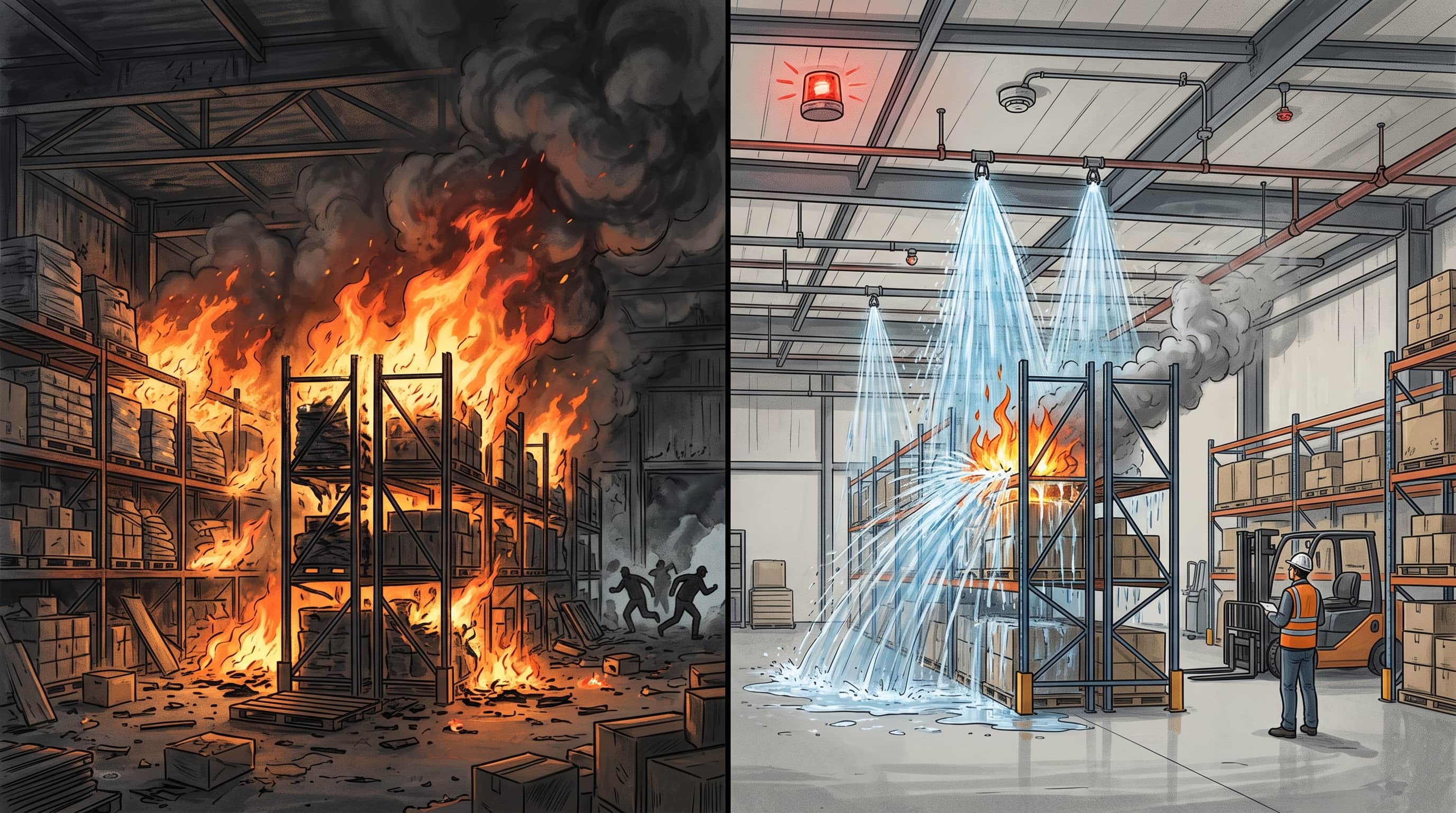
Fire Accident Without Protection vs. With System: A Real Case Study for Tamil Nadu Businesses
See what really happens in a fire - with and without a protection system. Real case study comparison for factories and warehouses in Tamil Nadu
A fire does not wait for anyone to be ready. It starts small. Then it grows fast. That growth happens in the first few minutes. A fire protection system is often the only thing that changes what happens next.
This is true for industrial hubs across Tamil Nadu. Coimbatore's textile mills, Chennai's factories and IT parks, Trichy's heavy industries, and Hosur's auto and electronics units all share the same risk. They have high fuel loads, heavy machinery, and long unattended hours. A single spark can cause a huge loss within minutes.
This case study compares two versions of the same fire. One has no protection. One has a full system. You will see the real difference in real numbers.
The Scenario
- Facility type: Mid-size warehouse and packaging unit
- Location type: Industrial estate (similar to setups common in Coimbatore, Hosur, and Trichy industrial areas)
- Occupancy: Small night shift team
- Stored material: Packaged goods, cardboard, plastic components
- Ignition source: Electrical fault near a storage rack
This kind of setup is common across Tamil Nadu. You can find it in textile godowns in Coimbatore, warehouses in Hosur, and factories near Chennai and Trichy.
What Happens Without a Fire Protection System
- 2:14 AM - An electrical fault sparks near a storage rack.
- 2:22 AM - The fire spreads to the next rack. No alarm goes off. No one notices.
- 2:31 AM - A security guard finally sees smoke and calls for help.
- 2:47 AM - The fire brigade arrives. By now, the fire has already spread across three aisles.
- 4:10 AM - The fire is finally brought under control, but the damage is already done.
The Damage
|
Impact Area |
Result |
|
Property damage |
₹1.2 crore |
|
Inventory lost |
70% of stock |
|
Downtime |
18 days |
|
Injuries |
2 minor smoke-related cases |
|
Insurance premium (next renewal) |
+25% |
The real problem was not the fire itself. It was the 17 minutes nobody knew it was happening. Then came another 16 minutes before anyone could act. That is over half an hour where the fire had a free run.
What Happens with a Fire Protection System
- 2:14 AM - The same electrical fault sparks.
- 2:14:30 AM - A smoke detector picks it up within 30 seconds. The alarm sounds. The fire station is notified automatically.
- 2:15 AM - A sprinkler above the rack activates and starts controlling the fire.
- 2:19 AM - The fire is contained to a single rack. It never gets the chance to spread.
- 2:29 AM - The fire brigade arrives to confirm everything is under control.
The Outcome
|
Impact Area |
Result |
|
Property damage |
₹4 lakh |
|
Inventory lost |
Under 3% of stock |
|
Downtime |
1-day, partial work continued |
|
Injuries |
None |
|
Insurance premium (next renewal) |
Flat or reduced (protection credit applied) |
Side-by-Side Comparison
|
Metric |
Without System |
With System |
|
Time to detect fire |
17 minutes |
30 seconds |
|
Time to first response |
33 minutes |
1 minute |
|
Area affected |
3 aisles, structural damage |
1 rack only |
|
Property damage |
₹1.2 crore |
₹4 lakh |
|
Downtime |
18 days |
1 day |
|
Injuries |
2 |
0 |
|
Insurance impact |
Premium goes up |
Premium stays flat or drops |
The numbers speak for themselves. A working detection and suppression system did not just cut the damage. It changed the whole story.
Why the Difference Is So Big
It comes down to one simple fact: every extra minute lets a fire grow. Fire experts say the burnt area roughly doubles each minute it stays unchecked.
- Detection speed matters most. A sensor spots smoke in seconds. A person might take 15 to 20 minutes to notice. This is a real risk for units in Coimbatore and Hosur that run all night.
- Suppression before spread. Sprinklers act right where the fire starts. Even a fast fire brigade arrives after the fire has already grown.
- The 30-minute gap decides everything. Here, the gap between a ₹4 lakh loss and a ₹1.2 crore loss came down to one thing: how early the fire was caught.
What This Means for Businesses in Chennai, Coimbatore, Trichy, and Hosur
Tamil Nadu has some of India's busiest industrial zones. Chennai's auto and IT belt, Coimbatore's textile and pump units, Trichy's heavy engineering plants, and Hosur's electronics and auto-parts factories all carry the same fire risks. These include high fuel loads, hot machinery, old wiring, and long working hours.
Standards like NFPA 13 (for sprinklers) and NFPA 72 (for fire alarms) exist for a reason. So do the local Tamil Nadu Fire and Rescue Services rules. This pattern repeats across every industry. Early detection is the biggest factor in how much a fire costs a business - in money, time, and safety.
Many insurers also cut premiums for certified fire protection systems. This means the system often pays for itself before any fire even happens.
Frequently Asked Questions
What is the ROI of a fire suppression system?
Most businesses recover the cost of a system many times over. They save it by avoiding just one serious fire. This comes through saved property, less downtime, and lower insurance costs.
Do insurance premiums reduce with a fire protection system installed?
Many insurers in India offer premium credits for certified fire systems. The exact amount depends on your insurer and the type of system you install.
What is the difference between fire detection and fire suppression?
Detection systems alert people early. These include smoke detectors, heat sensors, and alarms. Suppression systems fight the fire itself. These include sprinklers and clean-agent systems. The best protection uses both.
Which areas in Tamil Nadu need fire protection systems the most?
Industrial and warehouse zones in Chennai, Coimbatore, Trichy, and Hosur face the highest risk. This is especially true for units with high fuel loads, heavy machinery, or unattended night shifts. These are the facilities that gain the most from early detection and suppression systems.
The Bottom Line
The fire in both cases was the same. What changed was how fast someone, or something, noticed it and acted. A fire protection system cannot stop a spark from happening. But it can stop that spark from becoming a disaster.
If your facility in Chennai, Coimbatore, Trichy, or Hosur has no system yet, think about this comparison now. Don't wait for an incident to force the conversation.
Want to know what this looks like for your own facility?


