
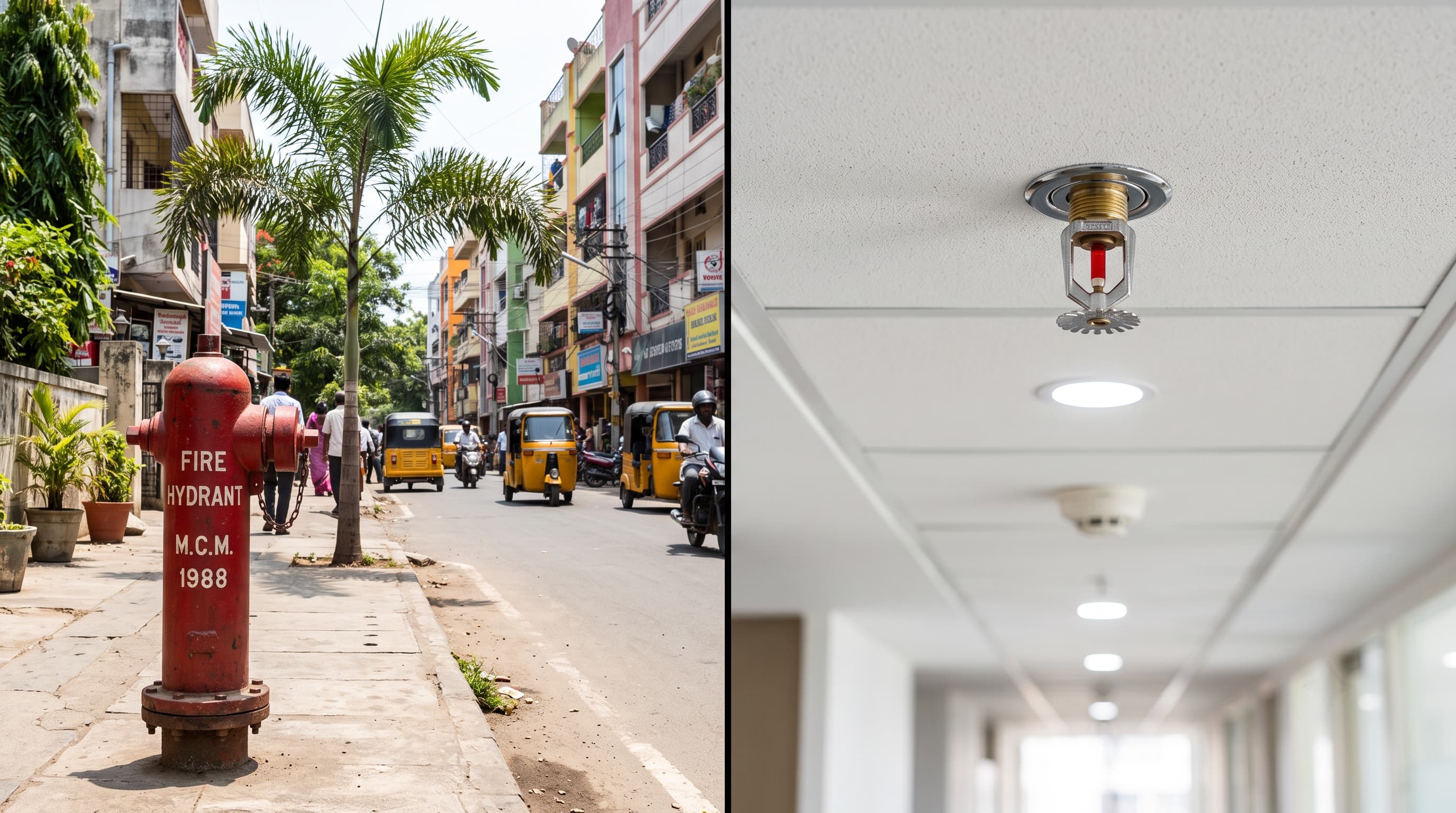
Fire Hydrant vs Fire Sprinkler: Which One Do You Need?
Fire hydrant or fire sprinkler system - what's the real difference, and which does your property need? Compare costs, code rules, and get expert guidance today.
Do you own a home or run a business in Tamil Nadu? If so, you may have asked this question: do I need a fire hydrant, a fire sprinkler system, or both?
It's a fair question, because both systems fight fires, yet they do very different jobs. Mixing up the two can leave your property under-protected, and it can also put you out of step with fire safety rules in cities like Chennai, Coimbatore, Trichy, and Hosur.
This guide explains the difference in plain, simple language. By the end, you will know which system your property needs.
Quick Answer
A fire hydrant sends water to firefighters from outside your building, while a fire sprinkler system fights fire on its own, from inside your building, often acting before the fire brigade even arrives. Most commercial buildings and factories need both systems, but homes usually need neither, unless a local rule says otherwise.
Now let's look at each system in detail.
What Is a Fire Hydrant?
A fire hydrant is a water point placed outside a building or along a street, and firefighters attach their hoses to it during a fire. It gives them fast, steady water, so they don't have to rely only on the small tank in a fire truck.
There are two types of hydrants.
Public hydrants sit on roads and public land. City bodies like Chennai Corporation or Coimbatore City Municipal Corporation install and take care of them.
Private hydrants sit inside factories, IT parks, or large office complexes. The building owner installs and maintains these. Many factories in Hosur and Coimbatore's textile belt use private hydrants, because their land often sits far from city water pipes, so they need their own water source.
A hydrant cannot work on its own. A trained firefighter must open it, connect a hose, and point the water at the fire.
What Is a Fire Sprinkler System?
A fire sprinkler system is a set of pipes and sprinkler heads fixed to a building's ceiling, and when a fire starts, the rising heat triggers the nearest sprinkler head. Water then sprays down on its own, right over the fire.
Here's a common mix-up worth clearing up: sprinklers react to heat, not smoke. So burnt toast or steam from a hot shower will not set them off.
There are four common types of sprinkler systems:
- Wet pipe systems - the pipes stay full of water at all times. This is the simplest and most common type.
- Dry pipe systems - the pipes hold pressured air instead of water. Cold stores and unheated spaces use this type, since plain water could freeze in the pipes.
- Pre-action systems - water only fills the pipes after a fire alarm goes off. The sprinkler head must still trigger on its own after that. Data centers and server rooms use this type, since water damage there is very costly.
- Deluge systems - every sprinkler head opens at the same time. High-risk factory areas use this type.
A sprinkler system needs no person to switch it on. That is its biggest strength. It's also why many insurance firms’ lower premiums for buildings that have sprinklers.
Fire Hydrant vs Fire Sprinkler - Key Differences
|
Factor |
Fire Hydrant |
Fire Sprinkler |
|
Purpose |
Gives firefighters a water supply |
Puts out fire at the source, on its own |
|
Location |
Outside the building |
Inside the building |
|
Activation |
Needs a firefighter to turn it on |
Turns on by itself, using heat |
|
Response time |
Depends on how fast the fire brigade arrives |
Almost instant, often within seconds |
|
Who runs it |
Trained fire staff |
No person needed |
|
Main rule source |
Municipal fire code, site access rules |
Building code, based on the building's size and use |
A Common Mix-Up to Avoid
Many property owners in Tamil Nadu believe that a hydrant nearby means they can skip indoor sprinklers. This is not true.
A hydrant only helps once the fire brigade reaches your building, and in a busy city like Chennai, traffic alone can slow a fire truck by many minutes, giving a fire time to spread across a whole floor. A sprinkler system, on the other hand, acts in the very first moments of a fire, and it often stops a fire before it can spread past one room. The two systems work at different points in time, so neither one can fully replace the other.
Which One Do You Actually Need?
For Homes
Most single-family homes in Tamil Nadu do not need a fire hydrant or sprinkler system by law. But tall apartment buildings and gated communities often fall under a different set of rules.
India's National Building Code (NBC 2016) and Tamil Nadu's fire safety rules ask taller buildings to add fire-fighting gear. This often applies to buildings with four floors or more. It can include a wet riser system, fire hose reels, and, in very tall buildings, sprinklers on every floor.
If you live in a high-rise in Chennai, Coimbatore, or Trichy, check your building's fire NOC papers. NOC stands for No Objection Certificate. It will list what your building must have.
For Business and Factory Buildings
This is where both systems usually become a must.
Offices, malls, hospitals, hotels, and warehouses across Tamil Nadu must follow fire safety rules based on how the building is used. Sprinkler systems are often required for:
- Buildings above a set height or floor area
- Basements used for storage or parking
- Hospitals and hotels, since many people stay there at once
- Warehouses and godowns that store goods which catch fire easily
Hydrant access is a separate need. It lets fire trucks reach your property and hook up to water fast in an emergency. Cities like Coimbatore and Hosur have large factory zones. Many factories there must build their own private hydrant system, since public hydrants alone cannot cover such large plots.
When You Need Both
For most business and factory buildings, sprinklers and hydrants are not a choice between one or the other. They work as a team.
Think of it as two layers of safety. The sprinkler system handles the first, most critical minutes of a fire. The hydrant system backs up the fire brigade if the fire grows too large for sprinklers alone. A textile unit in Coimbatore, an IT park in Chennai, or a factory in Hosur will often need both systems side by side to meet fire safety rules.
Cost and Maintenance: What to Expect
Costs change a lot based on building size, location, and system type. Treat the points below as general guidance, not a fixed price.
Fire hydrant systems often need underground pipes, a pump room, and hydrant valves, so setting one up can cost more upfront for large properties. Once it's in place, though, it needs less regular upkeep than a sprinkler system.
Fire sprinkler systems cost more to install per square foot, most of all for pre-action or deluge types used in sensitive spaces, and they also need regular checks, such as testing sprinkler heads, checking water flow, and checking pipe pressure.
Both systems need testing on a set schedule. Local fire departments and licensed fire safety experts in cities like Chennai and Coimbatore can carry out these checks. Skipping this step is one of the top reasons buildings fail fire safety checks.
Fire Safety Rules in Tamil Nadu
India's fire safety rules mostly come from the National Building Code (NBC) 2016, Part 4. This part covers fire and life safety. Many rules for sprinklers and hydrants borrow ideas from global standards like NFPA 13 for sprinkler design and NFPA 24 for private hydrant systems. These get adjusted to suit Indian buildings.
On top of the national rules, the Tamil Nadu Fire and Rescue Services Department gives out fire NOCs for new buildings. This paper shows that your property meets local fire safety rules. You need it before people can move in or before you renew approval to keep using the building.
Local Corporations in Chennai, Coimbatore, Trichy, and Hosur may add extra rules too. These depend on the type of building, the size of the plot, and what sits nearby. Always check with your local fire department or a licensed fire safety expert. Final rules depend on your exact property and location.
Frequently Asked Questions
Do sprinklers remove the need for a fire hydrant?
No. Sprinklers handle the first response from inside the building. Hydrants back up the fire brigade from outside. Most business buildings need both.
Can I add a sprinkler system without a hydrant nearby?
Yes. A sprinkler system can work on its own, since it draws from its own water tank and pump. But your building may still need a hydrant close by to meet local fire rules.
How often should hydrants and sprinklers be checked?
Most rules ask for a full check on hydrants and sprinkler heads once a year. High-risk factories often need a visual check every month too. Always follow your local fire department's schedule.
What happens if my property does not meet fire rules?
A property that fails to meet fire rules may lose its fire NOC. It may also face fines, or in serious cases, be denied approval to stay open. Insurance claims can also get rejected if a fire safety check finds broken or missing gear.
Is a sprinkler system worth it at home, even if it's not required?
For most single-family homes in Tamil Nadu, it's optional. But for larger homes, or ones that store items which catch fire easily, a basic sprinkler setup adds real safety, even beyond what the law asks for.
In Short
A fire hydrant and a fire sprinkler system are not rivals - they are two parts of one fire safety plan. Hydrants back up firefighters from outside, while sprinklers act on their own from inside, often before the fire brigade even shows up.
Whether you manage an apartment block in Chennai, a factory in Hosur, a textile unit in Coimbatore, or an office in Trichy, the right mix depends on your building's height, its use, and how many people stay there.
Not sure what your property needs? Don't guess. A fire safety check made for your exact property will tell you what Tamil Nadu's fire rules ask for, and help you steer clear of trouble down the line.


