
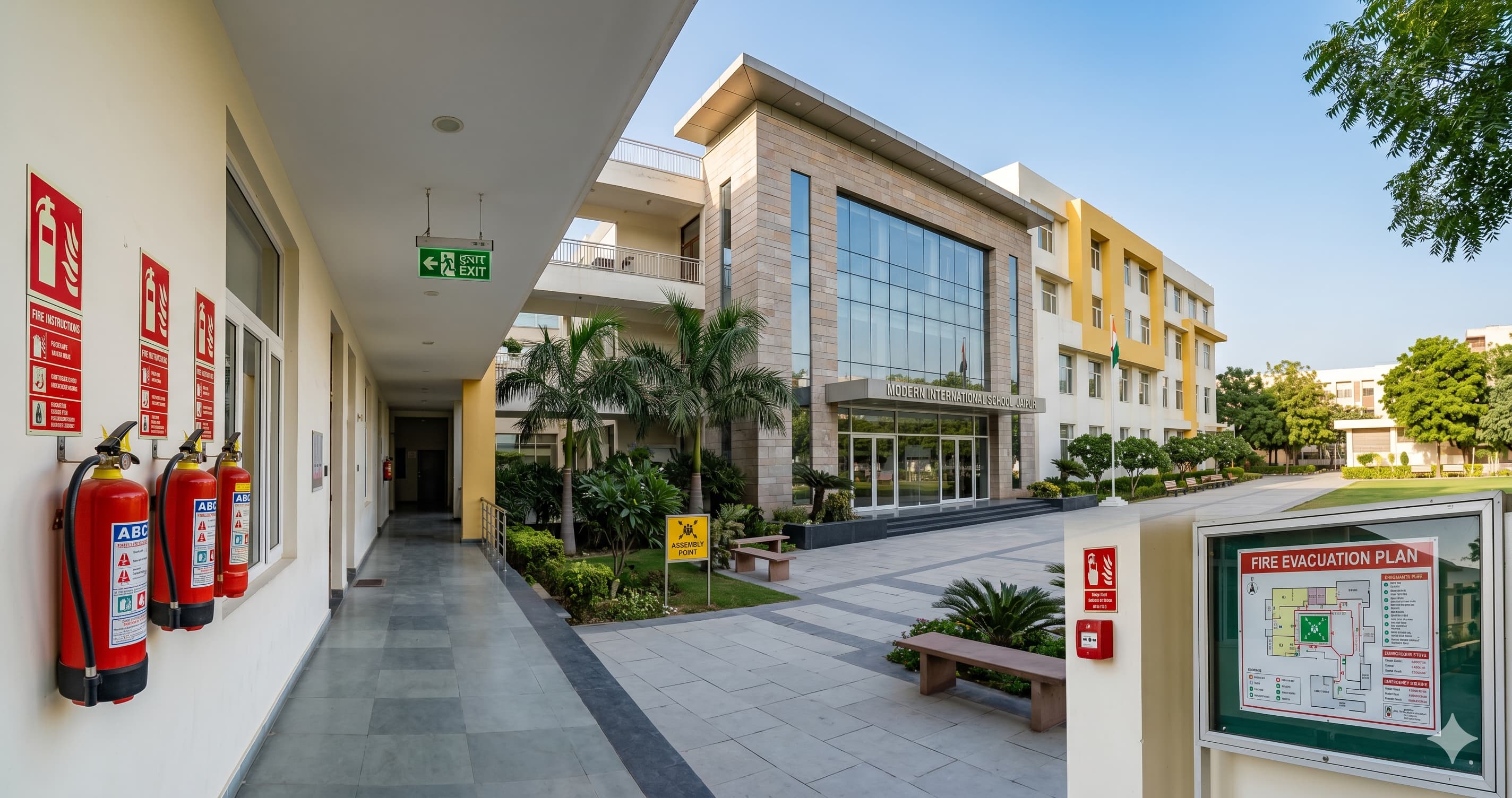
Fire Protection in Schools & Colleges – Mandatory Guidelines (India)
Know the mandatory fire safety rules, NOC process, equipment norms & audit checklist for schools and colleges in India. NBC 2016 & state law covered.
Introduction
Here is a number that should make every school principal, college administrator, and parent stop and think - over 40% of fire incidents in India occur in buildings with no functional fire safety systems. Schools are among the most vulnerable.
Yet, walk into many educational institutions across the country and what you find is sobering. A fire extinguisher with an expired tag sitting in a corner. An emergency exit blocked by old desks and cartons. No evacuation plan on the wall. No fire warden on duty.
Schools and colleges are not like offices or shopping malls. They are packed with hundreds - sometimes thousands - of young people who depend entirely on adults and systems to keep them safe. When a fire breaks out in a classroom block or a hostel at midnight, there is no margin for error.
The good news is that Indian law is very clear about what educational institutions must do. The National Building Code, state fire acts, CBSE guidelines, and AICTE mandates together form a solid framework. The problem is not a lack of rules. It is the lack of awareness and enforcement.
This guide covers everything your school or college needs to know - from the laws that apply to you, to the equipment you must install, to how to get your Fire NOC done right. Whether you manage a small primary school in Coimbatore or a large engineering campus in Bengaluru, this is your complete reference.
Why Fire Safety in Schools and Colleges Is a Critical Concern in India
The Numbers Are Hard to Ignore
India reports thousands of fire incidents in public buildings every year. Educational institutions, because of their size, occupancy, and infrastructure density, sit in a high-risk category. The consequences of a fire in a school are not just physical - they are emotional, legal, and permanent.
The Student-to-Exit Problem
Most older school buildings in India were not designed with fire safety in mind. They were built to fit as many classrooms as possible. The result is a high student-to-exit ratio -meaning there are far too many students trying to escape through far too few exits.
A building that houses 800 students but has only two narrow stairways is a disaster waiting to happen. When panic sets in during a fire, those two stairways can become deadly bottlenecks.
Real Incidents, Real Consequences
India has seen several fire tragedies in educational institutions over the years. From school fires caused by short circuits to hostel blazes in the middle of the night, many of these could have been prevented or their damage reduced significantly with basic fire safety infrastructure. These incidents have led to stricter enforcement drives by state fire departments - but institutions should not wait for a crisis to act.
High-Risk Occupancy Classification
Under Indian fire safety norms, including the National Building Code (NBC) 2016, educational buildings are classified as Group B – Educational occupancies. This classification reflects their high occupant load, the presence of minors, the complexity of evacuation, and the general vulnerability of the population inside.
The Cost of Non-Compliance
Non-compliance carries three types of costs that school managements often underestimate:
- Legal cost: Penalties, sealing of premises, criminal liability in case of fire-related casualties
- Financial cost: Fines, legal battles, rebuilding, and loss of institutional reputation
- Human cost: Injuries, deaths, and trauma that no settlement can undo
Fire Safety Laws and Regulations for Schools in India - What the Law Says
National Building Code (NBC) 2016 - Part 4
The NBC 2016, published by the Bureau of Indian Standards, is the primary technical reference for fire and life safety in India. Part 4 of the NBC deals specifically with Fire and Life Safety provisions. For educational buildings, it specifies:
- Minimum number and width of exits based on occupant load
- Fire compartmentation requirements
- Types of fire detection and suppression systems required
- Emergency lighting and signage norms
- Staircase and corridor width requirements
Any school or college building being newly constructed or significantly renovated must comply with NBC 2016 Part 4. Many states have adopted the NBC as the baseline for their own building bylaws.
State-Level Fire Prevention Acts
Most Indian states have enacted their own fire safety legislation. These acts govern fire NOC issuance, compliance audits, and penalties. Key state laws include:
- Tamil Nadu: Tamil Nadu Fire Service Act, 1961 (and subsequent amendments)
- Maharashtra: Maharashtra Fire Prevention and Life Safety Measures Act, 2006
- Delhi: Delhi Fire Service Act, 2007
- Karnataka: Karnataka Fire Force Act, 1964 (administered under BBMP and Karnataka Fire Force norms)
- West Bengal: West Bengal Fire Services Act, 1950
These acts give the State Fire Departments the authority to inspect, penalise, and seal non-compliant buildings - including schools and colleges.
CBSE and AICTE Mandates
The Central Board of Secondary Education (CBSE) requires affiliated schools to maintain fire safety compliance as a condition of affiliation. Schools must submit proof of fire safety measures during affiliation and renewal processes.
The All-India Council for Technical Education (AICTE) similarly mandates fire safety compliance for technical institutions - engineering colleges, polytechnics, and management institutes. AICTE inspections include fire safety as a parameter for approval and continuation.
Fire NOC - When Is It Mandatory?
A Fire No Objection Certificate (NOC) is mandatory for:
- New buildings above a certain height or floor area (varies by state, typically buildings above 15 metres or 500 sqm in public assembly use)
- Occupancies with high public footfall, including educational institutions
- Buildings seeking permission for renovation or change of use
- Institutions applying for CBSE/AICTE/State Board affiliation or renewal
The NOC is issued by the State Fire Department after a physical inspection. It has a validity period (usually 1–3 years depending on the state) and must be renewed before it expires.
Penalties for Non-Compliance
Penalties vary by state but can include:
- Fines ranging from ₹10,000 to several lakhs
- Sealing or shutting down of the institution
- Criminal prosecution under IPC provisions in case of fire-related deaths
- Cancellation of CBSE/AICTE affiliation
Quick Reference: Fire Safety Laws for Indian Educational Institutions
|
Law / Regulation |
Applicable Institution Type |
Key Requirement |
|
NBC 2016 – Part 4 |
All new/renovated educational buildings |
Exit widths, detection systems, signage, suppression norms |
|
Tamil Nadu Fire Service Act |
Schools & colleges in Tamil Nadu |
NOC from District Fire Officer, periodic inspection |
|
Maharashtra Fire Act, 2006 |
Schools & colleges in Maharashtra |
Fire NOC, annual inspection, compliance certificate |
|
Delhi Fire Service Act, 2007 |
Delhi schools & colleges |
NOC mandatory for buildings >15m height or >500 sqm |
|
CBSE Affiliation Bye-Laws |
CBSE-affiliated schools |
Fire safety infrastructure mandatory for affiliation |
|
AICTE Regulations |
Technical institutions |
NOC and fire systems required for approval |
|
Karnataka Fire Force Act |
Institutions in Karnataka |
NOC from Karnataka Fire and Emergency Services |
Mandatory Fire Safety Equipment Required in Schools & Colleges
Getting fire safety equipment right is not just about buying extinguishers and hanging them on walls. Each type of equipment has specific placement norms, maintenance schedules, and applicability criteria under the NBC and state regulations.
Fire Extinguishers
The NBC specifies fire extinguisher types based on the class of fire risk in each area. For educational buildings:
- ABC Dry Powder extinguishers - suitable for general classroom and office areas
- CO₂ extinguishers - required near electrical panels, server rooms, and labs
- Foam extinguishers - recommended for kitchens and canteens
Placement norm: One extinguisher for every 200 sqm of floor area, located at accessible points not more than 22.5 metres of travel distance from any point on the floor. Extinguishers must be mounted between 1.0 to 1.5 metres from the floor.
Annual maintenance and refilling by an authorised agency is mandatory.
Automatic Fire Detection and Alarm Systems (AFAS)
All educational buildings above a specified occupant load or floor area must have an Automatic Fire Detection and Alarm System. This includes:
- Smoke detectors in corridors, classrooms, labs, and common areas
- Heat detectors in kitchens and canteens
- Manual Call Points (Break Glass Units) at each floor exit
- Central Fire Alarm Panel monitored by trained staff
The system must comply with IS 2189 (the Indian Standard for fire detection and alarm systems) and be tested every six months.
Sprinkler Systems - When Are They Mandatory?
Automatic sprinkler systems are required under the NBC for:
- Educational buildings with a basement
- Buildings above 15 metres in height (approximately 4–5 floors)
- Areas with high fire load - libraries, storerooms, server rooms
Sprinklers are not mandated for standard ground-floor or low-rise school buildings in all states, but they are strongly recommended as best practice for hostels and laboratory blocks.
Emergency Lighting and Exit Signage
Every educational building must have:
- Emergency lighting that activates automatically during a power failure, providing a minimum illumination of 10 lux along escape routes
- Illuminated exit signs at every exit door and at changes of direction along escape routes
- Signs must conform to IS 9457 and be visible from 20 metres in clear conditions
Hose Reels, Wet Risers, and Hydrant Systems
For larger campuses and multi-storey buildings:
- Hose reels - mandatory in buildings above 15 metres
- Wet riser systems - required in high-rise educational buildings (above 24 metres)
- External hydrant systems - required for campuses with a large ground footprint to ensure fire department vehicles can access water supply on site
These systems must be connected to a dedicated fire water storage tank (minimum 25,000 litres for medium-size campuses, more for larger ones) and fire pumps tested monthly.
Public Address (PA) Systems for Evacuation
A PA system integrated with the fire alarm panel allows announcements to be made during evacuation. This is particularly important in large college campuses where a standard alarm bell may not reach all areas. The system should have zone-wise coverage so specific blocks can be alerted without causing campus-wide panic unnecessarily.
Equipment Reference Table for Educational Institutions
|
Equipment |
Mandatory For |
NBC Reference |
Maintenance Frequency |
|
Fire extinguishers (ABC/CO₂) |
All buildings |
NBC Part 4, Cl. 4.7 |
Annual refilling + monthly check |
|
Smoke/heat detectors + alarm panel |
All educational buildings with >300 occupants or >1,000 sqm |
NBC Part 4, IS 2189 |
Half-yearly testing |
|
Emergency lighting |
All escape routes in all buildings |
NBC Part 4, IS 9583 |
Monthly functional check |
|
Exit signage |
All exit doors and escape routes |
NBC Part 4, IS 9457 |
Quarterly inspection |
|
Hose reels |
Buildings above 15 metres height |
NBC Part 4, Cl. 4.10 |
Monthly pressure check |
|
Wet riser with hydrant |
Buildings above 24 metres |
NBC Part 4, Cl. 4.11 |
Half-yearly test |
|
Sprinkler system |
Basements, high-rise, high fire load zones |
NBC Part 4, Cl. 4.12 |
Annual test + quarterly visual |
|
PA / Evacuation announcement system |
Large campuses and multi-block institutions |
NBC Part 4 |
Monthly test |
Fire Escape and Evacuation Planning - NBC Norms for Educational Buildings
A fire safety system is only as good as the people using it. Equipment can detect a fire and sound an alarm, but getting everyone out safely depends on planning, signage, and practice.
Minimum Number of Exits
Under NBC 2016, every floor of an educational building must have at least two exits accessible from any part of the floor. For high-occupancy floors, more exits may be required.
The minimum clear width of exit doors is 2 metres for educational buildings. Exits must open outward in the direction of escape and must never be obstructed.
Staircase and Corridor Requirements
- Minimum staircase width: 1.5 metres (enclosed staircases must be fire-rated)
- Maximum travel distance to the nearest exit: 30 metres in non-sprinklered buildings; 45 metres in sprinklered buildings
- Corridors serving as escape routes must be at least 1.5 metres wide
- Staircase enclosures must have fire-rated walls (minimum 2-hour fire resistance)
Assembly Points
Every educational campus must have designated assembly points - clearly marked open areas where students and staff gather after evacuation. Assembly points must:
- Be large enough to accommodate all occupants with space to spare
- Be away from the building and out of reach of falling debris or fire spread
- Be marked with visible signage (the international assembly point symbol - a green square with a figure and directional arrows)
- Be divided by class/department to enable a faster headcount
Roll Call and Headcount Protocols
Each class teacher must carry a register or class list when evacuating. Once at the assembly point, teachers do a roll call and report any missing students to the designated Fire Warden or Emergency Coordinator. This process must be documented in every drill and actual emergency.
Provisions for Differently-Abled Students
NBC 2016 and the Rights of Persons with Disabilities (RPwD) Act, 2016 together require that evacuation planning account for students with physical disabilities. This includes:
- Identifying students who may need assistance
- Designating trained staff as evacuation assistants for each such student
- Providing refuge areas on each floor - enclosed, fire-rated spaces where students awaiting assistance can wait safely
- Including these students in mock drill planning
Displaying the Fire Evacuation Map
Every floor must have a prominently displayed fire evacuation map showing:
- Floor layout with rooms labelled
- Location of all fire exits and their direction
- Location of fire extinguishers, alarms, and hose reels
- Nearest assembly point
- Emergency contact numbers
Maps should be in both English and the local language and placed at eye level at all stairway landings and major corridors.
Fire Audit for Schools and Colleges - Process, Checklist & Frequency
What Is a Fire Safety Audit?
A fire safety audit is a systematic evaluation of a building's fire prevention and protection measures against legal requirements and best practices. In India, fire audits are conducted either by the State Fire Department (statutory audit) or by a licensed fire safety consultant (internal or third-party audit).
Statutory audit: Conducted by government fire officers, often as part of the NOC renewal process or following a complaint or incident.
Internal audit: Conducted by a licensed fire safety consultant or a trained in-house fire safety officer. Recommended annually as a proactive compliance measure.
Step-by-Step Fire Audit Process for Educational Institutions
- Document review - Check fire NOC validity, insurance documents, maintenance records, and previous audit reports
- Physical site inspection - Walk-through of all floors, exits, staircases, labs, hostels, kitchens, electrical rooms
- Equipment check - Test and inspect every fire extinguisher, detector, alarm, emergency light, and hose reel
- Exit and evacuation route assessment - Verify that all exits are unobstructed, properly signed, and meet NBC width norms
- Water supply verification - Check fire water tank levels, pump operation, and hydrant pressure
- Documentation review - Check drill records, training certificates, and warden appointment orders
- Compliance gap report - Auditor prepares a detailed report listing all non-compliances and recommended corrective actions
20-Point Fire Audit Checklist for Schools and Colleges
- Fire NOC is valid and displayed
- All fire extinguishers are within validity date and properly mounted
- Smoke/heat detectors are installed as per NBC norms
- Fire alarm panel is functional and tested within the last 6 months
- Emergency lighting tested and functional on all escape routes
- Exit signs are illuminated and visible
- All exit doors open outward and are unobstructed
- Minimum two exits available on every floor
- Staircase width meets NBC minimum of 1.5 metres
- Fire water storage tank is full and pump is operational
- Hose reels are accessible and pressure-tested
- Assembly points are designated and clearly marked
- Evacuation maps are displayed on all floors
- At least one trained Fire Warden per floor/department is appointed
- Fire drills have been conducted at least twice in the current academic year
- Lab flammable materials are stored in approved containers in ventilated areas
- Electrical panels are accessible and free of overloading
- Hostel emergency lighting and exit routes are functional
- Kitchen fire suppression system / CO₂ extinguisher is in place
- Fire safety training records for all staff are maintained and up to date
Audit Frequency
Most State Fire Acts require annual fire safety audits for educational institutions. In Maharashtra, for example, the Maharashtra Fire Prevention and Life Safety Measures Act mandates that buildings above a certain size undergo annual audits conducted by a licensed fire safety agency and submit the report to the Fire Department.
What Happens After a Failed Audit?
When an audit identifies non-compliances, the institution receives a list of observations with a rectification timeline - typically 30 to 90 days depending on the severity. Serious violations (blocked exits, non-functional alarms) may result in immediate show cause notices or even temporary closure orders. All rectifications must be documented and re-inspected before compliance is confirmed.
Fire Safety Training and Mock Drills - Rules & Best Practices for Schools
Buying fire extinguishers and installing alarms is step one. Step two - and arguably the more important one - is training your people to respond correctly when it matters most.
CBSE and State Board Directives on Mock Drills
CBSE guidelines require affiliated schools to conduct a minimum of two fire mock drills per academic year. Many State Education Boards have similar requirements. These drills must be conducted with the full participation of students and staff, and records must be maintained.
Who Needs to Be Trained?
Fire safety training is not just for the security guard. Everyone on the campus has a role:
- Teachers - Know the evacuation route for their classroom, lead their class to the assembly point, conduct roll call
- Administrative staff - Operate the fire alarm panel, call the fire department (Dial 101), coordinate the overall evacuation
- Security personnel - Open all emergency exits immediately, guide students and staff toward assembly points, prevent re-entry
- Hostel wardens - Manage evacuation of dormitory blocks, account for all residents
- Designated Fire Wardens - Take charge of their assigned zone, sweep for stragglers, confirm clearance to the Emergency Coordinator
Roles and Responsibilities of the Fire Safety Warden
The Fire Warden is the most important person in a campus fire emergency. Every institution should appoint one Fire Warden per floor or department. Their responsibilities include:
- Knowing the escape routes and emergency procedures for their zone
- Assisting students and staff to evacuate in an orderly manner
- Checking that all rooms and washrooms in their zone are cleared
- Reporting to the Emergency Coordinator at the assembly point
- Assisting differently-abled individuals as per the evacuation plan
Fire Wardens should receive dedicated training from a licensed fire safety trainer, not just a quick briefing.
How to Conduct an Effective Evacuation Drill
A fire drill is not a fire alarm test. It is a full rehearsal of the evacuation procedure. Here is how to do it well:
- Announce the drill in advance to staff (but not to students, to simulate real conditions)
- Sound the fire alarm - do not use an announcement bell for drills; use the actual fire alarm
- Ensure all staff know their roles before the drill starts
- Time the evacuation - the target for a well-prepared school is full evacuation within 3–4 minutes
- Conduct a roll call at the assembly point
- Debrief - discuss what went well and what needs improvement
- Document everything - date, time, total evacuation time, observations, improvements planned
Training for Students - Age-Appropriate Fire Safety Awareness
Students at different ages can absorb different levels of fire safety knowledge:
- Primary school (Grades 1–5): Teach "Stop, Drop, Roll"; how to recognise an alarm; follow the teacher's instructions
- Middle school (Grades 6–8): How fire spreads; importance of not using lifts; how to feel a door for heat before opening; importance of not re-entering a building
- High school and college (Grades 9 and above): How to operate a fire extinguisher (PASS technique); understanding fire safety roles; first aid awareness
Documentation and Record-Keeping
Every fire drill and training session must be recorded in a Fire Safety Register maintained at the institution. The register should include:
- Date and time of drill or training
- Total number of participants
- Evacuation time recorded
- Observations and action points
- Signature of the Fire Warden and Principal/Administrator
This register is inspected during audits and Fire NOC renewals.
Fire Protection for Hostels, Labs, and Libraries - Special Zones on Campus
Not all parts of a campus carry the same fire risk. Certain zones need dedicated attention beyond the standard institutional requirements.
Hostels - Night-Time Fire Risk
Hostels are the highest-risk zone on any campus after working hours. Students are asleep, visibility is low, and escape takes longer. Specific requirements for hostels include:
- Functional smoke detectors in every dormitory room and corridor - Heat detectors alone are not enough; smoke detectors provide earlier warning
- Emergency lighting on all escape routes - must activate automatically
- Clearly marked and unobstructed emergency exits on every floor
- Night warden with fire safety training on duty at all times
- Public address capability to wake and alert sleeping occupants
- Fire safety equipment - extinguishers, hose reels - immediately accessible at each floor landing
Science and Chemistry Labs - Flammable Material Safety
Laboratories present a unique combination of ignition sources (open flames, electrical heating equipment) and flammable materials. Key requirements:
- Flammable chemicals must be stored in approved, clearly labelled containers in ventilated, designated storage areas - not left on open benches
- Fume hoods must be functioning and regularly maintained
- Emergency shower and eyewash stations must be installed and accessible within 10 seconds of any chemical work area
- CO₂ extinguishers near all electrical equipment; dry powder extinguishers in general lab areas
- No flammable material storage near heat sources or open flames
- A lab safety officer responsible for enforcing safe storage and handling protocols
Libraries - Protecting People and Documents
Libraries contain large amounts of paper - one of the most flammable materials in any building. At the same time, many documents and books are irreplaceable. Appropriate suppression systems include:
- CO₂ or inert gas systems for rare book sections and archival areas - these suppress fire without damaging documents with water
- Water mist systems as a modern alternative - effective fire suppression with minimal water damage
- Smoke detectors are particularly important in libraries given the high paper load - any smouldering must be detected early
- All fire exits must be kept accessible; in many libraries, fire doors are propped open for convenience - this must be corrected
Canteens and Kitchens
Kitchens are the single most common source of fires in educational campuses. Requirements include:
- LPG cylinder storage in a ventilated, lockable external enclosure — never inside the kitchen
- Automatic fire suppression systems (wet chemical type) above cooking ranges in larger institutional kitchens
- Class K fire extinguishers (for cooking oil fires) or CO₂ extinguishers near cooking stations
- Gas leak detectors connected to automatic LPG shut-off valves
- Regular inspection of gas connections, pipes, and burners
Electrical Rooms and Server Rooms
Uncontrolled electrical fires can damage critical infrastructure and spread rapidly. Best practices include:
- Clean agent (FM-200 or Novec 1230) fire suppression systems - these are safe for electronic equipment and leave no residue
- Smoke and heat detectors connected directly to the fire alarm panel with priority alerts
- Strict no-combustible-material policy inside electrical rooms - no paper, wood, or plastic storage
- Regular electrical audits to identify overloaded circuits, loose connections, and aging wiring
State-Wise Fire NOC Requirements for Schools & Colleges in India
Fire NOC requirements vary by state in terms of the applicable law, the issuing authority, and the renewal period. Here is a quick overview of major states:
Tamil Nadu (Chennai, Coimbatore)
The Tamil Nadu Fire Service Act, 1961 applies. Fire NOCs are issued by the District Fire Officer or Divisional Fire Officer depending on the location. Educational institutions in urban areas, particularly those seeking government grants or board affiliation, are expected to maintain a valid NOC.
Maharashtra (Mumbai, Pune)
The Maharashtra Fire Prevention and Life Safety Measures Act, 2006 governs fire safety in the state. The NOC is issued by the Chief Fire Officer of the concerned Municipal Corporation (BMC in Mumbai, PMC in Pune). Renewal is typically required every year. Buildings above 15 metres or with a large occupant load are specifically covered.
Delhi
The Delhi Fire Service Act, 2007 and MCD Building Bylaws together govern fire safety in Delhi. The Delhi Fire Service issues NOCs, and educational buildings above 15 metres or with occupant loads above a specified threshold are mandatorily covered.
Karnataka (Bengaluru)
The Karnataka Fire Force Act, 1964, administered by Karnataka Fire and Emergency Services, governs fire NOC issuance. In Bengaluru, BBMP building plan approvals for educational institutions require fire NOC as a precondition. Annual renewal is standard.
West Bengal (Kolkata)
The West Bengal Fire Services Act, 1950 applies. The West Bengal Fire Service issues NOCs, and educational institutions are required to obtain and maintain fire NOC compliance.
State-Wise Quick Reference Table
|
State |
Governing Act |
NOC Issuing Authority |
Renewal Period |
|
Tamil Nadu |
Tamil Nadu Fire Service Act, 1961 |
District / Divisional Fire Officer |
Annual |
|
Maharashtra |
Maharashtra Fire Prevention & Life Safety Measures Act, 2006 |
Chief Fire Officer (BMC/PMC/NMC) |
Annual |
|
Delhi |
Delhi Fire Service Act, 2007 |
Delhi Fire Service |
Annual |
|
Karnataka |
Karnataka Fire Force Act, 1964 |
Karnataka Fire and Emergency Services |
Annual |
|
West Bengal |
West Bengal Fire Services Act, 1950 |
West Bengal Fire Service |
Annual |
|
Andhra Pradesh |
AP Fire Service Act |
AP Fire & Emergency Services |
Annual |
|
Telangana |
Telangana State Fire Service Act |
Telangana State Disaster Response & Fire Services Dept. |
Annual |
How to Get a Fire NOC for Your School or College - Step-by-Step Process
Getting a Fire NOC for the first time - or renewing one that has lapsed - can feel like a complicated process. But it follows a clear sequence, and knowing what to expect makes it much simpler.
Step 1: Appoint a Licensed Fire Safety Consultant
Start by appointing a fire safety consultant licensed in your state. They will guide the entire process, prepare technical documents, and liaise with the Fire Department on your behalf. Do not try to navigate this process entirely on your own - especially for a first-time application.
Step 2: Conduct a Fire Safety Gap Assessment
Before applying, understand where your institution stands. A gap assessment compares your current fire safety infrastructure against NBC requirements and state norms and produces a list of gaps that must be addressed before the NOC application.
Step 3: Install Mandatory Fire Safety Systems
Based on the gap assessment, install all required equipment - detectors, alarms, extinguishers, emergency lighting, signage, suppression systems, and water supply infrastructure. This is often the most time-consuming step, especially for older campus buildings that need retrofitting.
Step 4: Submit Application to the State Fire Department
Submit the Fire NOC application to the State Fire Department or Municipal Fire Authority in the prescribed format. Attach all required documents (see list below). Most states now have online portals for fire NOC applications.
Documents Required for Fire NOC Application
- Building plan / layout approved by the local authority
- Occupancy certificate or building completion certificate
- Details of fire safety equipment installed (make, model, quantity)
- Third-party test certificates for fire alarm and suppression systems
- Details of fire water storage and pumping arrangement
- Appointment letter of Fire Safety Officer / Warden
- Previous Fire NOC (for renewal applications)
- Proof of affiliation (CBSE/AICTE/State Board) if applicable
Step 5: Site Inspection by Fire Officer
After the application is submitted, a Fire Officer will conduct a site inspection. They will verify that the installed systems match the submitted documents and check compliance with NBC norms. Be present during the inspection and have all equipment operational and accessible.
Step 6: Rectify Observations (If Any)
The Fire Officer may issue an inspection report with observations - items that are non-compliant or incomplete. These must be rectified within the timeline mentioned in the report, typically 30 to 60 days. After rectification, a follow-up inspection may be required.
Step 7: Receive Fire NOC / Compliance Certificate
Once the Fire Officer is satisfied with compliance, the Fire NOC is issued. Display it prominently in the institution - it is a document that should be visible to anyone walking into the premises.
Step 8: Schedule Renewal Before Expiry
Mark your calendar well before the NOC expiry date. Renewing a valid NOC is simpler than applying for a lapsed one. Begin the renewal process at least 60 days before expiry.
Typical timeline for first-time NOC: 30 to 90 days from application to issuance, depending on the state and the speed of installation and inspections.
Common Fire Safety Violations Found in Indian Schools & Colleges
Fire inspections across India consistently find the same violations. Knowing them helps institutions avoid them.
1. Blocked Emergency Exits and Corridors Used as Storage
This is the most common - and most dangerous - violation. Storerooms overflow, old furniture gets pushed into corridors, and fire exits get locked "to prevent students from sneaking out." Every one of these decisions can kill someone in an emergency.
Rule: Emergency exits must be unobstructed and operational at all times, including during school hours.
2. Expired or Missing Fire Extinguishers
Many institutions buy fire extinguishers for their initial NOC application and then forget about them. By the time the next inspection comes around, half the extinguishers are expired, some have discharged pressure, and a few cannot be located.
Rule: Annual refilling and maintenance by a licensed service provider is mandatory.
3. Non-Functional Fire Alarm Systems
Alarm panels that have been switched off to avoid nuisance alerts. Detectors clogged with dust. Battery backup systems that have not been tested in years. A fire alarm system that does not work when a fire breaks out is worse than no alarm - it creates false confidence.
Rule: Fire alarm systems must be tested every six months by a licensed maintenance agency, with records maintained.
4. No Documented Evacuation Plan
Many schools have done an informal drill at some point but have never written down an evacuation plan. There is no map on the walls, no warden assignment, and no documented procedure. In an actual emergency, this creates chaos.
Rule: A written evacuation plan, approved evacuation maps on every floor, and warden assignment letters are all mandatory.
5. No Trained Fire Warden on Staff
A school has 700 students and no one on staff knows how to use a fire extinguisher. The security guard has never attended a fire safety training session. This is more common than it should be.
Rule: At least one trained Fire Warden per floor is required. Training must be documented.
6. Overcrowded Electrical Panels and Unsafe Wiring
Overloaded circuits, loose connections, extension cords running under carpets, and electrical panels stuffed with additional switchgear — these are fire hazards that compound over time. Many educational institution fires start in electrical rooms or due to wiring faults.
Rule: Annual electrical audits by a licensed electrical contractor are essential. Overloaded circuits must be rectified immediately.
7. Missing or Faded Exit Signage
Signs that were installed during the original NOC application but have since faded, been painted over, or been removed during renovation.
Rule: All exit signs must be maintained in good, illuminated condition. Quarterly inspection of signage is a basic requirement.
How Inspections and Penalties Work
State Fire Departments have the authority to conduct inspections with or without prior notice. If violations are found, a show cause notice is issued. Continued non-compliance or serious violations - especially blocked exits or non-functional alarms - can result in a closure order issued to the District Collector or Municipal Commissioner. For institutions under CBSE or AICTE, fire safety violations can also be reported during affiliation inspections, putting the institution's recognition at risk.
FAQs About Fire Protection in Schools & Colleges in India
1. Is fire NOC mandatory for all schools in India?
Fire NOC requirements vary by state and building characteristics. Generally, all educational buildings above 15 metres in height or with a large occupant load require a Fire NOC. Some states apply the requirement to all public buildings used for education, regardless of size. CBSE-affiliated schools are expected to maintain fire safety compliance as part of their affiliation requirements.
2. Which authority issues fire NOC for educational institutions in India?
The Fire NOC is issued by the State Fire Department or the fire safety division of the Municipal Corporation, depending on the city. In Mumbai it is the BMC's Fire Department, in Delhi it is the Delhi Fire Service, in Bengaluru it is Karnataka Fire and Emergency Services, and so on. In smaller towns, the District Fire Officer typically issues the NOC.
3. What is the penalty for not having fire safety compliance in schools?
Penalties range from financial fines to sealing of premises, depending on the state and the severity of the violation. In some states, the institution can be sealed until compliance is achieved. In the event of a fire-related injury or death due to non-compliance, the management can face criminal charges under the Indian Penal Code.
4. How many fire extinguishers are required in a school building?
As per NBC 2016 guidelines, a minimum of one fire extinguisher per 200 sqm of floor area is required. The exact type and number will depend on the floor area, the type of activities in each zone (classroom vs. lab vs. kitchen), and the specific requirements of the state fire authority.
5. Are fire sprinklers mandatory in Indian schools?
Not for all school buildings. Sprinkler systems are mandatory for educational buildings with basements, buildings above 15 metres in height, and areas with high fire load such as libraries and storerooms. For standard ground-floor or low-rise primary schools, sprinklers are not always mandatory but are recommended for hostels and lab areas.
6. How often should fire drills be conducted in schools and colleges?
CBSE guidelines and most State Board requirements specify a minimum of two fire drills per academic year. Many fire safety experts recommend at least four drills annually for institutions with hostels or night operations. Records of all drills must be maintained.
7. What is the role of a fire warden in a school?
A fire warden is responsible for the safe evacuation of their assigned zone during a fire emergency. Their responsibilities include knowing all escape routes, guiding students and staff to the assembly point, sweeping for stragglers, assisting differently-abled occupants, and reporting to the Emergency Coordinator once their zone is clear. They must receive formal fire safety training.
8. What does a fire safety audit include for educational institutions?
A fire safety audit covers a complete review of fire protection equipment (extinguishers, detectors, alarms, sprinklers, emergency lighting, signage), exit and evacuation infrastructure, fire NOC validity, drill records, training documentation, special zone assessments (labs, kitchens, hostels), and electrical safety status. It concludes with a compliance report and list of corrective actions.
9. Can a school be sealed for fire safety non-compliance?
Yes. State Fire Departments have the authority to recommend sealing of non-compliant buildings to the local District Collector or Municipal Commissioner. A school with seriously compromised fire safety - blocked exits, non-functional alarm systems, or a lapsed NOC - is at risk of such action, particularly after a complaint or an incident.
10. What is the difference between a fire NOC and a fire safety certificate?
A Fire NOC (No Objection Certificate) is issued before occupancy or as part of building approval - it confirms that the fire safety plan and systems proposed meet the required standards. A Fire Safety Certificate is issued after inspection and confirms that the building, as occupied, complies with fire safety requirements. In practice, many state authorities use the terms interchangeably, but some states issue both as separate documents at different stages of the compliance process.
Conclusion - Fire Safety Is Not Optional. It Is a Responsibility.
A school or college is a place of trust. Parents send their children there every day, trusting that the people in charge have thought about their safety. A fire NOC on the wall, trained wardens on every floor, and functional alarms in every corridor are not bureaucratic checkboxes - they are the visible proof that an institution takes that trust seriously.
India has the laws. It has the standards. What it needs is consistent implementation -from management that takes compliance seriously, from staff that is trained and prepared, and from government bodies that enforce the rules without exception.
The cost of getting fire safety right is a fraction of the cost of getting it wrong - financially, legally, and above all, humanly.
Ensure Your Institution Is Fully Fire-Safe and Compliant - Consult Our Team Today.
Do not wait for a notice from the fire department or an incident on campus. Get a free fire safety audit for your school or college from a certified fire safety expert who knows Indian norms inside out.
Contact us today - your trusted fire protection partner in India.
We serve educational institutions across Chennai, Coimbatore, Mumbai, Bengaluru, Delhi, Pune, Hyderabad, and all major education hubs in India.


