
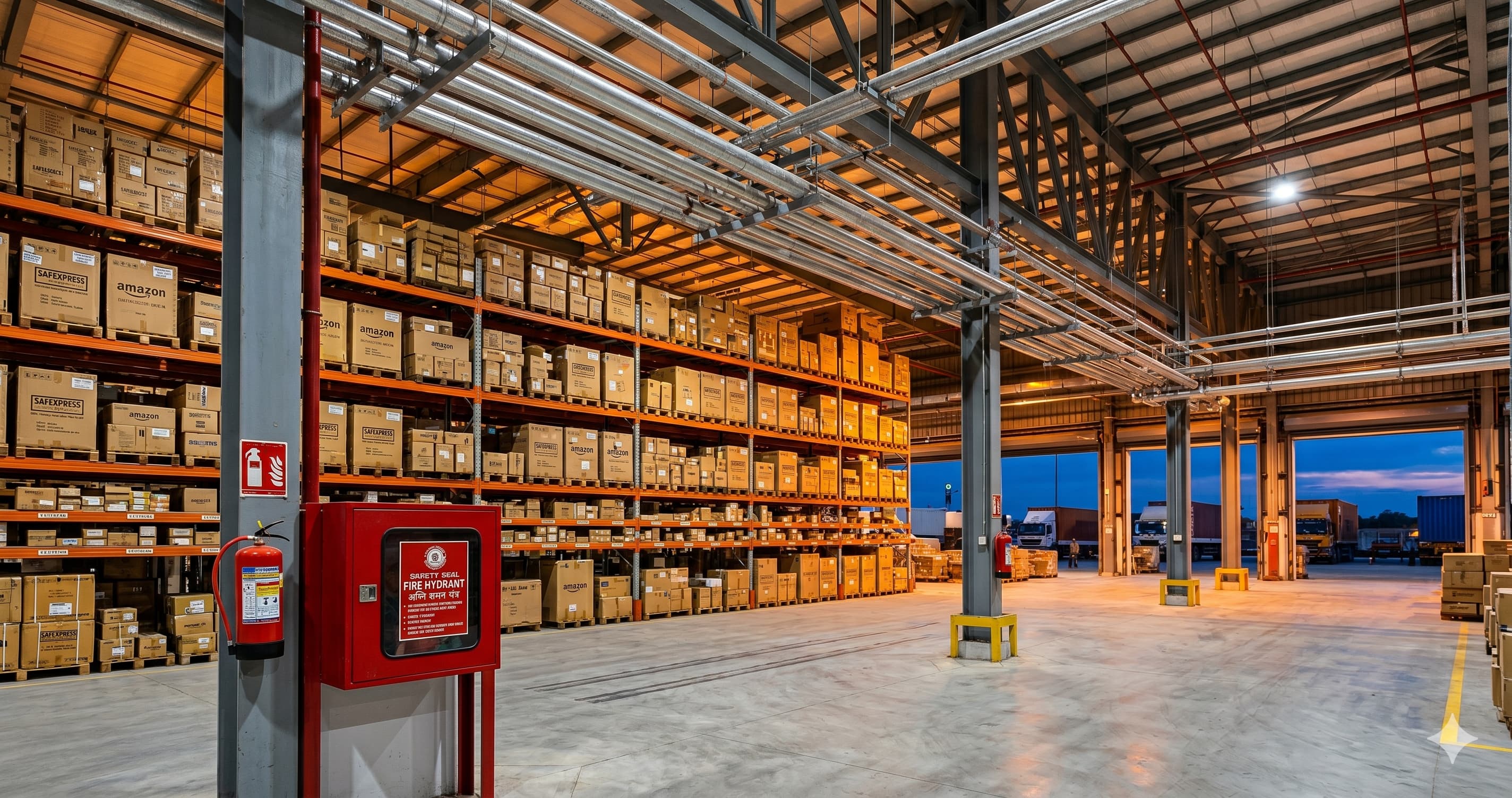
Fire Safety Requirements for Warehouses in India
Learn the fire safety requirements for warehouses in India - NBC 2016 norms, Fire NOC process, equipment checklist, and Hosur-specific Tamil Nadu regulations.
India's logistics and warehousing industry has grown at a pace few sectors can match. New industrial parks, e-commerce fulfilment centres, and cold-chain facilities are coming up every year - many of them in cities like Hosur, Pune, Chennai, and Coimbatore. But as the sector grows, so does the risk.
India recorded over 14,000 industrial fire incidents in 2023, and warehouses were among the hardest-hit categories. A single fire in a storage facility can wipe out crores of rupees in inventory, halt supply chains for weeks, and - most critically - cost lives. Most of those incidents had one thing in common: the buildings either lacked proper fire safety systems, or the existing systems were not maintained.
This is not a risk you manage after the fact. Fire safety compliance in Indian warehouses is a legal obligation and a business necessity.
If you operate a warehouse in Hosur's SIPCOT industrial belt, or anywhere across India's major industrial zones, this guide covers everything - the laws, the equipment, the NOC process, the costs, and a ready-to-use checklist.
What Are Fire Safety Requirements for Warehouses in India?
Fire safety requirements for warehouses in India are a set of technical, legal, and operational standards that every warehouse must meet before it can legally operate — and continue to meet throughout its operational life.
The primary technical document governing this is the National Building Code of India 2016 (NBC 2016), published by the Bureau of Indian Standards (BIS). Part 4 of the NBC specifically deals with fire and life safety, and it classifies buildings by occupancy type and fire load.
Occupancy Type: Warehouses typically fall under Occupancy Group F (Mercantile and Storage) in the NBC classification. Depending on what is stored, some warehouses may also touch Occupancy Group H (Hazardous) if flammable goods, chemicals, or explosives are involved.
Fire Load: Fire load refers to the total amount of combustible material in a space, measured in kilograms per square metre (kg/m²). Warehouses storing goods like textiles, paper, plastics, or FMCG products typically carry a high fire load. This directly determines which suppression systems are required, how many exits you need, and what fire resistance rating your walls and floors must have.
Key compliance areas under NBC 2016 include:
- Minimum travel distance to emergency exits
- Fire compartmentalisation (dividing large spaces with fire-rated walls)
- Fire detection and alarm systems
- Sprinkler and suppression system specifications
- Emergency lighting and exit signage
- Safe passage widths for evacuation
These are the baseline standards. On top of this, state-level fire service regulations, the Factories Act, and local planning authority norms add further layers of requirements.
Key Fire Safety Laws and Regulations Governing Warehouses in India
Understanding which law applies to your warehouse - and who enforces it - saves you from compliance gaps that can lead to penalties, NOC rejection, or forced closure.
National Building Code of India 2016 (NBC 2016)
This is the primary design and construction standard. It mandates fire safety requirements from the building design stage itself. If you are constructing a new warehouse or doing major renovation, your architect and structural consultant must follow NBC 2016 norms. The BIS updates this code periodically, so always check for the latest amendments.
State Fire Services Acts
Each Indian state has its own Fire Services Act, which gives the State Fire Department the authority to inspect buildings, issue Fire NOCs, and take action against violators. In Tamil Nadu, the Tamil Nadu Fire Service Act, 1985 governs this. The Tamil Nadu Fire and Rescue Services (TNFRS) is the authority responsible for inspections and NOC issuance across the state, including Hosur and Coimbatore.
The Factories Act, 1948
If your warehouse employs workers and is registered as a factory (which applies to some fulfilment and processing centres), the Factories Act places clear obligations on the employer regarding fire safety, escape routes, fire-fighting equipment, and employee training. Section 38 specifically mandates precautions against fire.
The Environment Protection Act, 1986 and Hazardous Waste Rules
Warehouses storing chemicals, solvents, or hazardous materials have additional compliance requirements under this Act. The type of fire suppression system permitted near such materials is also regulated separately.
The Factories Act, 1948
If your warehouse employs workers and is registered as a factory (which applies to some fulfilment and processing centres), the Factories Act places clear obligations on the employer regarding fire safety, escape routes, fire-fighting equipment, and employee training. Section 38 specifically mandates precautions against fire.
The Environment Protection Act, 1986 and Hazardous Waste Rules
Warehouses storing chemicals, solvents, or hazardous materials have additional compliance requirements under this Act. The type of fire suppression system permitted near such materials is also regulated separately.
MSME and Industrial Zone Rules
Warehouses in SIDCO or SIPCOT industrial estates in Tamil Nadu must also comply with the plot use conditions issued by these bodies. Non-compliance with fire safety norms can result in plot allotment cancellation.
Local Authority (DTCP / Municipality)
The Directorate of Town and Country Planning (DTCP) in Tamil Nadu issues building plan approvals. Fire safety clearance from TNFRS is a pre-condition for DTCP approval of warehouse projects beyond a certain built-up area.
Essential Fire Safety Equipment Required in Indian Warehouses
Here is a breakdown of the fire safety equipment that Indian warehouse regulations typically mandate, along with the relevant BIS standards.
- Fire Extinguishers
Every warehouse must have portable fire extinguishers. The type depends on what is stored:
- Stored goods (general): ABC dry powder extinguishers - suitable for ordinary combustibles, flammable liquids, and electrical fires
- Chemical/flammable liquid storage: CO₂ extinguishers
- Electrical equipment zones: CO₂ or clean agent extinguishers
The relevant BIS standard is IS 2190 (Code of Practice for Selection, Installation, and Maintenance of First-Aid Fire Extinguishers). Extinguishers must be placed at a maximum distance of 15 metres from any point in the storage area and serviced annually.
- Automatic Sprinkler Systems
For warehouses above a certain height or floor area, automatic sprinkler systems are mandatory under NBC 2016. The system must conform to IS 15105 (Design and Installation of Fixed Automatic Sprinkler Fire Extinguishing Systems). High-rack storage warehouses (above 5 metres racking height) may require in-rack sprinklers in addition to ceiling sprinklers.
- Fire Hydrant System
A wet-riser or hydrant system is required for warehouses over a specified size. This system provides a reliable water supply for firefighting operations. It must comply with IS 3844 (Code of Practice for Installation and Maintenance of Internal Hydrants and Hose Reels) and IS 9668 for external hydrants.
- Smoke and Heat Detectors
Automatic fire detection and alarm systems are mandatory for warehouses above a specific floor area. These include:
- Smoke detectors (ionisation or photoelectric type)
- Heat detectors (rate-of-rise or fixed-temperature)
- Manual call points (break-glass units)
- Fire alarm control panel with zone indicators
These must meet IS 2189 (Selection, Installation, and Maintenance of Automatic Fire Detection and Alarm Systems).
- Emergency Exits and Exit Signage
NBC 2016 mandates that warehouses have a minimum number of exits based on floor area and occupancy load. Exit doors must open outward in the direction of egress. Emergency exit signs must be illuminated or phosphorescent, with backup power. Passageways to exits must remain clear at all times.
- Fire-Rated Doors and Walls
Openings in fire compartment walls must have fire-rated doors (typically 1- or 2-hours fire resistance rating). These conform to IS 3614 for fire check doors.
- Public Address and Emergency Lighting Systems
Large warehouses must have a public address system for evacuation announcements and emergency lighting (battery-backed) to illuminate escape routes during power failure.
Fire Safety Compliance Checklist for Warehouses in India
This checklist covers the full scope of fire safety compliance for warehouse operators. Use it for internal audits, pre-inspection preparation, and staff training.
A. Documentation and NOC
- Valid Fire NOC obtained from the State Fire Department (TNFRS in Tamil Nadu)
- Fire NOC renewal filed before expiry (typically every 1–3 years)
- Building plan approved by DTCP/local authority with fire safety clearance
- Occupancy certificate obtained
- Insurance policy covering fire and allied perils — up to date
- Fire safety register maintained on-site (inspection records, drill dates, equipment service logs)
B. Fire Detection and Alarm Systems
- Automatic smoke and heat detectors installed across all zones
- Manual call points (break-glass) placed at exits and key locations
- Fire alarm control panel operational and tested monthly
- Alarm audible in all parts of the warehouse, including loading bays
- System tested and certified by a licensed agency
C. Fire Suppression Systems
- ABC/CO₂ fire extinguishers installed at correct intervals (IS 2190 compliant)
- Extinguishers serviced and tagged - not overdue for annual inspection
- Sprinkler system installed, pressure-tested, and operational
- Sprinkler heads unobstructed - minimum 450mm clearance below sprinkler heads maintained
- Hydrant/wet riser system operational, hose reels accessible and undamaged
- Pump room accessible and pump tested weekly
D. Exits, Signage, and Emergency Lighting
- All exit doors are clearly marked, unobstructed, and open outward
- Minimum number of exits provided as per NBC 2016 (based on floor area)
- Illuminated exit signs visible from all points in the storage area
- Emergency lighting operational - backup battery tested
- Assembly point designated and marked outside the building
E. Storage and Layout Compliance
- Clear aisle width maintained (minimum 1.5m for pedestrian aisles)
- Flammable and hazardous materials stored in designated, separated zones
- No storage within 1m of electrical panels or switch rooms
- Rack height compliant with sprinkler coverage specifications
- Charging points for forklifts (lithium-ion batteries) located in ventilated areas away from main storage
F. Staff Training and Drills
- Fire safety officer designated and trained
- All staff trained on use of fire extinguishers
- Evacuation procedure written and posted
- Mock fire drill conducted at least twice a year
- Drill records maintained in the fire register
- Visitors and contract workers briefed on emergency procedures
G. Periodic Audits and Maintenance
- Annual fire safety audit conducted by a certified third-party agency
- Sprinkler and hydrant systems inspected quarterly
- Electrical installation tested annually for leakage and overloading
- Fire-rated doors checked for damage and self-closing mechanism every 6 months
- HOD or fire safety officer reviews checklist monthly
Fire Safety Requirements for Warehouses in Hosur, Tamil Nadu
Hosur is not just another town in Tamil Nadu. It is one of the fastest-growing industrial cities in South India, sitting right at the Karnataka border and part of the Chennai-Bengaluru Industrial Corridor. Companies like Ola Electric, Foxconn, Titan, and scores of auto-component manufacturers operate massive warehousing and production facilities here.
Applicable Local Authorities
Tamil Nadu Fire and Rescue Services (TNFRS) - Krishnagiri District
The local fire station in Hosur operates under the Krishnagiri district fire department. All Fire NOC applications for warehouses in Hosur must go through this office.
DTCP (Directorate of Town and Country Planning)
For warehouses built in panchayat-administered areas around Hosur, the DTCP is the planning authority. Fire NOC from TNFRS is mandatory before DTCP issues a completion certificate.
SIPCOT (State Industries Promotion Corporation of Tamil Nadu)
Hosur has active SIPCOT industrial estates. Plots within SIPCOT estates have specific fire safety conditions attached to the allotment agreement. SIPCOT has been known to conduct its own periodic checks.
SIDCO (Small Industries Development Corporation of Tamil Nadu)
Smaller warehouse units in SIDCO estates in the Hosur region also fall under TNFRS jurisdiction for NOC purposes.
TNFRS NOC Process - Hosur
The NOC application process in Tamil Nadu has been partially digitised. Applications can be submitted through the Tamil Nadu Single Window Portal (TNSWAN) for certain categories. However, physical inspection remains mandatory.
Key documents typically required:
- Site plan and floor plan approved by the competent authority
- Structural stability certificate
- List of fire safety equipment installed (with make, model, and capacity)
- Electrical safety certificate from a licensed electrical inspector
- Ownership or tenancy documents
- Declaration by the occupier on storage type and maximum load
After document submission, the local fire officer schedules a site visit. If the site meets requirements, the NOC is issued. If not, a deficiency notice is given with a period to rectify.
Contact: Hosur Fire Station operates under the Krishnagiri District Fire Officer.
Address: Fire Station, Hosur, Krishnagiri District, Tamil Nadu
For escalations: TNFRS Regional Office, Salem
Fire NOC for Warehouses Across Key Industrial Zones - Chennai, Coimbatore, Bangalore, Pune
Fire NOC norms follow the same national framework across India, but the process, fees, and timelines vary by state and city. Here is what you should know about each major logistics hub.
Chennai, Tamil Nadu
Warehouses in Chennai fall under the Greater Chennai Corporation (GCC) for planning approvals and TNFRS for fire NOC. Industrial areas like Sriperumbudur, Oragadam, and Manali have high concentrations of warehouses. TNFRS Chennai issues NOCs after site inspection. The TNFRS headquarters is in Chennai, making escalations faster here than in smaller districts.
Coimbatore, Tamil Nadu
Coimbatore has significant warehousing activity in the textile and FMCG segments. The Coimbatore City Municipal Corporation (CCMC) handles planning approvals, while TNFRS Coimbatore handles fire NOC. Given Coimbatore's textile sector, fire load in many warehouses is significantly high - this affects the class of suppression system required.
Bengaluru (Bangalore), Karnataka
Warehouses in Bengaluru fall under the Karnataka State Fire and Emergency Services (KSFES) for NOC. Areas like Peenya, Electronic City, and Hoskote have major warehousing clusters. Karnataka has a reasonably digitised NOC process through the Sakala portal. Industrial buildings above 500 sq. m typically require a NOC in Karnataka.
Pune, Maharashtra
Pune is a major logistics hub with large warehousing zones in Chakan, Ranjangaon, and Bhosari. Fire NOCs here are issued by the Maharashtra Fire Services, with city-level offices in Pimpri-Chinchwad Municipal Corporation and Pune Municipal Corporation areas. Maharashtra has been more proactive in enforcement after several industrial fire incidents in the Pune belt.
Key Point for Multi-Location Operators
If you run warehouses across multiple states, you will deal with different state fire departments, different application portals, and different renewal timelines. It is practical to work with a fire safety consultant who has pan-India experience to ensure no NOC lapses across locations.
How Much Does Fire Safety Compliance Cost for a Warehouse in India?
This is the question most warehouse operators ask first - and it is a fair one. Compliance costs vary based on warehouse size, type of storage, age of the building, and current state of your fire systems.
Equipment Costs (Approximate, 2024 Estimates)
|
Item |
Small Warehouse (up to 5,000 sq ft) |
Medium Warehouse (5,000–20,000 sq ft) |
Large Warehouse (20,000+ sq ft) |
|
Fire extinguishers (set) |
₹15,000 – ₹40,000 |
₹40,000 – ₹1,50,000 |
₹1,50,000 – ₹5,00,000+ |
|
Smoke/heat detectors + panel |
₹30,000 – ₹80,000 |
₹80,000 – ₹3,00,000 |
₹3,00,000 – ₹10,00,000+ |
|
Sprinkler system (installation) |
₹3,00,000 – ₹7,00,000 |
₹7,00,000 – ₹25,00,000 |
₹25,00,000 – ₹80,00,000+ |
|
Hydrant system |
Not always mandatory |
₹5,00,000 – ₹15,00,000 |
₹15,00,000 – ₹50,00,000+ |
|
Emergency lighting + signage |
₹20,000 – ₹60,000 |
₹60,000 – ₹2,00,000 |
₹2,00,000 – ₹6,00,000 |
NOC Application Fees
State governments charge NOC fees based on building area. In Tamil Nadu, fees are relatively modest — typically ₹500 to ₹5,000 for most warehouse categories — but this is subject to revision. Check the current fee schedule with TNFRS before applying.
Fire Safety Audit Costs
A third-party annual fire safety audit from a certified agency typically costs:
- Small warehouse: ₹15,000 – ₹30,000
- Medium warehouse: ₹30,000 – ₹75,000
- Large warehouse: ₹75,000 – ₹2,00,000+
Penalties for Non-Compliance
This is where the costs become serious.
- Operating without a valid Fire NOC: Under state fire acts, penalties range from ₹5,000 to ₹50,000 per offence, plus potential closure orders
- Insurance claim rejection: Insurers routinely reject fire damage claims if the warehouse lacked a valid NOC or had documented system failures at the time of the incident
- Criminal liability: If a fire causes death or injury, the occupier and management can face prosecution under IPC sections related to negligence (Section 304A) and endangering life
- Regulatory closure: In serious cases, the District Collector or Fire Department can seal the warehouse
The cost of compliance is always lower than the cost of non-compliance. Always.
How to Get a Fire NOC for Your Warehouse in India - Step by Step
The Fire NOC (No Objection Certificate) is the most critical document for warehouse fire safety compliance. Here is the standard process, applicable across most Indian states with minor variations.
Step 1: Pre-Application Preparation
Before you file anything, ensure:
- All fire safety equipment is installed and functional
- Building plans are approved by the competent local authority
- An electrical safety inspection has been completed
- You have a complete list of the materials stored and their quantities
Step 2: Application Submission
Submit the NOC application to the State Fire Department (online or offline, depending on the state). The application typically includes:
- Filled application form
- Approved building plan with fire safety layout marked
- Equipment list with specifications
- Ownership/tenancy documents
- Previous NOC copy (if applying for renewal)
In Tamil Nadu, applications go to the district fire officer. Large or high-risk warehouses may be referred to the TNFRS headquarters in Chennai.
Step 3: Site Inspection
A fire officer is deputed to visit the site. They inspect:
- Actual equipment installed vs. the list submitted
- Condition and accessibility of extinguishers, hose reels, and hydrants
- Exit routes and emergency lighting
- Electrical panel safety
- Storage arrangement and fire load
Do not rush this step. If you are not ready, request a date extension rather than facing a deficiency notice.
Step 4: Deficiency Rectification (If Applicable)
If the inspection identifies gaps, you receive a written notice listing deficiencies. You must rectify them within the stated period and request a re-inspection. Common deficiency reasons include blocked exits, extinguishers overdue for service, missing signage, and sprinkler head obstructions.
Step 5: NOC Issuance
Once the site passes inspection and all documents are in order, the NOC is issued. It specifies:
- The building/plot address
- The type of occupancy
- Validity period (usually 1 or 3 years)
- Any conditions attached
Step 6: Renewal
NOCs are not permanent. Apply for renewal before the expiry date. Renewing on time avoids penalties and prevents a lapse that could invalidate your insurance. The renewal process is similar to the initial application, often with a re-inspection.
Fire Safety Audit for Warehouses - What to Expect and How to Prepare
A fire safety audit is a systematic examination of your warehouse's fire safety measures - its equipment, layout, documentation, and staff preparedness. Audits can be conducted by the Fire Department (statutory audit) or by an independent third-party fire safety consultant (voluntary or as part of insurance requirements).
What Auditors Check
Equipment condition: Auditors physically inspect every extinguisher, detector, sprinkler head, and hose reel. They check pressure levels, service tags, and physical damage. Equipment that looks fine visually can still fail a pressure test.
Layout and egress: They Walk the escape routes as a normal employee would. Anything blocking a path, a door that jams, or an exit sign that is burnt out — it all gets flagged.
Documentation: Fire register, drill records, equipment service certificates, electrical safety certificate, and the NOC itself are all reviewed. Missing records are a common failure point even when the physical systems are in order.
Staff awareness: Auditors sometimes speak to random staff members to assess whether they know the assembly point, who the fire safety officer is, and how to use an extinguisher. Poor staff awareness is a red flag.
Storage compliance: Goods must be stored in a way that does not obstruct sprinkler discharge patterns or block access to fire-fighting equipment.
Common Reasons Warehouses Fail Inspections
- Extinguishers not serviced in the last 12 months
- Sprinkler heads painted over or covered with plastic bags to avoid "accidental" discharge during loading
- Storage stacked too close to sprinkler heads (less than 450mm clearance)
- Exit doors locked or blocked from inside
- No drill conducted in over 12 months
- Electrical panel room used for storage
How Third-Party Fire Safety Consultants Help
Many warehouse operators in India engage fire safety consultants for two reasons. First, for gap analysis before the official inspection - so they can fix issues without the pressure of a formal deficiency notice. Second, for ongoing compliance management, which includes tracking renewal dates, scheduling drills, and coordinating equipment servicing.
A good consultant does not just help you pass an inspection. They help you maintain a warehouse that is actually safer to operate. The difference matters when something goes wrong.
FAQs About Warehouse Fire Safety Compliance in India
1. How long is a Fire NOC valid for warehouses in India?
This varies by state. In Tamil Nadu, Fire NOCs for industrial and commercial buildings are typically valid for 1 year, after which renewal is required. Some states issue 3-year NOCs for compliant facilities. Always confirm the validity period on your NOC document and set a reminder to apply for renewal at least 60 days before expiry.
2. Who issues the Fire NOC for warehouses in Tamil Nadu?
The Tamil Nadu Fire and Rescue Services (TNFRS), through the respective district fire officer, issues Fire NOCs in Tamil Nadu. For warehouses in Hosur, this falls under the Krishnagiri district fire office.
3. Is a sprinkler system mandatory for all warehouses in India?
Not all warehouses - NBC 2016 specifies sprinkler requirements based on occupancy type, floor area, height, and fire load. Generally, warehouses above 500 sq. m with high fire load materials are required to have sprinkler systems. Your fire consultant or the fire department can give a definitive assessment for your specific building.
4. Can I operate my warehouse while the Fire NOC is under renewal?
In practice, many facilities continue operating, but legally, operating without a valid NOC is a violation. More importantly, if a fire occurs during this period, your insurance claim may be at risk. Renew on time to avoid this grey area.
5. What happens if a fire breaks out and I do not have a valid Fire NOC?
Beyond the physical damage, you face insurance claim rejection, civil liability suits from affected workers or neighbours, and potential criminal prosecution under the IPC. The fire department can also seal the premises.
6. How often should mock fire drills be conducted in a warehouse?
At minimum, twice a year. The Factories Act requires regular mock drills for registered factories. TNFRS guidelines also recommend at least two drills per year. Records of each drill - including date, attendance, and observations - must be maintained.
7. Are there separate fire NOC requirements for cold storage warehouses?
Cold storage warehouses that use ammonia-based refrigeration systems fall under a separate regulatory layer. Ammonia is a toxic flammable gas, and such facilities must also comply with the Factories Act (for pressure vessels and refrigerant safety) and may require PESO (Petroleum and Explosives Safety Organisation) clearances.
8. What type of fire extinguisher is needed for a warehouse storing lithium-ion battery-powered equipment?
Lithium-ion battery fires are Class D or Class B fires depending on the phase. Standard ABC powder extinguishers can be used to suppress the initial fire, but specialised lithium fire suppression agents are recommended for warehouses with significant EV or battery storage. Consult a fire safety consultant for a site-specific assessment.
9. What is the penalty for not having fire extinguishers in a warehouse?
Under state fire acts, this can result in a fine of ₹5,000 to ₹50,000 and a notice to cease operations. Under the Factories Act, the inspector can issue an improvement notice or prosecute the occupier.
10. Do warehouses in SIPCOT estates in Tamil Nadu need separate fire clearance from SIPCOT?
SIPCOT itself does not issue fire NOCs - that is TNFRS's jurisdiction. However, SIPCOT's allotment conditions require occupiers to comply with all statutory requirements including fire safety. SIPCOT can take action on plot allotments if fire NOC compliance is not maintained.
11. Is fire safety training mandatory for warehouse workers in India?
Yes, under the Factories Act, employers must ensure workers are trained in fire prevention and emergency procedures. TNFRS also expects trained fire safety officers for larger facilities. Training records must be maintained on-site.
12. Does the size of the warehouse affect which fire safety systems are mandatory?
Yes, significantly. NBC 2016 uses floor area thresholds and building height to determine whether sprinklers, hydrant systems, fire lifts, and other systems are required. A 1,500 sq. ft storage space has different requirements from a 50,000 sq. ft distribution centre. Always get a formal assessment for your specific building.
Conclusion: Your Fire Safety Compliance Roadmap
Fire safety compliance for warehouses in India is not a one-time task. It is an ongoing responsibility - one that protects your business, your inventory, your staff, and your legal standing.
The roadmap is straightforward. Start with a gap assessment against NBC 2016 norms. Install or upgrade your fire safety equipment to meet BIS standards. Get your Fire NOC from the Tamil Nadu Fire and Rescue Services (or the relevant state authority). Set up a maintenance schedule for all systems. Train your staff. Conduct drills. Renew your NOC on time.
If you are setting up or operating a warehouse in Hosur, Coimbatore, Chennai, or any other industrial zone in India, you need a partner who understands both the technical requirements and the local regulatory landscape.
Technique Engineers provides end-to-end fire safety compliance services for warehouses across Tamil Nadu and India. From Fire Protection Systems design and installation to NOC application support, third-party audits, and staff training - we handle the complexity so you can focus on your business.
Get in touch with Technique Engineers today. We'll make sure your warehouse is compliant, your team is prepared, and your NOC is never at risk.


