
Fire Safety Training for Factory Staff: Drills That Work
What makes fire safety training work in a factory? See who needs what, how to run realistic drills, and the records inspectors ask for in Hosur.
A factory can have perfect alarms, sprinklers and hydrants and still lose people, because equipment only helps when staff know what to do. Good fire safety training is practical and role-based. It teaches everyone how to evacuate, trains a smaller group to use fire equipment, and backs it up with drills that feel realistic and are written down. India has no single national rule that sets how often drills must happen. But the law, the National Building Code and the inspectors who visit your factory all expect trained staff and records. This guide explains how to set up fire safety training that actually works for a factory in Hosur.
The Problem: Drills Done as a Formality
Most factories hold a fire drill of some kind. The problem is what the drill looks like. Everyone knows it's coming. The alarm sounds, people walk to the gate, someone ticks a sheet, and everyone goes back to work. Nobody has practised using an extinguisher. Nobody has seen what happens if the nearest exit is blocked. The night shift was never included.
It's a common pattern. Reviews of fire safety compliance in Indian factories list two common violations. One is the absence of regular drills and training. The other is evacuation plans that are outdated or not shared with staff. The gap matters because a real fire doesn't follow the plan. It starts in a place nobody expected, at a time when half the team is on a break.
What the Rules Expect
The Factories Act, 1948 deals with precautions in case of fire, including means of escape and fire-fighting equipment, and states can add detailed rules. One legal review points out that the Act doesn't spell out mock drills in so many words, but it does put a clear duty on employers to keep workers safe. Some states have gone further. Maharashtra's 2025 factory rules, for example, made mock drills mandatory there. That isn't Tamil Nadu law, but it shows where regulation is heading.
In practice, fire departments and factory inspectors commonly ask to see drill records, warden appointment letters and training records, particularly when you apply for or renew a Fire NOC. NBC 2016 Part 4 also expects documented evacuation arrangements. Check the current Tamil Nadu requirements with your fire authority and factory inspector, and treat records as something you'll need to produce.
The Solution: Fire Safety Training by Role, Not Just by Headcount
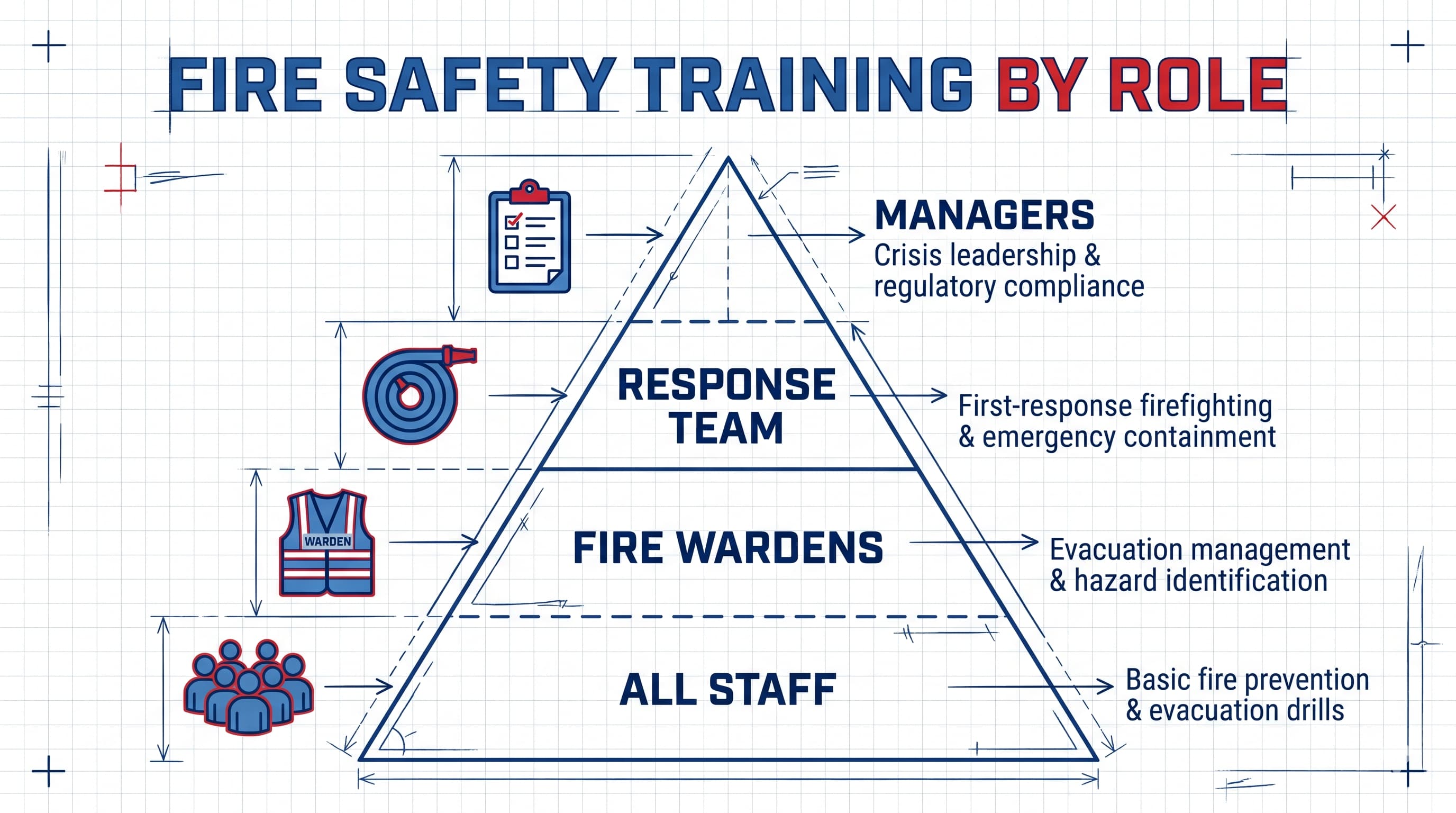
Different people need different things. One session for everybody covers the basics, but it won't cover the people who'll actually handle a fire.
|
Group |
What they need to learn |
How often |
|
All staff |
Alarm sounds, exit routes, assembly point, what not to do (no lifts, no going back) |
On joining, then refreshed regularly |
|
Fire wardens |
Extinguisher types, roll call, helping those who need assistance, calling the fire brigade on 101 |
At least once a year, plus after changes |
|
Response team and security |
Hose and hydrant handling, monitor nozzles, pump room basics |
Hands-on, several times a year |
|
Managers and supervisors |
The emergency plan, drill reviews, records, who decides what |
Annually, and after every drill |
Fire Safety Training for Wardens
Wardens are your most important investment. Their fire safety training should cover the fire triangle and extinguisher types, your building's actual evacuation routes, roll call procedures, helping people who need assistance, calling the fire brigade, and basic first aid. Wardens should be appointed in writing, with a backup for every shift.
Hands-On Equipment Practice
People remember what they've done with their hands. Our sessions include hose handling, how to approach and operate a hydrant, and demonstrations with monitor nozzles, including mobile monitor units. We also walk teams through the fire pump room and the control panels, so they know what the indications mean and where things are before an emergency, not during one.
How to Run a Drill That Teaches Something
A drill should test something. A few habits make a big difference:
- Use a scenario. For example, a fire in the warehouse with one exit blocked, or an alarm during a power cut.
- Vary the timing. Include night and weekend shifts, and surprise drills once staff know the basics.
- Time it. Record how long it takes to clear each area and to complete a roll call.
- Appoint observers. Have someone note what went wrong: congestion at a door, wardens not in position, people going back for belongings.
- Debrief the same day. Share what you saw while it's fresh.
- Write it down and fix what you found. An action list with dates is worth more than a signed sheet.
Safety comes first in any surprise drill. Someone must be in control, and people on hazardous tasks should be able to make their process safe before leaving.
How Often Should Fire Safety Training Happen?
There's no single national figure. Reported state guidance varies, with Telangana asking commercial buildings for quarterly drills, for example. A sensible baseline for a factory is a full evacuation drill at least twice a year, more often for high-hazard processes, shift work or high staff turnover. New joiners should be trained in their first days, not at the next annual session.
Keep the Records Inspectors Ask For
- Fire warden appointment letters
- Drill records with date, time, attendance, duration and observations
- Fire safety training records and attendance sheets
- The displayed evacuation plan and its revision date
- The action list from each drill, and proof the actions were closed
These documents also help in an audit, which we cover in our guide to fire and lift safety audits. Clear exit signage is part of the same picture, as explained in our post on fire safety signage.
Why Facilities in Hosur Choose Technique Engineers
Technique Engineers runs fire safety training for factories, warehouses and institutions across Hosur and Krishnagiri. We design sessions around the systems your site actually has, so your team practises on your own layout rather than a generic example. Fire safety training works best when it's linked to maintenance, because both keep your protection ready, as we explain in our guide to Fire Protection System AMC.
Frequently Asked Questions
Are fire drills mandatory for factories in Tamil Nadu?
The Factories Act puts a duty on you to protect workers and provide means of escape, but it doesn't clearly set a drill frequency. Inspectors and the Fire NOC process still commonly look for drill and training records. The safe approach is to drill regularly and keep proof, and to confirm current rules with your fire authority.
How many fire wardens do we need?
Enough that every area and shift has one, plus a backup. A rough rule is one warden per floor or work area per shift, but your layout and headcount decide the real number.
Should drills be a surprise?
Sometimes. Start with announced drills so people learn the routine, then add unannounced ones. Always have a safety coordinator so a surprise drill doesn't create a hazard of its own.
Can we practise on our own equipment?
Yes, and it's the best way to learn. Use your own extinguishers, hose and hydrants under supervision, and use training equipment or test discharge where needed, so you don't deplete your live protection or damage anything.
How do we keep fire safety training current when staff turnover is high?
Build a short induction into the first days of work: exits, alarm sounds, assembly point and who the wardens are. Refresh it often, because a drill held six months ago won't help someone who joined last week.
Technique Engineers provides fire safety training, drills, AMC and complete fire protection solutions for industrial and commercial facilities across Hosur and Krishnagiri. Contact us to plan a training programme for your site.


