
Foam Fire Suppression Systems Explained: Low, Medium and High Expansion
Foam fire suppression systems aren't one-size-fits-all. Learn how low, medium, and high expansion foam differ, and which fits your Hosur facility.
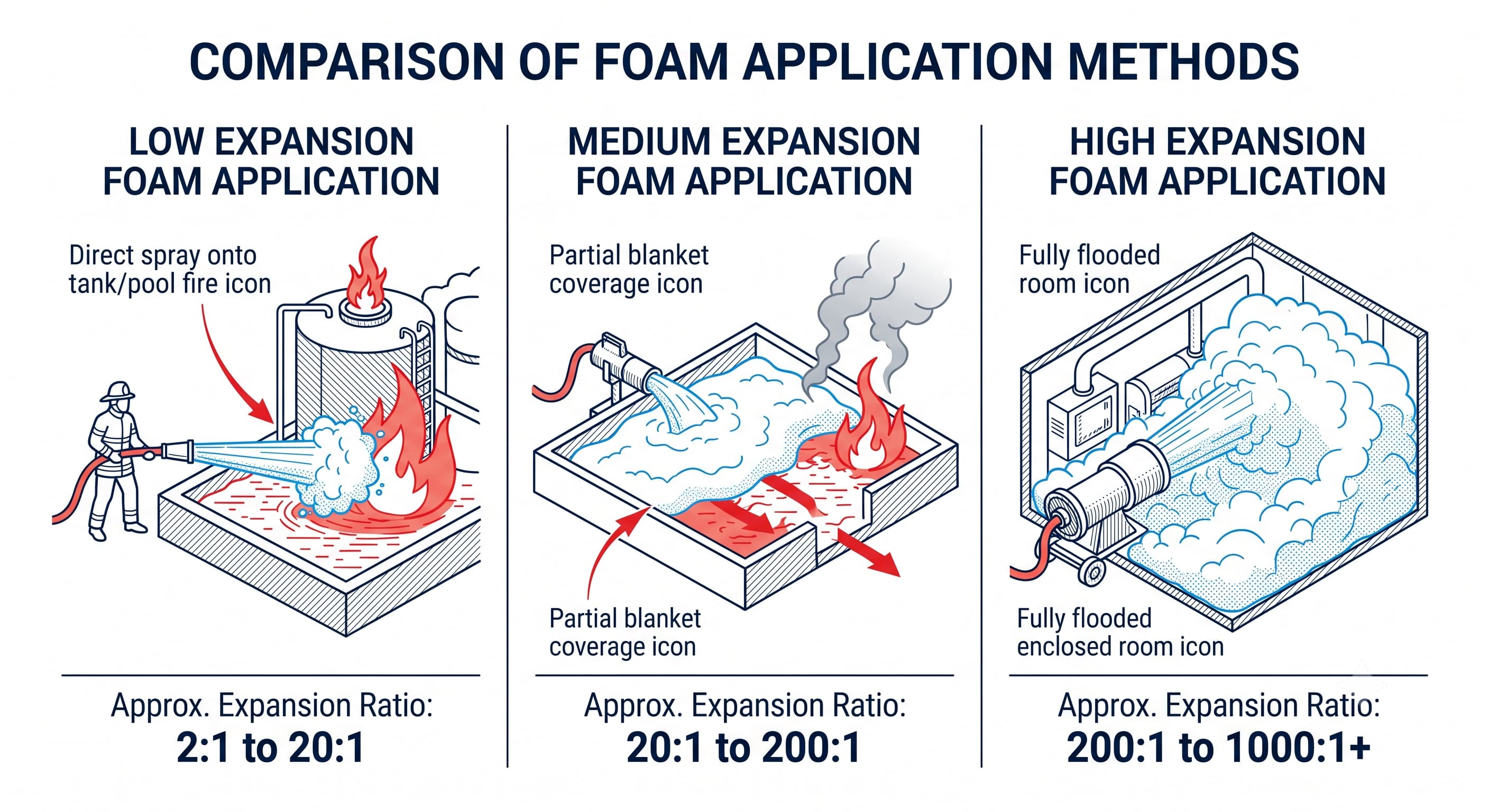
Foam fire suppression systems are not a monolithic category: low expansion foam is designed for up-close attacks on fires involving flammable liquid pools, whereas high expansion foam is used to blanket entire volumes where a fire cannot be reached directly. Medium expansion foam fills the space between the two. Selecting the wrong category for a particular application leads to a fire suppression system that doesn't actually work: one that might activate and attempt to suppress a fire, but fails to do so. This page compares the three main categories of foam fire suppression, driven by NFPA 11, explains their differences, and indicates where they're typically used.
The Problem: "Foam System" Gets Treated as a Single Category
Buyers often approach foam fire suppression the same way they might purchase a sprinkler system: looking for a certain category of fire suppression equipment, and choosing based on a rating. Foam fire suppression systems are not a single category. NFPA 11 covers the design, installation, operation, testing, and maintenance of low, medium, and high-expansion foam systems, applying criteria to fixed, semi-fixed, or portable systems for interior and exterior hazards - three distinctly different categories of expansion are covered by a single standard, each with different application and hazard criteria.
The Solution: Understanding the Three Expansion Categories
Low Expansion Foam
Low-expansion foam expands less than 20 times when properly proportioned and agitated with air, with a normal expansion range usually between 8 and 12 times. Low expansion foam is familiar to most people as the type of foam used in firefighting: a relatively dense foam blanket that's applied directly to a fuel surface.
Low expansion foam is what firefighters use when spraying from a distance to protect themselves from intense heat, since it can be propelled effectively over 35 to 50 feet, but it doesn't cover as much area as higher expansion foams, so more concentrate is needed and the application becomes costlier for large-area coverage.
Best suited to: Flammable liquid storage tanks, spill fires, loading/unloading areas - two-dimensional pool or surface fires where the foam is applied directly to an exposed liquid surface.
Medium Expansion Foam
Medium expansion foam is the middle ground between low and high expansion, providing a balance between the density and penetration of low expansion foam and the coverage of high expansion foam. As the fire fighter moves in closer to a controlled fire or spill - typically within 12 to 15 feet - a higher expansion foam can be used to blanket the area more thoroughly, since higher-expansion foam covers more target area with less water and concentrate.
Best suited to: Spill control operations where the hazard has been partially contained, two-dimensional fires other than those that require full enclosure flooding, general industrial fire risks where enclosure flooding is not necessary.
High Expansion Foam
High expansion foam is a fundamentally different application than low and medium expansion foam fire suppression systems: rather than being applied directly to a fire, high expansion foam involves generating a thick foam blanket and using it to flood an enclosed area.
High-expansion foam systems should be used in combination with sprinkler protection meeting NFPA 13 requirements, since the sprinkler system also provides protection of the roof from hot gases prior to complete submergence of the fire area. This is a combination that's important: high expansion foam doesn't replace a sprinkler system in these applications; the two work in concert, with high expansion foam smothering the fire and displacing oxygen, while a sprinkler system addresses heat exposure to the structure itself.
Best suited to: Enclosed spaces where the hazard cannot be directly accessed or where total-area flooding is more effective than targeted application: basements, cable vaults, aircraft hangars, and large enclosed storage areas.
Comparison Table
|
Factor |
Low Expansion |
Medium Expansion |
High Expansion |
|
Expansion ratio |
Roughly 8-12x |
Between low and high |
Can reach 100x-1000x+ |
|
Application style |
Direct spray onto fuel surface |
Blanket over partially contained area |
Total space flooding |
|
Effective throw distance |
35-50 feet |
12-15 feet |
Not sprayed — floods the enclosure |
|
Typical use |
Pool fires, tank fires, spills |
Spill control, transitional coverage |
Enclosed spaces, hangars, vaults |
|
Works alongside |
Standalone or with other suppression |
Standalone or combined systems |
Sprinkler systems (per NFPA 13) |
How Foam Actually Extinguishes a Fire
Foam fire suppression works by a combination of separating the fire from its source (by forming a barrier), suppressing the release of flammable vapors from the surface of the fuel, and cooling the fire by converting water to steam as the foam is heated (which in turn dilutes the oxygen in the atmosphere). Foam will not extinguish flowing or falling liquid, and three-dimensional fires generally aren't extinguished by foam alone unless the burning liquid has a high flash point - which is why foam fire suppression needs to be selected in accordance with the type and geometry of the fire hazard.
A Common Mistake: Treating Foam Type as Interchangeable
Medium- and high-expansion foam concentrate is generally not recommended for use on polar solvents, which is a concern for facilities that store chemicals like alcohols or ketones in addition to more conventional hydrocarbon fuels. The wrong foam concentrates for a given liquid type can lead to a fire suppression system that activates and attempts to discharge, but fails to actually control the fire - a potentially more dangerous situation than a system that doesn't activate at all.
Why Facilities in Hosur Choose Technique Engineers for Foam Suppression
Technique Engineers designs and installs foam fire suppression systems for industrial facilities across Hosur and Krishnagiri, taking into account the specific hazard category (flammable liquid storage, enclosed high-value spaces, or partial containment scenarios) rather than applying a generic foam fire suppression solution. If your facility is also considering gas suppression as an alternative or complement, our earlier coverage of fire fighting pipes and valves touches on the broader suppression network these systems interface with.
Frequently Asked Questions
How do I know which expansion category my facility needs?
It depends almost entirely on the hazard type and space geometry: an open flammable liquid storage area typically needs low expansion for up-close application, whereas an enclosed space that's difficult to access directly is a better fit for high expansion flooding. This is not something that can be determined on an ad hoc basis; it requires a hazard assessment in accordance with NFPA 11.
Can foam suppression replace a sprinkler system entirely?
Not generally, and for high expansion systems specifically, the standard actually recommends combining it with sprinkler protection rather than using foam alone. The two systems address different aspects of fire control: sprinklers address heat exposure to the structure, while foam controls the fire itself by smothering and displacing oxygen.
Is foam suppression safe to use around people, or does the area need to be evacuated first?
This depends very much on the specific system and expansion type: high expansion systems that flood an entire enclosure are generally intended for use in unoccupied spaces or require evacuation prior to activation, due to the amount of foam involved. This is a matter that needs to be specifically addressed in your system design and emergency procedure planning.
Does foam concentrate expire or need replacement over time?
Yes, foam concentrate has a service life and should be tested periodically as part of routine AMC, since degraded concentrate may not perform to its rated expansion ratio or extinguishing performance even if the rest of the system tests fine mechanically.
Can the same system switch between expansion types, or is each one a fixed installation?
Generally, each system is designed and fixed for a specific expansion category and application method, since the generating equipment, concentrate proportioning, and distribution design differ significantly between categories. If your facility's hazard profile changes substantially, that's a reason to reassess the system design rather than expect the existing equipment to adapt.
Technique Engineers designs and installs foam fire suppression systems, gas suppression, and complete fire protection solutions for industrial and commercial facilities across Hosur and Krishnagiri. Contact us for a hazard assessment to determine the right foam suppression approach for your facility.


