
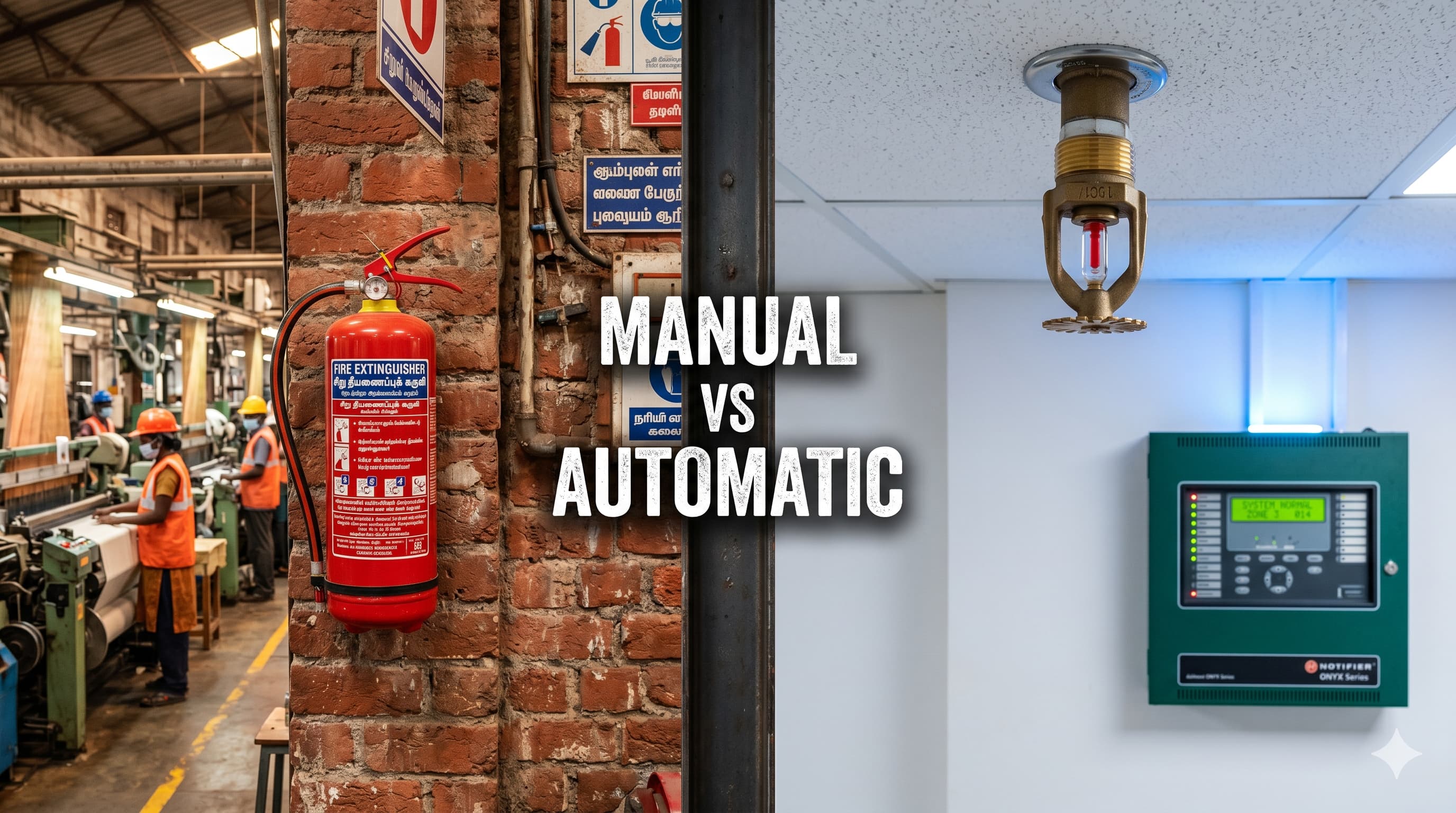
Manual vs Automatic Fire Protection Systems: A Complete Guide for Tamil Nadu
Compare manual vs automatic fire protection systems for Tamil Nadu - costs, NBC 2016 compliance, Fire NOC rules, and which system suits your property.
Why Fire Protection Is a Critical Decision for Tamil Nadu Businesses and Buildings
India loses more than 25,000 lives to fire every single year. That number alone should make any factory owner or building manager sit up straight. And Tamil Nadu is not exempt - the state records thousands of industrial and residential fire incidents annually, from garment unit fires in Tiruppur to kitchen fires in high-rise apartments in Chennai.
Yet, the number of buildings still running on outdated or inadequate fire protection setups is alarming. Most owners either don't know what system they need, or they delay the decision until a Fire NOC rejection forces their hand.
Here's the real issue: not every building needs the same solution. A small provision store in Madurai and a data centre in Chennai's OMR IT corridor have completely different fire risks - and completely different legal requirements.
This guide is written for factory owners, building contractors, facility managers, housing society committees, and fire safety consultants across Tamil Nadu. By the end, you'll know exactly what each type of fire protection system does, what the law says you need, what it costs, and how to make the right call for your specific property.
What Is a Fire Protection System and Why Does It Matter in India?
Put simply, a fire protection system is any combination of equipment and processes designed to detect, control, or extinguish a fire - and to protect the people inside a building when one breaks out.
These systems fall into two broad categories:
Active fire protection means systems that physically respond to a fire - sprinklers that release water, alarms that sound, suppression agents that smother flames. These either need a person to activate them (manual) or do it on their own (automatic).
Passive fire protection is everything built into the structure itself - fire-rated doors, compartment walls, smoke dampers, non-combustible materials. It doesn't put out fires, but it slows down how fast a fire spreads and gives people time to evacuate.
Both matters. But when most people ask "do I have fire protection?", they're thinking about active systems - and that's what this guide covers in detail.
In India, fire safety requirements for buildings are governed by the National Building Code 2016 (NBC 2016), published by the Bureau of Indian Standards. The Tariff Advisory Committee (TAC) sets guidelines that directly affect your insurance premiums. And in Tamil Nadu specifically, the Tamil Nadu Fire and Rescue Services Act lay out state-level compliance requirements, including when you need a Fire NOC and what systems you must install to get one.
Tamil Nadu's climate adds another layer to all of this. The state's high temperatures - regularly crossing 38–40°C in the summer - combined with humidity, make certain materials more prone to spontaneous combustion. Industrial facilities dealing with textiles, chemicals, plastics, and rubber face elevated risk simply because of where they're located. Proper fire protection here isn't optional - it's survival.
What Are Manual Fire Protection Systems?
A manual fire protection system is one that requires a person to detect the fire and take action to control it. The equipment is ready and waiting - but nothing happens until a human steps in.
Types of Manual Fire Protection Systems
Fire extinguishers are the most common. They come in different types depending on what they're meant to put out:
- ABC dry powder extinguishers - suitable for general fires involving solids, liquids, and electrical equipment
- CO₂ extinguishers - ideal for electrical fires, common in offices and server areas
- Foam extinguishers - used where flammable liquids are present
Manual call points (break-glass units) are wall-mounted devices that trigger an alarm when someone smashes the glass panel. They don't automatically suppress anything - they just raise an alert so people can evacuate and call for help.
Fire buckets and hydrant hose reels (manual operation) are low-tech but still legally required in many premises. A manually operated hose reel draws water from the building's stored supply - but someone has to unroll it, open the valve, and direct the stream.
Wet riser and down comer systems with manual valves are found in multi-storey buildings. Water is stored in an overhead or underground tank, and firefighters or trained staff open the valves to get water to the affected floor. The system is there - but it doesn't activate itself.
Where Manual Systems Are Used in Tamil Nadu
Manual systems are standard in small shops along Anna Nagar commercial streets, temples (which often have significant fire loads from diyas and camphor but limited budgets), small residential buildings under 15 metres, village-level industries, and small-scale manufacturing units.
Pros and Cons of Manual Fire Protection Systems
|
Factor |
Detail |
|
Cost |
Low - a basic setup for a small unit can start from ₹5,000–₹50,000 |
|
Installation complexity |
Simple - minimal wiring or integration needed |
|
Response speed |
Slow - depends entirely on a person noticing the fire first |
|
Human dependency |
Very high - useless if no one is present or trained |
|
False alarm risk |
Very low |
|
Legal sufficiency |
Only for small, low-occupancy, or low-risk buildings |
|
Insurance benefit |
Minimal premium reduction |
|
Maintenance |
Straightforward - refilling, pressure checks, inspection |
The biggest weakness of manual systems is obvious: fires don't wait for business hours. A fire that starts at 2 AM in a locked warehouse with only manual extinguishers has already done significant damage before anyone arrives.
What Are Automatic Fire Protection Systems?
Automatic fire protection systems detect fire on their own using sensors and respond immediately - without any human involvement. They work 24 hours a day, every day, even when the building is empty.
Types of Automatic Fire Protection Systems
Automatic sprinkler systems are the most widely used. Individual sprinkler heads are activated by heat - typically when the ambient temperature at the head reaches 57°C-79°C. The water releases only from the heads closest to the fire, not from the entire system at once (contrary to the movie trope where all sprinklers go off simultaneously).
There are three main configurations:
- Wet pipe systems - pipes are always filled with water, ready to discharge the moment a head opens. Common in offices, malls, and residential towers.
- Dry pipe systems - pipes are filled with pressurised air instead of water. Used in cold storage units or areas where water in the pipes could freeze or cause damage.
- Pre-action systems - require both a detector signal AND a sprinkler head to activate before water releases. Used in museums, archival rooms, or data centres where accidental discharge would be catastrophic.
Automatic fire alarm systems use a network of detectors wired to a central panel:
- Smoke detectors - optical or ionisation-based, triggered by visible or invisible combustion particles
- Heat detectors - triggered when temperature crosses a threshold or rises too quickly
- Beam detectors - use an infrared beam across large open spaces like warehouses; if smoke interrupts the beam, the alarm fires
- Addressable fire alarm panels - the modern standard for larger buildings; each device has its own address, so the panel can pinpoint exactly where the alarm originated
Gas suppression systems are used in spaces where water would destroy the contents - server rooms, control rooms, electrical substations, archival vaults. Common agents include:
- FM-200 (HFC-227ea) - fast-acting, leaves no residue, safe for occupied spaces
- Novec 1230 - environmentally preferred, zero ozone depletion potential
- CO₂ systems - effective but requires evacuation before discharge (not for occupied spaces)
These systems are standard in Chennai's OMR, Perungudi, and Sholinganallur IT parks, where server downtime from water damage could cost crores.
Automatic foam systems are deployed in Tamil Nadu's petrochemical plants along the Ennore coast and chemical industries in SIPCOT zones. Foam suppresses vapour release from burning liquids, preventing re-ignition.
Where Automatic Systems Are Used in Tamil Nadu
IT parks and BPO campuses, government hospitals like Rajiv Gandhi Government General Hospital, private hospitals, shopping malls, multi-screen cinemas, warehouses in logistics parks, garment export units in Tiruppur, and any building above 15 metres - these all rely on automatic systems, both because the occupancy load demands it and because Tamil Nadu law requires it.
Pros and Cons of Automatic Fire Protection Systems
|
Factor |
Detail |
|
Cost |
Moderate to high depending on system type and area |
|
Response speed |
Seconds - no human action needed |
|
Human dependency |
Very low |
|
False alarm risk |
Moderate - can be triggered by steam, dust, or cooking fumes if poorly positioned |
|
Legal sufficiency |
Meets all NBC 2016 and Fire Department NOC requirements |
|
Insurance benefit |
10–30% reduction in property insurance premiums |
|
Maintenance |
Periodic AMC (Annual Maintenance Contract) required |
|
24/7 protection |
Yes - works even when the building is empty |
Manual vs Automatic Fire Protection Systems - Head-to-Head Comparison
Here's the side-by-side breakdown that most buyers spend hours searching for. No jargon, no fluff - just what matters.
|
Parameter |
Manual System |
Automatic System |
|
Response Time |
Minutes (human must detect and act) |
Seconds (sensor-triggered, zero human input) |
|
Installation Cost |
Low |
Moderate to High |
|
Maintenance |
Minimal |
Periodic AMC mandatory |
|
Human Dependency |
High |
Low |
|
BIS / NBC 2016 Compliance |
Basic level |
Full compliance |
|
Best Suited For |
Small premises, low occupancy |
Large buildings, critical infrastructure |
|
False Alarm Risk |
Very low |
Moderate (if poorly designed) |
|
Insurance Premium Benefit |
Limited |
Significant (10–30% reduction) |
|
24/7 Protection |
No |
Yes |
|
Tamil Nadu Use Case |
Residences, small shops, temples |
Factories, IT parks, hospitals, malls |
Reading this table in isolation is useful, but context matters.
A textile dyeing unit in Tiruppur that runs three shifts - 24 hours a day - with workers, chemicals, and heat sources on every floor is a fundamentally different risk than a one-room tailor shop in a Madurai side street. The dyeing unit may legally need automatic sprinklers. The tailor shop probably gets by with a couple of fire extinguishers and a manual call point.
The point is this: matching the system to the actual risk and the legal requirement is how you avoid both under-protection and unnecessary cost.
Which Fire Protection System Is Required by Law in Tamil Nadu?
This is where many building owners get into trouble. They install what seems reasonable - and then find out during a Fire NOC application that it's not legally sufficient.
Tamil Nadu Fire and Rescue Services Rules
Under the Tamil Nadu Fire and Rescue Services Act, the state Fire Department has authority to specify fire safety requirements for all buildings. Non-compliance can result in refusal of a Fire NOC, occupancy certificate denial, or in serious cases, sealing of the premises.
NBC 2016 Requirements by Building Type
The National Building Code 2016 classifies buildings into occupancy groups (residential, educational, institutional, assembly, business, mercantile, industrial, storage, hazardous) and sets specific requirements for each. Key mandates include:
- Buildings above 15 metres in height: Automatic fire alarm system and wet riser / sprinkler system are mandatory
- Hospitals and nursing homes: Automatic detection and alarm systems required, along with compartmentation and emergency lighting
- Schools and educational institutions: Manual call points, fire extinguishers, and evacuation plans are minimum; larger institutions need automatic detection
- Hotels above a certain floor count: Automatic sprinkler systems mandatory
- Malls and multiplex buildings: Fully automatic system required including sprinklers, addressable alarm panels, and public address systems
- Industrial buildings: Depends on occupancy type and fire load - NBC 2016 Part 4 and Part 7 specify requirements in detail
TNPCB and Industrial Units
The Tamil Nadu Pollution Control Board (TNPCB) requires consent-to-operate applications from industrial units to include fire safety provisions. Units handling hazardous substances, flammable materials, or chemicals are expected to demonstrate adequate fire suppression capability - which in most cases means automatic systems.
When Manual Systems Are Legally Sufficient
Manual systems alone are generally acceptable for:
- Residential buildings below 15 metres with low occupancy
- Small shops and offices below a threshold floor area
- Places of worship (with basic extinguishers and a fire safety plan)
- Small storage facilities without hazardous materials
When Automatic Systems Are Mandatory
Automatic systems are required for:
- Any building above 15 metres (roughly above 4 floors)
- All hospitals, nursing homes, and healthcare facilities
- Schools, colleges, and educational institutions beyond a certain scale
- Hotels with more than a specified number of rooms or floors
- Shopping malls, multiplexes, and assembly occupancies
- Factories with fire-prone processes or large workforce
- IT parks and commercial complexes above defined thresholds
TAC Guidelines and Insurance
The Tariff Advisory Committee's guidelines link fire safety compliance to property insurance. Buildings with automatic suppression and detection systems attract lower premiums. For a large industrial unit, this saving over 5–10 years can offset the entire cost of the system.
Industry-Wise Fire Protection System Guide for Tamil Nadu
Tamil Nadu's economy is diverse - and so are its fire risks. Here's what each major industrial hub typically needs:
Chennai - IT Parks, Hospitals, High-Rise Residential
Chennai's IT corridor from Tidel Park to Perungalathur runs on servers, UPS systems, and continuous power. Server rooms need clean agent suppression (FM-200 or Novec 1230) - water-based systems are not appropriate here. High-rise residential towers in OMR, Porur, and Perambur need automatic wet pipe sprinkler systems combined with addressable alarm panels. Government and private hospitals across the city require automatic detection systems and emergency stairwell pressurisation.
Coimbatore - Textile Mills, Pump Manufacturing
Coimbatore's textile and engineering industries deal with cotton dust, oil, and metal chips - all fire hazards. Automatic sprinkler systems with wet riser infrastructure are standard for larger mills. Dry powder suppression is common in machining and forging areas. Fire hydrant networks with adequate pressure are essential given the large floor areas.
Madurai - Temples, Commercial Complexes, Hospitals
Madurai presents a unique mix. The city's temples - Meenakshi Amman being the most visited - deal with camphor, lamp oil, and large crowds. Manual systems with trained personnel and a clear evacuation plan are the baseline. Commercial complexes in Bypass Road and Anna Nagar require semi-automatic setups: addressable alarm systems paired with manual hose reel stations. Hospitals in the city follow NBC 2016 institutional occupancy requirements.
Hosur - EV and Electronics Manufacturing
Hosur has transformed into one of India's key electronics and electric vehicle manufacturing hubs. Battery manufacturing and assembly facilities have specific fire risks - lithium-ion battery fires are notoriously hard to extinguish with conventional methods. Clean agent suppression and specialised battery fire protocols are increasingly standard here. Electronics assembly areas use FM-200 or Novec 1230 to protect sensitive equipment.
Tiruppur - Garment and Dyeing Units
Tirupur’s dyeing and finishing units handle large volumes of fabric, hot water, and in some cases, flammable chemicals. Automatic foam systems combined with sprinklers are the recommended setup for chemical storage areas. Garment packing and dispatch areas benefit from wet pipe sprinkler systems. Given the shift-based, 24-hour nature of operations, automatic detection is not optional - it's essential.
Trichy - Cement and Heavy Industries
Trichy's cement and heavy engineering industries involve high temperatures, conveyor systems, and electrical infrastructure. Manual hydrant systems form the backbone, given the large open spaces. Automatic heat and smoke detection is increasingly installed in control rooms and administrative buildings. Dust-triggered alarms using beam detectors are relevant for cement handling areas.
How Much Do Fire Protection Systems Cost in Tamil Nadu?
Cost is usually the first question - and it's a fair one. Here's a realistic picture.
Manual System Costs
- ABC fire extinguisher (2–4 kg): ₹1,500 – ₹3,500 per unit
- CO₂ extinguisher (4.5 kg): ₹3,500 – ₹8,000 per unit
- Manual hydrant system (small premises): ₹50,000 – ₹2,00,000 depending on pipe run and tank capacity
- Manual call points: ₹1,500 – ₹3,000 per unit
Automatic System Costs
- Wet pipe sprinkler system: ₹80 – ₹150 per sq. ft. of covered area (installation, piping, and heads included)
- Addressable fire alarm panel system: ₹2,00,000 – ₹15,00,000+ depending on number of devices and zones
- Gas suppression system for a server room (up to 30 sq. m.): ₹3,00,000 – ₹8,00,000
- Large-area gas suppression: ₹10,00,000 – ₹20,00,000+
- Automatic foam system for chemical storage: Project-specific; typically, ₹5,00,000 – ₹25,00,000+
What Affects the Final Cost
Building size and floor count are the biggest variables. A 10,000 sq. ft. single-storey warehouse costs far less to protect than a 10-floor hospital. The type of occupancy matters too - hazardous occupancies need more robust systems. Product quality also plays a role: BIS-certified equipment costs more upfront but is the only legally compliant option.
Annual Maintenance Contracts (AMC)
AMC pricing typically falls in the range of 8–12% of the installation cost per year. For a ₹5,00,000 sprinkler system, expect to pay ₹40,000 – ₹60,000 per year for servicing, testing, and certification. This isn't optional - Tamil Nadu Fire Department inspections check for valid AMC documentation.
Long-Term Savings
Automatic systems reduce property insurance premiums by 10–30%. On a warehouse insured for ₹2 crore, a 15% premium reduction saves roughly ₹30,000–₹50,000 per year depending on the insurer. Over a decade, that adds up to close to the cost of the system itself.
How to Choose the Right Fire Protection System for Your Property in Tamil Nadu?
Here's a step-by-step process you can follow without needing a fire safety degree.
Step 1: Identify your property type. Residential, commercial, industrial, institutional — each has different risk profiles and legal requirements. Start here.
Step 2: Check your compliance obligations. Does your building exceed 15 metres? Does your industry involve flammable materials? Do you need a Fire NOC? Look at NBC 2016 requirements for your occupancy type and check Tamil Nadu Fire Department guidelines.
Step 3: Assess your actual risk. What's stored in the building? Is it staffed round the clock? What's the fire load (amount of combustible material)? A printout shop has a different risk level than a paint storage facility — even if they're the same size.
Step 4: Set a realistic budget. Include installation cost, AMC, and periodic replacements. Factor in the insurance premium savings on the other side.
Step 5: Find certified vendors. Only work with companies that supply BIS-certified equipment. Ask about their NFPA training, experience with Tamil Nadu Fire Department liaison, and past project references. Unbranded extinguishers and uncertified installation are liabilities, not savings.
Step 6: Get a site survey done. Any serious vendor will visit the property, assess layout, ceiling heights, occupancy, and risk zones before designing a system. A system designed for your specific building will outperform a generic "standard package" every time.
Step 7: Plan for training and drills. A fire protection system is only as good as the people who work around it. Quarterly mock drills, trained fire wardens, and regular staff briefings are part of a complete safety plan.
Step 8: Commission and apply for Fire NOC. Once the system is installed and tested, you'll receive a commissioning certificate. This document is required along with your Fire NOC application to the Tamil Nadu Fire Department.
Top Mistakes to Avoid When Installing Fire Protection Systems in Tamil Nadu
These errors show up repeatedly in buildings across the state - and they're all avoidable.
Buying non-BIS-certified extinguishers to save money. You're not just cutting corners on safety - you're creating a legal liability. The Tamil Nadu Fire Department checks for BIS certification on inspections. If your extinguishers don't carry the mark, they're treated as non-compliant.
Installing only manual systems in buildings that legally need automatic ones. This is the single most common reason for Fire NOC rejection. If your building is above 15 metres, is a hospital, or handles hazardous materials, a few extinguishers and break-glass points won't be enough.
Skipping the AMC. Systems degrade. Sprinkler heads corrode. Detector sensitivity drifts. Suppression agent pressure drops. Without regular maintenance, your "installed" system may do nothing when you actually need it.
Ignoring sprinkler head placement standards. NFPA 13 and IS 15105 specify exactly how far apart sprinkler heads should be, their height from the ceiling, and clearance requirements from stored goods. A poorly laid-out sprinkler system will have blind spots - areas a fire can spread through undetected and unsuppressed.
Not training staff on manual system usage. A fire extinguisher sitting in a cabinet does nothing if the person nearest to the fire has never handled one. Staff training is mandatory under NBC 2016 - and it takes two hours, not two days.
Failing to update systems after renovation. You knock down a partition wall, extend a storage area, or add a mezzanine floor - and suddenly the existing sprinkler and detector layout no longer covers the space correctly. Any significant modification to a building requires a review of the fire protection design.
FAQs About Manual vs Automatic Fire Protection Systems in Tamil Nadu
1. Which is better - manual or automatic fire protection system?
Neither is universally better - the right answer depends on your building. Manual systems are cost-effective and legally sufficient for small, low-risk premises. Automatic systems are essential for larger buildings, high-occupancy spaces, critical infrastructure, and anywhere people may not be present at all times. For any property above basic risk, automatic systems offer significantly better protection.
2. Is automatic fire protection mandatory for all buildings in Tamil Nadu?
No - not all buildings. But any building above 15 metres in height, hospitals, schools beyond a certain scale, hotels, malls, and most industrial units with fire-prone processes are legally required to have automatic systems. Check NBC 2016 occupancy requirements and confirm with the Tamil Nadu Fire Department for your specific building type.
3. How often should fire extinguishers be refilled in India?
As per IS 2190 (the Indian standard for fire extinguisher maintenance), extinguishers should be inspected every year and refilled every three years, or immediately after use. However, pressure checks should happen at every inspection - not just at refill time.
4. What is the cost of installing a fire sprinkler system in Chennai?
Typically, ₹80 – ₹150 per sq. ft. for wet pipe systems in Chennai, depending on the building type, ceiling height, and pipe material. A 5,000 sq. ft. office floor would generally cost ₹4,00,000 – ₹7,50,000 for the sprinkler system alone, excluding the alarm panel.
5. Can I use only manual fire systems for my factory in Coimbatore?
It depends on your factory type, floor area, occupancy load, and whether you handle flammable materials. Many small fabrication shops manage with manual systems. But textile mills, large warehouses, chemical units, and factories with fire-prone processes will require automatic systems under TNPCB and NBC 2016 guidelines. Get a site assessment done before deciding.
6. What certifications should a fire protection system vendor have in Tamil Nadu?
Look for vendors who supply BIS-certified equipment (Bureau of Indian Standards), have experience installing to NFPA and IS standards, are empanelled with or approved by the Tamil Nadu Fire Department, and can provide a commissioning certificate valid for Fire NOC applications.
7. Does automatic fire suppression affect my property insurance premium?
Yes, significantly. TAC-compliant automatic suppression systems reduce premiums by 10-30% depending on the insurer and property type. Get your insurer's specific discount schedule before installing - some systems qualify for higher discounts than others.
8. What is the difference between a fire alarm system and a fire suppression system?
A fire alarm system detects fire and alerts occupants - it does not put out the fire. A fire suppression system (sprinklers, gas suppression, foam) physically attacks the fire. In most buildings, both are required: detection gets people out, suppression prevents total loss.
9. How do I get a Fire NOC in Tamil Nadu?
Submit an application to the District Fire Officer along with building plans, fire protection system design drawings, the commissioning certificate from your installed system, and relevant structural clearances. The Fire Department conducts a site inspection before issuing the NOC. Requirements vary slightly by occupancy type and building size.
10. What are the BIS standards for fire protection equipment in India?
Key standards include IS 2171 (portable fire extinguishers), IS 15105 (sprinkler systems), IS 2189 (automatic fire detection and alarm systems), and IS 15524 (clean agent fire suppression systems). All equipment installed in India should carry valid BIS certification marks.
11. How long does it take to install an automatic fire protection system?
For a medium-sized building (say, 20,000 sq. ft. commercial space), expect 4–8 weeks for installation after design approval. Larger or complex projects - hospitals, multi-storey IT parks - take 3–6 months. Factor this in when planning construction timelines and Fire NOC applications.
12. What maintenance is required for fire protection systems in Tamil Nadu?
Monthly visual checks are the owner's responsibility. Quarterly functional testing should be done by a qualified engineer. Annual inspections and certification are mandatory for Fire NOC renewal. AMC contracts with certified vendors cover all of this and include documentation for Fire Department inspections.
Protect What Matters - Get the Right Fire Protection System for Your Property in Tamil Nadu
Fire protection is one of those decisions that feels optional - until it isn't.
Manual systems are the right fit for small, low-occupancy, low-risk properties. They're affordable, simple, and legally sufficient for the right applications. Automatic systems are the necessary standard for anything larger, more occupied, or more critical - and they're legally mandatory for a long list of building types in Tamil Nadu.
The practical takeaway is straightforward: check what the law requires for your building first. Then assess your actual risk. Then match the system to both.
Don't wait for a Fire NOC rejection or - worse - an actual incident to make this decision.
Contact Technique Engineers - Tamil Nadu's trusted fire protection system experts. We handle site surveys, system design, BIS-certified equipment supply, installation, and Fire NOC documentation. Whether you're in Chennai, Coimbatore, Madurai, Hosur, or Tiruppur - our team knows the local requirements and knows how to get you compliant.
? Call us today for a free site survey and compliance consultation.
? Download our Free Fire Safety Checklist for Tamil Nadu Properties — a practical tool to assess your current setup against NBC 2016 and Tamil Nadu Fire Department requirements.
Technique Engineers - Fire Protection Systems for Tamil Nadu Industries, Institutions, and Residences.


