
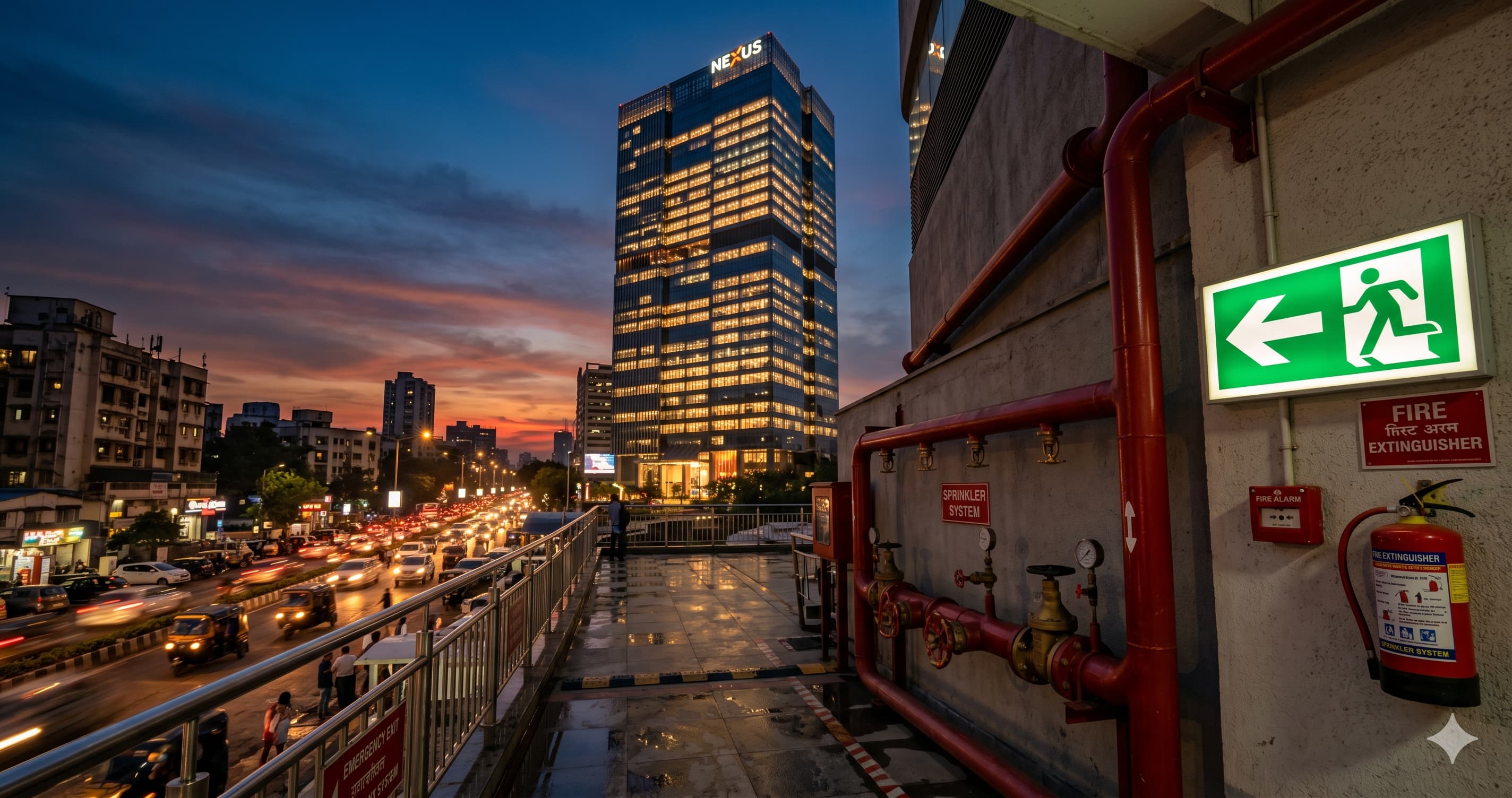
NBC Fire Safety Norms in India Explained
Learn NBC fire safety norms in India - Part 4 requirements, building classifications, Fire NOC process, and what's changing with the NBC 2025 draft update.
Why NBC Fire Safety Norms Matter More Than Ever
Every year, India records thousands of fire-related incidents across residential complexes, commercial towers, factories, and hospitals. In 2025 alone, Delhi reported a 10% rise in residential fire incidents - the majority occurring in buildings that either lacked proper safety systems or failed to comply with existing norms. Behind each of those statistics is a preventable tragedy.
- 10% Rise in Delhi residential fires, 2025
- 9 Occupancy groups covered under NBC Part 4
- NBC 2025 Draft revision introduced March 2025
At the heart of India's fire safety framework sits a single, legally enforceable document: The National Building Code of India (NBC), Part 4 - Fire and Life Safety. Whether you are a builder in Hosur, a facility manager in Chennai, or an architect designing a high-rise in Bangalore, understanding and complying with NBC fire safety norms is not optional - it is the law.
The NBC is developed and published by the Bureau of Indian Standards (BIS) and is formally adopted by State governments and municipal authorities across India. The current active edition is NBC 2016, and in March 2025, a significant draft revision - NBC 2025 - was introduced, proposing stricter, technology-forward requirements that every developer and architect must begin planning for today.
This guide is designed to cut through the technical complexity of NBC Part 4 without losing accuracy. By the end, you will understand what the code requires, how it classifies your building, what the Fire NOC process looks like, and what is on the horizon with NBC 2025 - all explained in clear, professional language.
Who This Guide Is For
Builders, real estate developers, architects, structural engineers, facility managers, and building owners across India - particularly those operating in fast-growing corridors like Hosur, Bangalore, Chennai, Mumbai, Hyderabad, and Delhi-NCR.
What Is the National Building Code (NBC) and What Does Part 4 Cover?
The National Building Code of India is a statutory instrument developed by the Bureau of Indian Standards that establishes the minimum safety, structural integrity, and sustainability standards applicable to all buildings across the country. It is not limited to large projects - the NBC applies to every construction undertaking, from a modest residential dwelling to a 50-storey commercial skyscraper.
First introduced in 1970 and subsequently revised in 1983, 2005, and most comprehensively in 2016, the NBC has evolved alongside India's rapidly changing built environment. It is divided into distinct parts, each governing a specific domain of building regulation:
|
NBC Part |
Subject Covered |
|
Part 1 |
Definitions |
|
Part 2 |
Administration |
|
Part 3 |
Development Control Rules & General Building Requirements |
|
Part 4 |
Fire & Life Safety — the focus of this guide |
|
Part 5 |
Building Materials |
|
Part 6 |
Structural Design |
|
Part 8 |
Building Services |
|
Part 9 |
Plumbing Services |
Part 4 - Fire and Life Safety is the most compliance-critical section for anyone involved in constructing, operating, or managing a building in India. It is structured around four core pillars:
- Fire Prevention - passive protection measures, fire-resistant construction materials, and fire zone designations that govern what can be built where.
- Life Safety - means of egress design, travel distances, exit access widths, and evacuation planning to ensure occupants can safely evacuate in an emergency.
- Fire Protection - active systems including automatic sprinklers, fire alarms, hydrant systems, hose reels, and fire pumps.
- Occupancy-Wise Requirements - specific prescriptive rules tailored to how a building is actually used, recognising that a hospital faces fundamentally different fire risks than a warehouse.
Key Cross-References: NBC Part 4 does not stand alone. It cross-references several Indian Standards including IS 1641 (fire safety terminology), IS 1642 (fire resistance of construction elements), IS 1644 (exit requirements), and IS 15105 (fire detection and alarm systems). Compliance with these referenced IS standards is legally inseparable from Part 4 compliance.
Why India's Buildings Need a Dedicated Fire Safety Code
India's rapid urbanisation presents a fire safety challenge unlike almost any other country in the world. The sheer diversity of building types, the prevalence of mixed-use developments, the variation in State enforcement capacities, and the pace of high-rise construction across Tier-1 and Tier-2 cities demand a nationally standardised, prescriptive code - one that generic international frameworks simply cannot address with the necessary granularity.
The Scale of the Challenge
Consider the complexity facing any Indian city today. Buildings range from traditional single-storey structures in dense urban neighbourhoods to 40-storey residential towers in the same municipal boundary. A single mixed-use development may house a retail floor, multiple office levels, a restaurant, and apartments - each carrying its own distinct fire risk profile. India's NBC addresses this by classifying buildings into nine distinct occupancy groups (Group A through Group I), each with its own set of requirements, and by dividing cities into four Fire Zones based on density and hazard levels.
In fast-growing corridors like Hosur in Tamil Nadu - where IT parks, EV manufacturing campuses, and large residential projects are being built simultaneously - the need for rigorous, consistently enforced fire safety standards has never been more pressing.
What Happens When Buildings Are Not Compliant?
Non-compliance with NBC fire safety norms carries serious legal and commercial consequences. Any developer who fails to meet the required standards faces the following under Indian law:
- Financial penalties imposed by the local authority
- Cancellation of the building permit, halting construction entirely
- Refusal to issue the Occupancy Certificate (OC) — meaning the completed building legally cannot be occupied or sold
- In the most serious cases of negligence, demolition orders issued by the municipal authority
The Business Case for Compliance:
Beyond legal obligations, buildings with documented NBC compliance attract better valuations, complete the approval process faster, and face significantly lower exposure to post-occupancy liability claims. Fire safety compliance is an investment, not merely a cost.
NBC Building Classification: Which Category Does Your Building Fall Under?
Before any fire safety design decision can be made, your building must be correctly classified under NBC Part 4's nine-group occupancy system. This classification is the single most important input in the entire compliance process — it determines your required travel distances, sprinkler thresholds, staircase widths, fire resistance ratings, and exit counts.
The Nine Occupancy Groups
|
Group |
Occupancy Type |
Common Examples |
|
A |
Residential |
Apartments, hotels, dormitories, hostels, starred hotels |
|
B |
Educational |
Schools, colleges, research institutions, coaching centres |
|
C |
Institutional |
Hospitals, nursing homes, jails, orphanages, rehabilitation centres |
|
D |
Assembly |
Theatres, auditoriums, places of worship, stadia, heritage structures |
|
E |
Business |
Offices, banks, IT parks, TV stations, data centres |
|
F |
Mercantile |
Shops, markets, shopping malls, supermarkets |
|
G |
Industrial |
Factories, workshops, manufacturing plants, EV production units |
|
H |
Storage |
Warehouses, cold storage facilities, multi-level parking garages |
|
I |
Hazardous |
Chemical plants, explosive storage, petroleum storage and processing |
Critical for Mixed-Use Buildings:
If your building houses two or more occupancies - a very common scenario in Indian cities, such as ground-floor retail beneath residential apartments - each zone must be analysed independently. Where occupancies overlap or are adjacent, the more restrictive requirement governs. Mixed-use zones must additionally be separated horizontally or vertically by a240-minute fire resistance rating
Sub-Classifications Under Group A (Residential)
Residential buildings are further sub-divided to reflect their varying occupancy characteristics and risk profiles. NBC 2016 introduced starred hotels as a new sub-category, acknowledging the unique risks that high-occupancy, transient-guest environments present:
- A-1: Lodging or rooming houses
- A-2: Dormitories
- A-3: Apartment buildings
- A-4: One- and two-family dwellings
- A-5: Row houses
- A-6: Starred hotels (newly introduced in NBC 2016)
NBC Fire Safety Requirements: What Does You’re Building Actually Need?
Once your building is correctly classified, NBC Part 4 applies requirements through a height-based tiering system. The higher the building, the more comprehensive the mandated fire safety package. Understanding which tier applies to your project determines the full scope of systems, exits, and infrastructure you must provide.
Height-Based Tiers (NBC 2016 Part 4, Cl. 1.2)
|
Height Class |
Typical Configuration |
Core Requirements |
|
Low-Rise (up to 15 m) |
G+4 typical |
Hose reels, manual call points, fire extinguishers, one enclosed staircase per wing |
|
Medium-Rise (15 m – 30 m) |
G+5 to G+9 |
Adds wet-riser system, automatic detection systems, pressurised staircases in applicable occupancies |
|
High-Rise (above 30 m) |
G+10 and above |
Full compliance package — refuge floors, sprinklers, mechanical smoke management, fireman's lift, two pressurised escape stairs |
Below is a detailed breakdown of the specific systems that NBC Part 4 mandates, each with its precise requirements:
1. Means of Egress (Exit Design)
Egress design is the backbone of any life safety strategy. NBC Part 4 is explicit: every floor of every applicable building must provide occupants with a clear, unobstructed path to safety. The key requirements are that each floor must have a minimum of two staircase exits for efficient evacuation. These staircases must be fully enclosed, continuously accessible from the ground floor to the terrace level, and formally approved by the Chief Fire Officer. No combustible materials may be used in staircase decoration, handrails must reach a minimum height of 100 cm, and critically, lifts and revolving doors cannot under any circumstances serve as fire exits. External staircases designated as the second means of egress must have a clear width of at least 1,250 mm and treads of no less than 250 mm.
2. Refuge Areas
For buildings exceeding 24 metres in height, NBC mandates the provision of refuge areas - designated safe zones where mobility-impaired occupants can shelter while awaiting evacuation by fire services. The first refuge area is required at 24 m or at the first accessible terrace, with subsequent areas at every 15 m interval above. Each refuge area must be cross-ventilated and directly accessible from the staircase lobby. These are not final assembly points - they are temporary holding positions while staircases are cleared for evacuation.
3. Fire Detection & Alarm Systems
Automatic fire detection and alarm systems are mandatory across educational, institutional, assembly, business, mercantile, and industrial occupancies. Designed to the requirements of Indian Standard IS 2189, these systems must include smoke detectors, manual call points, and audible hooters capable of alerting occupants on every floor. The system must be capable of identifying the location of a fire event and initiating an appropriate alarm response building-wide.
4. Sprinkler Systems
Automatic sprinklers are among the most effective fire suppression tools available and are mandated by NBC Part 4 in most buildings exceeding 15 m in height (as specified in Table 7 of Part 4). For high-risk industrial occupancies, sprinklers are required regardless of height. A single sprinkler installation control valve may protect a maximum floor area of 4,500 m²; projects exceeding this threshold require additional valve sets and corresponding infrastructure.
5. Fire Hydrant & Hose Reel Systems
Wet-riser systems with internal hydrants and hose reels are required for all medium-rise and high-rise buildings. The Code prescribes one pump set per 100 hydrants, and each installation must include a jockey pump - a small pressure-maintenance pump that prevents the main fire pump from cycling unnecessarily due to minor pressure fluctuations. Buildings above 15 m trigger additional hydrant and riser requirements specific to their occupancy classification.
6. Fire Extinguishers
Fire extinguishers are the first line of defence and are required in all building types without exception. The specific type - water, CO₂, dry powder, foam - and the number required depend on the occupancy group, total floor area, and the hazard classification of the building's contents. All extinguishers must be installed at accessible, clearly marked locations and maintained on a regular service schedule.
7. Fireman's Lift
In buildings exceeding 30 metres in height, NBC mandates the installation of a fire-rated, high-speed fireman's lift to allow fire service personnel to reach upper floors with equipment rapidly. This lift must be connected to the emergency power backup system to ensure it remains operational even during a mains power failure.
8. Emergency Power & Backup Systems
High-rise buildings must be equipped with emergency power supply systems - typically a combination of diesel generating sets and UPS units - capable of sustaining the fireman's lift, fire alarm panels, emergency lighting, mechanical smoke management, and pressurised staircase systems throughout a fire event. Power backup is not optional; it is a life safety system in its own right.
Fire Zones in India: What Zone Is Your Building In?
In addition to occupancy classification and height-based requirements, NBC Part 4 establishes a Fire Zone framework that divides Indian cities into four zones based on urban density, predominant land use, and the presence of flammable or hazardous materials. Your building's fire zone directly influences what construction materials are permitted and what additional fire protection measures may be required by your state authority.
|
Fire Zone |
Typical Character |
Risk Level |
|
Zone I |
Low-density residential neighbourhoods, open green areas |
Lower Risk |
|
Zone II |
Mixed-use areas, moderate-density commercial-residential mix |
Moderate Risk |
|
Zone III |
High-density commercial zones, light industrial areas |
High Risk |
|
Zone IV |
Heavy industrial areas, hazardous material storage, petroleum facilities |
Very High Risk |
An important and often misunderstood provision: existing buildings in any fire zone are not automatically required to retrofit to new NBC fire zone requirements unless major alterations or additions are planned. However, any significant alteration - even a floor addition or a change in occupancy use - triggers a fresh approval requirement from the local authority, at which point the current NBC standards apply in full to the altered portions.
Comparison: NBC 2016 vs NBC 2025 Draft - What's Changing?
In March 2025, the Bureau of Indian Standards introduced a revised draft of the National Building Code - informally referred to as NBC 2025. While the final published text is still undergoing review through national seminars and FSAI technical sessions, the direction of change is unambiguous: India's fire safety code is moving toward stronger compliance thresholds, smarter technology integration, and closer alignment with leading international standards.
For developers, architects, and facility managers, this draft is not something to monitor from a distance. It is something to plan for right now.
|
Feature |
NBC 2016 (Current) |
NBC 2025 (Draft) |
|
Fire Detection Systems |
Standard automatic detection for high-rise only |
Addressable fire detection mandatory in all buildings above 15 m |
|
Alarm Systems |
Conventional fire alarms |
IoT-enabled alarms that automatically alert emergency services |
|
Evacuation Guidance |
Manual evacuation protocols and drills |
Smart integrated systems identifying exact fire location for guided evacuation |
|
Fire Safety Clearances |
Case-by-case application process |
Single-window clearance process encouraged for buildings above 15 m |
|
Water Supply (45 m+ Buildings) |
Rooftop tank reliance |
Mid-level gravity-fed tanks recommended to ensure reliable pressure |
|
Sprinkler Requirements |
Standard thresholds per Table 7 |
Non-negotiable for all high-risk and mixed-use buildings |
|
International Alignment |
Partial NFPA reference |
Full alignment with NFPA 13, NFPA 25, NFPA 72 — adapted for Indian conditions |
What This Means for Your 2025–26 Project:
If you are currently in design or pre-construction, plan for NBC 2025 requirements today. Retrofitting addressable detection systems, IoT alarm infrastructure, and mid-level water tanks after construction is completed is far more expensive - and far more disruptive - than integrating them at design stage. The prudent step is to conduct a fire safety gap analysis now and begin budgeting accordingly, ahead of the final NBC 2025 text being formally gazetted.
What Is a Fire NOC and How Do You Get One?
The Fire No Objection Certificate (NOC) is the formal clearance issued by a State's Fire Department that certifies a building complies with NBC Part 4 and applicable State fire safety legislation. It is one of the most important documents in the life of any building -and without it, no Occupancy Certificate can be issued.
Why the Fire NOC Is Non-Negotiable
The Fire NOC is a mandatory prerequisite for the Occupancy Certificate (OC), which is itself the legal instrument that permits a building to be occupied, used commercially, or sold. Group housing schemes, apartment complexes, and all commercial, institutional, industrial, and assembly buildings must obtain a Fire NOC irrespective of their height. While individual residences below 15 m are typically exempt under most State fire rules, the practical reality is that any substantial construction project in India requires this clearance. The NOC is not a one-time formality - it must be renewed periodically, with physical inspections to verify that installed systems remain functional and the building has not been altered without authorisation.
The Fire NOC Process: Step by Step
01. Online Application Submission
Submit building plans, compliance documentation, system layout drawings, and applicable fees through the State Fire Department's online portal. In Tamil Nadu — relevant for Hosur-based projects - this is handled through the Tamil Nadu Fire and Rescue Services Department.
02. Document Scrutiny
Fire Department engineers review submitted plans against NBC Part 4 requirements, checking exit design, travel distances, sprinkler layouts, fire detection schematics, and refuge area placement. Deficiencies result in a query letter requiring corrections before the process can advance.
03. Physical Site Inspection
Fire officers visit the construction site to verify that installed systems and physical configurations match what was submitted in the approved plans. Any deviation - even a relocated fire panel or a changed staircase width - must be formally re-submitted and re-approved.
04. System Testing Under Load
All active systems are tested under operational conditions: fire pumps, sprinklers, alarm panels, emergency lighting, the fireman's lift, and pressurised staircases are each verified to function as designed. This is typically the most time-sensitive phase of the NOC process.
05 NOC Issuance
Upon satisfactory inspection and testing, the Fire NOC is formally issued. This document - along with its reference number - becomes the basis for obtaining the Occupancy Certificate from the municipal authority.
⚠️ State Variations Apply:
While the process broadly follows the sequence described above, specific documentation requirements, fee structures, and inspection timelines differ significantly by State. Always verify the current process with your local State Fire Department before submission.
Fire NOC Pre-Application Checklist
Before submitting your Fire NOC application, verify all of the following are in order:
- Building plans approved and signed by a licensed architect
- Occupancy classification correctly identified and documented
- Minimum two enclosed staircase exits confirmed on every floor
- Fire-resistant construction materials used as per NBC Table 1
- Sprinkler layout completed and verified for all applicable floors
- Wet-riser and hose reel systems fully installed and pressure-tested
- Fire alarm and detection systems commissioned and functionally tested
- Emergency power backup operational and load-tested
- Refuge areas provided at correct intervals (for buildings above 24 m)
- Fireman's lift installed, tested, and certified (for buildings above 30 m)
- Fire extinguishers installed at all required locations
NBC Fire Safety Requirements for Different Building Types
While NBC Part 4 provides a unified framework, its specific applications vary substantially based on how a building is used. Below is a practical summary of requirements for the most common building categories encountered in Indian construction:
Residential Buildings (Group A)
Residential buildings require a minimum of two staircase exits on every floor, with fire-resistant staircase construction and no combustible materials in staircase areas. Large apartment complexes above 15 m must install fire extinguishers on every floor, smoke detectors throughout common areas, and fully functional sprinkler systems. Emergency exits must be clearly marked with illuminated signage. Under the NBC 2025 draft, addressable fire detection systems will become mandatory in all residential buildings above 15 m - a significant upgrade from the current standard.
High-Rise Buildings (Above 30 m)
High-rise buildings carry the most comprehensive fire safety obligations in the Code. Refuge floors must be provided at 24 m and at every 15 m thereafter. Two independent pressurised escape staircases are mandatory, along with a mechanical smoke management system, a complete automatic sprinkler installation, a fireman's lift with dedicated emergency power, and a structural audit for any building exceeding 50 m in height. These requirements reflect the dramatically increased evacuation time and fire service access challenges that tall buildings present.
Industrial Buildings (Group G)
Industrial facilities require hazard classification - categorised as Low, Moderate, or High based on the materials processed and stored - before the appropriate fire suppression systems can be specified. Compartmentation walls between production zones are mandatory to prevent lateral fire spread. Sprinkler systems are non-negotiable in Moderate and High hazard classifications, and fire detection systems must be designed specifically for the chemical and thermal characteristics of the industrial processes involved.
Hospitals and Institutional Buildings (Group C)
Group C buildings carry a unique obligation: their occupants are often unable to self-evacuate. This demands wider exit corridors to accommodate hospital beds and wheelchairs, fire compartmentation to prevent smoke from spreading between wards, refuge areas specifically accessible to mobility-impaired patients, and round-the-clock fire alarm monitoring. Staff fire drill protocols, as governed by NBC Annex D, must be formally documented and regularly conducted.
Commercial and Retail Buildings (Groups E and F)
Shopping malls and large mercantile occupancies require full sprinkler coverage, as well as additional smoke management infrastructure in atrium spaces. Emergency lighting and clearly marked exit signage must be maintained throughout. Restaurants and commercial kitchen installations within these buildings must also comply with the specific provisions of NBC Annex G, which governs commercial kitchen fire safety - an often-overlooked compliance requirement that fire inspectors scrutinise closely.
How Much Does NBC Fire Safety Compliance Cost in India?
Fire safety compliance represents a significant line item in any construction budget - and one that, if underestimated at project inception, can cause serious cost overruns at the NOC stage. Costs vary substantially based on building height, occupancy classification, total floor area, the systems mandated, and prevailing contractor rates in your State. The following table provides indicative budget ranges for common project types:
|
Building Type |
Typical Fire Safety Budget (₹) |
|
Low-rise residential (up to 15 m) |
₹2 – 5 lakh per building |
|
Medium-rise apartment (15 – 30 m) |
₹8 – 20 lakh per building |
|
High-rise residential (above 30 m) |
₹25 – 75 lakh per building |
|
Commercial office building |
₹15 – 50 lakhs (depending on area) |
|
Factory / industrial unit |
₹10 – 40 lakhs (depending on hazard class) |
|
Hospital / institutional building |
₹20 – 60 lakhs |
⚠️ These are indicative ranges only. Actual costs depend on specific system specifications, local contractor rates, and State-level requirements. Always obtain detailed quotes from licensed fire safety consultants and certified contractors before finalising your budget.
The principal cost components that drive the fire safety budget on any Indian project include fire detection and alarm systems, sprinkler installation (typically the single largest cost element in high-rise buildings), wet-riser and hydrant systems, emergency power backup infrastructure (DG set and UPS), the fireman's lift for buildings above 30 m, and ongoing Annual Maintenance Contracts (AMC) which represent a recurring compliance obligation post-occupancy.
Cost-Saving Principle: Every rupee invested in fire safety at design stage saves an estimated four to six rupees in retrofit costs if the same compliance gaps are identified at the NOC stage. Early engagement with a fire safety consultant is the most effective cost-control strategy available to any project team.
NBC Fire Safety Compliance in Key Indian Cities and Industrial Hubs
While NBC Part 4 is a national standard, enforcement, the Fire NOC process, and State-specific additions vary meaningfully by location. Here is a city-by-city overview of what builders and developers need to know:
Hosur, Tamil Nadu
One of India's fastest-growing industrial corridors - IT parks, EV manufacturing, and residential projects expanding rapidly. Compliance managed by Tamil Nadu Fire and Rescue Services. Industrial units in auto and electronics sectors must meet Group G requirements; high-hazard facilities need additional State approvals.
Chennai, Tamil Nadu
Strict NBC enforcement for high-rise commercial buildings, hospitals, and IT parks. The Greater Chennai Corporation and Tamil Nadu Fire Department jointly oversee Fire NOC issuance for large commercial and institutional projects.
Bangalore, Karnataka
High concentration of Group E (Business) buildings - offices, tech parks, and data centres - across the city. BBMP and Karnataka State Fire and Emergency Services manage compliance. Strong enforcement track record for large commercial projects.
Mumbai, Maharashtra
Maharashtra operates one of the most rigorous State fire safety frameworks in the country, supplementing NBC norms with the Maharashtra Fire Prevention and Life Safety Measures Act. High-rise residential and commercial projects face frequent surprise inspections.
Delhi-NCR, Delhi
Reporting the highest rate of urban fire incidents in India, Delhi enforces NBC compliance aggressively. The Delhi Fire Service conducts regular unannounced inspections of commercial buildings and residential complexes, with significant penalties for non-compliance.
Hyderabad, Telangana
Rapid pharmaceutical and IT sector growth drives strong demand for Group G and Group E compliance. GHMC and Telangana State Disaster Response and Fire Services jointly manage Fire NOC processes, with growing scrutiny of mixed-use developments.
Step-by-Step: How to Achieve NBC Fire Safety Compliance for Your Building
NBC compliance is a process that must begin at the earliest stages of a project, not after construction has commenced. The following eleven-step framework is applicable to all new construction projects in India, regardless of building type or location:
01. Classify Your Building
Identify the correct occupancy group (A through I) for your project. Confirm whether any mixed-occupancy elements are present and document each zone separately.
02. Determine Your Height Tier
Measure building height accurately from average ground level to terrace. Establish definitively whether low-rise, medium-rise, or high-rise requirements apply to your project.
03. Conduct a Fire Safety Design Review
Engage a licensed fire safety consultant at concept stage to review architectural plans against NBC Part 4 requirements — exit locations, travel distances, refuge areas, and fire protection system layouts.
04. Prepare Compliant Building Plans
Incorporate all fire safety elements into the building design: staircase positions, fire compartmentation walls, sprinkler routing, fire panel locations, and alarm system schematics.
05. Source NBC-Compliant Materials and Systems
Specify fire-rated construction materials from BIS-certified suppliers. Select fire suppression and detection equipment from approved manufacturers with documented compliance certifications.
06. Submit for Pre-Construction Fire NOC
Where required by your state authority — which covers the majority of commercial, institutional, and multi-residential occupancies — submit plans for pre-construction Fire NOC approval before work begins on site.
07. Install Systems During Construction
Ensure all fire protection systems are installed precisely as per the approved plans. Do not deviate from submitted layouts without prior formal approval — any deviation requires re-submission and re-inspection.
08. Commission and Test All Systems
Before applying for the final Fire NOC, commission and test every active system under operational load: fire pumps, sprinklers, alarm panels, emergency lighting, and the fireman's lift.
09. Apply for Occupancy Fire NOC
Submit the final Fire NOC application with full inspection documentation and arrange the fire officer's site visit. Ensure all pre-application checklist items are complete before this stage.
10. Obtain the Occupancy Certificate
With the Fire NOC secured, proceed to obtain the Occupancy Certificate from the relevant municipal authority. The building is now legally cleared for occupation, sale, or commercial use.
11. Maintain, Audit, and Renew
Enter all fire protection systems into Annual Maintenance Contracts (AMC). Renew the Fire NOC as required by your state authority. Conduct regular fire drills per NBC Annex D guidelines to maintain staff preparedness.
FAQs About NBC Fire Safety Norms in India
Q1. What is NBC Part 4 and is it legally mandatory?
NBC Part 4 - Fire and Life Safety is the section of the National Building Code of India that specifies all fire safety requirements for buildings. It is legally mandatory across India and is enforced by State governments and municipal authorities through the building permit and Fire NOC processes. Non-compliance carries penalties ranging from fines to demolition orders.
Q2. What is the difference between NBC 2016 and the proposed NBC 2025?
NBC 2016 is the current active standard. NBC 2025 is a draft revision introduced in March 2025 that proposes stricter requirements, including mandatory addressable fire detection in all buildings above 15 m, IoT-enabled alarms that automatically alert emergency services, smart integrated evacuation systems, and mid-level gravity-fed water tanks for buildings above 45 m. The final text is still undergoing national consultation, but developers should begin planning for these requirements immediately.
Q3. When is a Fire NOC mandatory in India?
A Fire NOC is mandatory before an Occupancy Certificate can be issued for group housing schemes, apartment complexes, and all commercial, institutional, industrial, and assembly buildings. Individual residences below 15 m height are typically exempt under most State fire rules, but this exemption varies by State and should be confirmed with your local fire authority.
Q4. What is a "high-rise building" under NBC 2016?
Under NBC 2016, a high-rise building is any structure with a height above 15 metres, measured from average ground level to terrace level. This threshold triggers additional fire safety requirements. Buildings above 30 m require the full compliance package: refuge floors, two pressurised escape staircases, sprinklers, mechanical smoke management, and a fireman's lift.
Q5. Are sprinkler systems mandatory in all Indian buildings?
No. Sprinklers are mandatory for buildings above 15 m in most occupancies as specified in NBC Part 4, Table 7, and for all high-risk industrial occupancies regardless of height. Low-rise residential buildings typically require only fire extinguishers and basic detection systems. Under the proposed NBC 2025, sprinkler requirements will become stricter for high-risk and mixed-use buildings.
Q6. What is a refuge area and which buildings need one?
A refuge area is a temporary safe zone within a building where occupants who cannot use stairs - particularly elderly or mobility-impaired persons - can shelter while waiting for fire service evacuation. Refuge areas are required in buildings above 24 m in height, positioned at the first accessible terrace or at 24 m, and at every 15 m interval above that level.
Q7. What are the exit requirements under NBC Part 4?
Every floor must provide a minimum of two enclosed staircase exits. Lifts and revolving doors cannot function as fire exits. External staircases used as secondary exits must be at least 1,250 mm wide with treads of no less than 250 mm. All staircases must run continuously from the ground floor to the terrace and must be entirely free of combustible materials.
Q8. Does NBC Part 4 apply to existing buildings?
Existing buildings are generally not required to retrofit to new NBC provisions unless major alterations or additions are planned. Any significant alteration - a floor addition, a change in occupancy use, or a structural modification - requires fresh approval from the local authority, at which point the current NBC standards apply to the altered portions.
Q9. What is the Fire Zone classification and how does it affect my building?
Indian cities are divided into Fire Zones I to IV based on urban density, land use, and fire risk levels. Zone I cover lower-risk residential areas; Zone IV covers the highest-risk industrial and hazardous material zones. Your fire zone affects which construction materials are permitted, what fire protection levels are mandated by your local authority, and what additional approvals may be required.
Q10. What are the consequences of not complying with NBC fire safety norms?
Non-compliance consequences include financial penalties, cancellation of the building permit, refusal of the Occupancy Certificate (rendering the building legally unoccupiable), and in the most serious cases, demolition orders from the local authority. Post-occupancy, buildings found to be non-compliant during renewal inspections face NOC cancellation.
Q11. How often must the Fire NOC be renewed?
Renewal frequency varies by State - typically every one to three years, accompanied by physical inspections to verify that all installed systems remain functional and that no unauthorised alterations have been made to the building or its fire protection systems. Failure to renew in time can result in the NOC lapsing, which in turn affects the building's legal status for occupation.
Q12. How does NBC Part 4 compare to international fire safety standards?
NBC Part 4 shares the foundational principles of NFPA 101 (USA), the IBC (USA), and BS 9999 (UK): occupancy classification, means of egress design, and combined passive and active fire protection. However, NBC is more prescriptive than the risk-based approach of BS 9999. The proposed NBC 2025 explicitly draws from NFPA 13, NFPA 25, and NFPA 72, adapting these standards to India's specific building characteristics and enforcement environment.
Conclusion: Staying Ahead of NBC Fire Safety Compliance in India
India's fire safety regulatory environment is evolving at a pace that demands proactive engagement from every stakeholder in the built environment. The active NBC 2016 Part 4 already constitutes a comprehensive, legally enforceable framework covering building classification, exit design, fire detection, suppression systems, and the Fire NOC process. The upcoming NBC 2025 draft signals a more technology-integrated, internationally aligned future - one where IoT-enabled alarms, addressable detection, and smart evacuation systems will become the baseline standard, not the premium option.
For builders, architects, developers, and facility managers - particularly those operating in fast-growing industrial and residential corridors like Hosur - early compliance is not merely a legal obligation. It is a strategic business advantage. Projects with robust, documented fire safety profiles complete the NOC process faster, command better valuations, attract institutional buyers and tenants, and face substantially lower exposure to post-occupancy liability.
- Classify your occupancy group and determine your height tier before any other design decision
- Engage a licensed fire safety consultant at concept stage - not after building plans have been submitted
- Budget now for NBC 2025 compliance, even though the final text is still pending
- Never defer the Fire NOC process - no NOC means no Occupancy Certificate, no legal occupation, no revenue
- Maintain all fire protection systems under formal AMC and conduct documented fire drills per NBC Annex D
Contact our Fire Safety Compliance Team


