
Gas Fire Suppression Systems: How Clean Agent Protection Works
How does a gas fire suppression system work? Compare FM-200, Novec 1230 and inert gas, plus room sealing and safety rules for Hosur facilities.
A gas fire suppression system puts out a fire by flooding a sealed room with an extinguishing gas, with no water, foam or residue left behind. That makes it the usual choice for server rooms, electrical panels and control rooms where water would cause its own damage. But the system only works if the room can hold the gas long enough, and the wrong agent in an occupied room can hurt people. This guide explains how a gas fire suppression system works, how the main agents compare, and what has to be right before one is installed in a Hosur facility.
The Problem: The Gas Cylinders Are the Easy Part
Most buyers focus on the agent and the cylinder count. The failures usually come from somewhere else. A room leaks. A ceiling can't take the discharge pressure. An agent is chosen without thinking about who works in the space.
A gas system is a total-flooding design. It has to reach a set concentration in seconds and hold it there while the fire dies and the surfaces cool. If gas escapes through an open cable cut-out or a gap under the door, the concentration drops below the design level. The fire can then restart as the gas thins out. The equipment can be perfect and the system can still fail.
The Solution: How a Gas Fire Suppression System Works
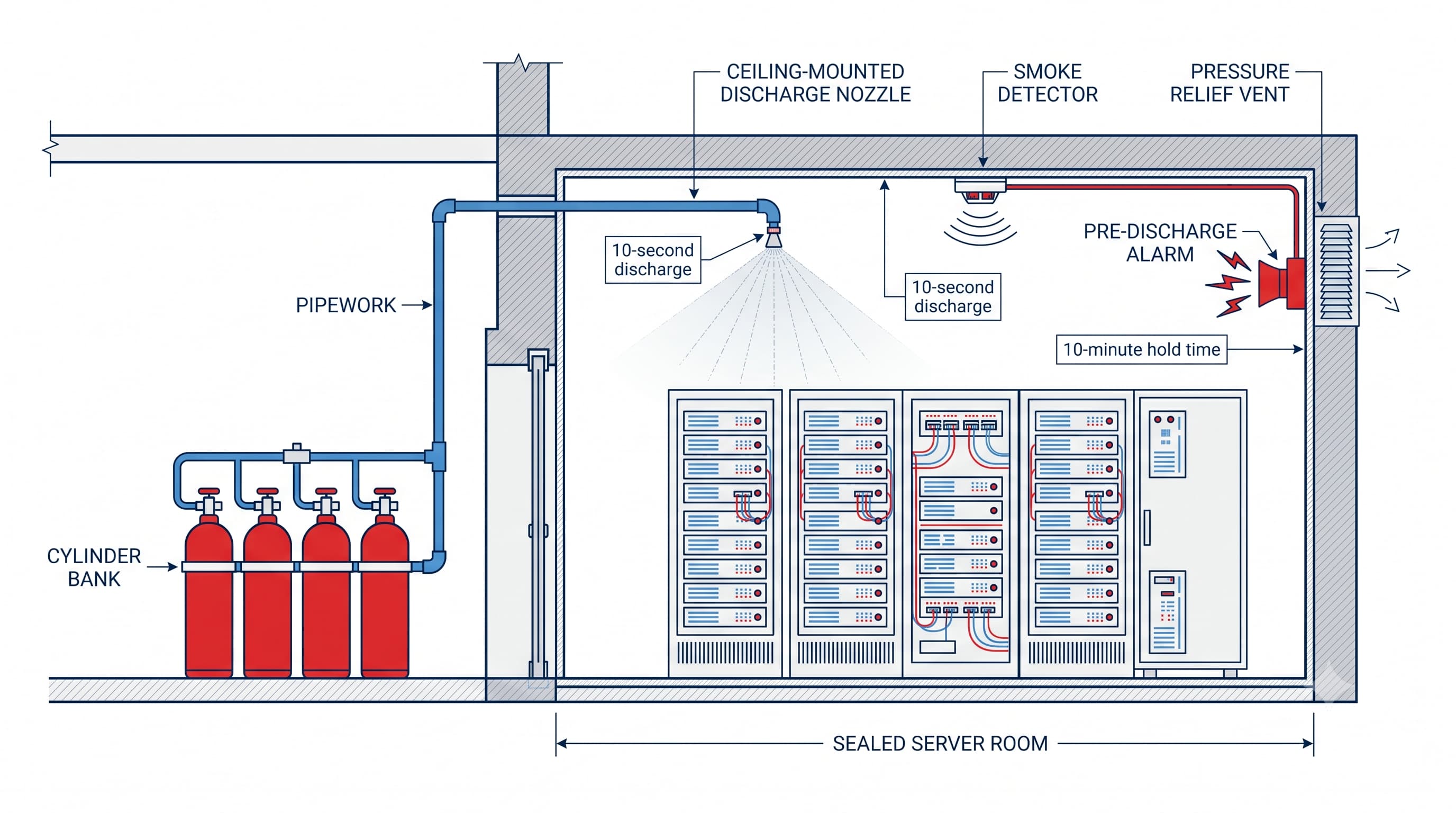
A detector in the protected room senses smoke or heat and signals the control panel. The panel sounds a pre-discharge alarm and runs a short delay so people can leave. It then releases the agent from storage cylinders through pipework and nozzles, filling the room at the design concentration.
Some agents work mainly by absorbing heat from the flame. Others lower the oxygen level in the room until burning can't continue. Either way, the fire is stopped without wetting equipment.
Two Numbers That Decide Whether It Works
NFPA 2001, the main standard for clean agent systems, sets two targets that matter most. Most agents must discharge in about ten seconds, and the room must then hold the agent at design concentration for a minimum of around ten minutes. Inert gas systems are allowed a longer discharge, roughly a minute, because they use much larger volumes.
The ten seconds depends on the pipework and nozzle design. The ten minutes depends entirely on how well the room is sealed.
Room Integrity Testing
To check the seal, installers run a door fan test. A fan is fitted in the doorway, the room is pressurised, and the leakage is measured. Software then predicts how long the agent will stay in the room. According to NFPA 2001, ISO 14520 and EN 15004, this test is part of compliance for clean agent systems. The test doesn't release any agent.
Guidance generally calls for an integrity test at least once a year. Test again after any change to the room, such as a new cable opening or a replaced door. A hole drilled for a conduit and left unsealed is enough to fail the test.
Comparing the Main Agents
|
Agent type |
Examples |
How it works |
Typical use |
|
Halocarbon (synthetic) |
FM-200 (HFC-227ea), Novec 1230 |
Mainly absorbs heat from the fire |
Server rooms, control rooms, switchgear, archives |
|
Inert gas |
Inergen (IG-541), IG-55 |
Lowers oxygen in the room |
Spaces where residue-free, non-chemical agents are preferred |
|
Carbon dioxide |
CO2 |
Displaces oxygen |
Unoccupied hazards only |
FM-200 is a hydrofluorocarbon; a class of gases being phased down internationally under the Kigali Amendment. It's worth asking your designer how long the chosen agent will remain available and supported.
Safety Isn't Optional
Gas systems change the air in a room, so people have to be considered from the start. The pre-discharge alarm and time delay exist for that reason. Manual abort and release stations, clear door signage and trained staff are part of the design too.
Inert gas and CO2 systems carry the most risk. A review by the Italian Workers' Compensation Authority and Fire Brigade (Piccolo et al., 2018) looked at 12 separate accidents involving inert gas suppression systems, several with serious injuries. CO2 should be kept for spaces where nobody is present when it discharges.
Pressure Relief
A fast discharge pushes a lot of gas into a closed room. Pressure vents are mandatory for inert gas systems and may be needed for synthetic agents. Testing has shown that FM-200 and Novec 1230 can cause both over-pressure and under-pressure during discharge, enough to damage walls or ceiling tiles in a lightly built room. This is checked during design, not after.
Where a Gas System Makes Sense
- Server rooms and data rooms, where water would destroy the equipment, it's meant to protect
- Electrical, switchgear and control rooms in factories, including the control rooms of manufacturing plants
- Battery rooms and UPS rooms
- Archives and record rooms with high-value paper storage
- Telecom and instrumentation rooms
It's less suited to very large open areas, because the room can't be sealed or the gas quantity becomes impractical. In those cases foam or water-based protection is usually the better answer, as covered in our guide to foam fire suppression systems.
Why Facilities in Hosur Choose Technique Engineers
Technique Engineers designs and installs gas fire suppression systems for factories, data rooms and control rooms across Hosur and Krishnagiri. We check the room's size, sealing, ventilation and occupancy before choosing an agent. The integrity test and pressure relief are planned into the design from the start. For spaces where prevention is a better fit than extinguishing, our post on Oxy-Reduct fire prevention systems explains the alternative.
Frequently Asked Questions
Is a gas fire suppression system safe if people are in the room?
Usually yes for the synthetic agents, because they're designed for occupied spaces and the pre-discharge alarm gives people time to leave. It's a different story for CO2, and inert gas systems need careful design. The honest answer is that safety depends on the agent and the design, so ask who will be in the room and when.
How do I choose between FM-200, Novec 1230 and inert gas?
It comes down to the room, the budget and what you're protecting. Synthetic agents need less storage space. Inert gases use more cylinders but leave no chemical agent behind. A designer should compare them against your room volume, ceiling strength and long-term supply, not just the quote.
Can my server room be protected if it has a false ceiling and cable openings?
Often yes, but the leaks have to be sealed first. Cable openings, gaps around pipes and ceiling voids are where agent escapes. A door fan test will tell you how much work the room needs before the system can be signed off.
What does maintenance involve?
Regular checks of cylinder pressure or weight, detectors, the control panel, discharge pipework and release devices, plus the room integrity test. This usually sits inside an AMC. If the system has ever discharged, the cylinders need refilling and the room needs inspecting before it's put back into service.
How is gas suppression different from Oxy-Reduct?
A gas system puts out a fire after it starts. Oxy-Reduct keeps oxygen low all the time so a fire can't start. Gas is the more common and usually the cheaper choice; Oxy-Reduct suits special cases like archives and automated storage.
Technique Engineers designs and installs gas fire suppression systems and complete fire protection solutions for industrial and commercial facilities across Hosur and Krishnagiri. Contact us for an assessment of your server room, control room or electrical room.


