
Aspirating Smoke Detection for Data Centres and Clean Rooms
How does aspirating smoke detection work? See EN 54-20 classes, where ASD suits data centres and clean rooms, and what a Hosur installation needs.
Aspirating smoke detection (ASD) draws air from the protected room through a network of small pipes to a very sensitive detector, so it can pick up smoke much earlier than ordinary ceiling detectors. That's why it's the usual choice where a fire would cost more than the equipment: data centres, control rooms, clean rooms and high-value storage. It only performs if the pipe network is designed and commissioned properly. This guide explains how aspirating smoke detection works, how the EN 54-20 sensitivity classes differ, and what to check before you specify it for a facility in Hosur.
The Problem: By the Time a Ceiling Detector Reacts, It Can Be Late
A standard smoke detector senses smoke only when it reaches the detector in enough concentration. In an ordinary office that works well enough.
Server rooms and clean rooms are different. Cooling units and air-handling systems keep the air moving constantly, so smoke is diluted and carried away before it builds up at a ceiling detector. In a clean room the air is changed many times an hour on purpose. Meanwhile, a fault in a cable or a component can overheat and smoulder for some time before any flame appears. Early on, that produces very little visible smoke.
So, the first sign of trouble can be missed. By the time a spot detector reacts, the room may already have lost equipment or uptime.
The Solution: How Aspirating Smoke Detection Works
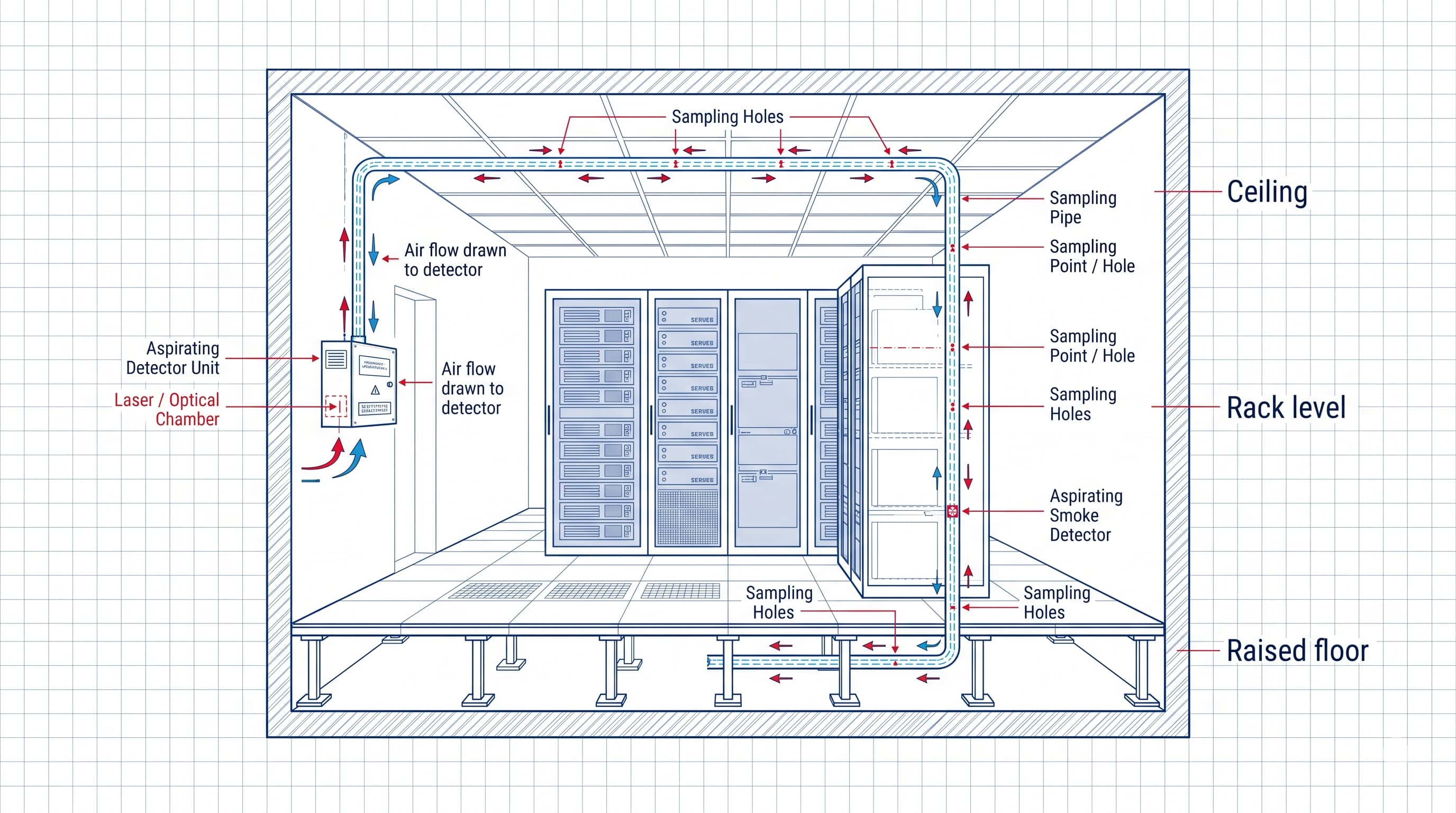
Unlike a conventional detector, which only senses smoke at its own location, an aspirating system continuously pulls air from the room through a network of pipes. The air passes through a filter and into a sensitive detection chamber. Small holes along the pipes act as sampling points, so a single detector unit can monitor many points across a room.
Most units give several alarm levels. That means staff can get an early alert, investigate, and act before the full fire alarm triggers. The unit connects to your fire alarm panel like any other detection device, so it fits into the system we describe in our guide to fire alarm systems in Hosur.
Sampling Where It Matters
In a data centre, the strength of this approach is that sampling can cover several levels in one room. The pipes can draw from the raised floor, near the racks and at the ceiling, rather than relying on smoke eventually reaching one height. Specialised designs also sample inside individual equipment cabinets for very localised protection.
EN 54-20 Sensitivity Classes
EN 54-20 is the European product standard for aspirating smoke detectors. It splits them into three sensitivity classes:
|
Class |
Sensitivity |
Typical use |
|
A |
Very high |
Data centres and other critical areas where the earliest warning matters |
|
B |
Enhanced |
Challenging spaces with strong airflow or high ceilings, where smoke is diluted |
|
C |
Normal |
An alternative to spot or beam detectors where access is difficult, such as warehouses and cold stores |
The class you need depends on the risk. A server room usually calls for Class A. A large warehouse may only need Class C, because the aim there is practical coverage rather than the earliest possible alert.
Before EN 54-20 arrived around 2009, there was only one class of sensitivity. The standard gave designers a clearer way to match the detector to the job.
Design Matters as Much as the Detector
The pipe network is part of the detector. Its length, the number of sampling holes and the airflow balance all affect how fast smoke reaches the sensor. That's why design uses pipe-flow calculation software, and why the system must be calculated to confirm it actually achieves the sensitivity class you paid for. A good detector on a badly designed pipe network will not give you Class A performance.
Things we check during design:
- Room layout and airflow, including where cooling air enters and leaves
- Sampling hole positions and count, within the limits for the chosen class
- Pipe routing and supports, so the network is sealed and stays in position
- Alarm thresholds, set to catch problems early without causing nuisance alarms
- Links to other systems, such as the main fire alarm panel or a gas suppression system
ASD is often paired with a gas system in protected rooms. It gives the early warning, and the gas system is the response. We explain how that works in our guide to gas fire suppression systems. For spaces where preventing ignition altogether is the aim, see our post on Oxy-Reduct fire prevention.
Where Aspirating Smoke Detection Makes Sense
- Data centres and server rooms
- Clean rooms and cleanroom-type production areas
- Electrical and control rooms
- Archives and high-value storage
- Cold stores and high-bay warehouses, where spot detectors are hard to reach
It isn't needed everywhere. For a standard office, ordinary detection is usually enough, and it costs less. ASD earns its cost where early warning has a real value.
Maintenance: Don't Install and Forget
Like any detection system, aspirating smoke detection needs ongoing care. Filters clog, pipes can get damaged or blocked, and airflow has to be checked so the unit still draws air normally. Sensitivity should also be verified, and any change to the room layout should trigger a check of the pipe design. This sits naturally inside an AMC, as covered in our guide to Fire Alarm AMC.
Why Facilities in Hosur Choose Technique Engineers
Technique Engineers supplies and installs aspirating smoke detection and air sampling systems for server rooms, control rooms and critical spaces across Hosur and Krishnagiri. We work out the sensitivity class from the risk, calculate the pipe network before installation, and test the system at commissioning. We also connect it to your fire alarm panel and any suppression system, so the alert leads to the right response.
Frequently Asked Questions
Is aspirating smoke detection just a more sensitive smoke detector?
Partly, but the real difference is how it works. A normal detector waits for smoke to reach it. An aspirating system actively pulls air in from several points and tests it continuously. That's why it can react to a very small amount of smoke.
Does it replace my fire alarm system?
No. It's a detection device that connects to the fire alarm panel. The rest of the building still needs its normal detectors, call points and sounders.
Will it cause false alarms in a dusty factory?
It can if it's wrongly designed or sited. Filters, the right alarm thresholds and careful positioning keep nuisance alarms down. Very dusty areas need extra care, and sometimes a lower sensitivity class is the better choice.
Which class do I need for my server room?
Class A is the usual answer for a data centre. But rooms with heavy airflow or high ceilings can behave differently. The class should come from the risk assessment and pipe calculation, not a rule of thumb.
How much does aspirating smoke detection cost?
There's no honest single figure. It depends on room size, pipe length, sensitivity class and how many zones you need. A site survey gives a real quote, and it's cheaper than finding out later that the design was wrong.
Technique Engineers supplies and installs aspirating smoke detection, fire alarm and suppression systems for industrial and commercial facilities across Hosur and Krishnagiri. Contact us for a survey of your server room, control room or critical space.


