
Fire Protection System Commissioning: What Happens Before Handover
What happens during fire protection system commissioning? See the tests done before handover in Hosur: flushing, hydrostatic, pump and alarm checks.
Fire protection system commissioning is the set of tests that proves your hydrants, sprinklers, pumps and alarms actually work before the contractor hands the building over. Installed and looking right is not the same as working. For a water-based system the usual proof includes flushing the pipes, holding the pipework at 200 psi for two hours, and running the fire pump through a full acceptance test. This guide explains what fire protection system commissioning involves, in what order, and what paperwork you should have in your hands at handover for a facility in Hosur.
The Problem: "Installed" Gets Mistaken for "Working"
At the end of a build, a fire protection system looks finished. The red pipes are up, the panels are lit, the sprinkler heads are in the ceiling. It's easy to sign off on that.
But a system can look complete and still have a closed valve, a leaking joint, or a pump that doesn't reach its rated flow. An alarm may also never reach the pump controller. These faults don't show on a walk-through. They show up in a Fire NOC inspection, during the first year of operation, or in a real fire.
Finding them during fire protection system commissioning is far cheaper. The pipes are still accessible, the contractor is still on site, and nobody's life depends on the answer yet.
The Solution: What Commissioning Actually Covers
Two terms get mixed up, so it helps to separate them. Acceptance testing is what the installation standard demands for a particular system, such as NFPA 13 for sprinklers and NFPA 72 for fire alarms. Commissioning, as NFPA 3 defines it, is wider. It verifies that the systems will work as planned and that the owner can operate and maintain them. NFPA 4 adds integrated system testing, which checks that systems work properly together, especially when new systems are tied into existing ones.
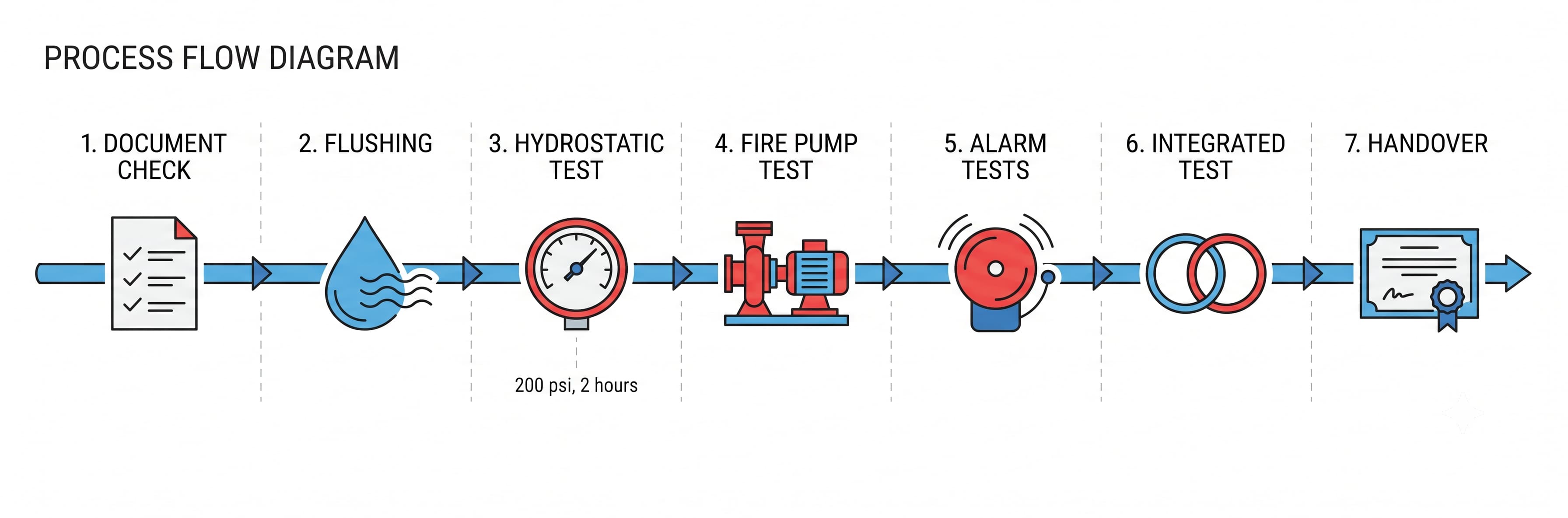
The Usual Sequence
|
Stage |
What happens |
What you should receive |
|
1. Document check |
Installed system compared with approved drawings and the fire fighting scheme |
As-built drawings, approvals |
|
2. Flushing |
Pipework flushed to clear debris before pressure testing |
Flushing certificate |
|
3. Hydrostatic test |
Pipework pressurised and held to check for leaks |
Hydrostatic test certificate |
|
4. Fire pump acceptance test |
Pump run at no load, rated load and peak load |
Test report compared with the pump curve |
|
5. Detection and alarm tests |
Every detector, call point and sounder checked |
Device-by-device test record |
|
6. Integrated test |
Systems tested working together |
Integrated test report |
|
7. Handover |
Documents, manuals and staff training |
Handover pack, training record |
Flushing and Hydrostatic Testing
Flushing comes first, always before the pressure test. NFPA 20 guidance then calls for the pump's suction and discharge piping to be tested at no less than 200 psi. Where the system's maximum pressure is higher, the test is 50 psi above it. For a wet pipe sprinkler system, NFPA specialists describe a two-hour test at 200 psi during which the pressure must not fall. The test is also repeated on any new section of more than 20 sprinklers added to an existing system.
A drop in pressure means a leak somewhere. Better to find it now than behind a finished ceiling.
The Fire Pump Acceptance Test
The pump is the heart of a water-based system, and its test is the longest. NFPA guidance notes that a fire pump is complex enough that acceptance testing can take a full day. Before the test starts, the electrical wiring, controller and standby power must be complete and checked, and the installing contractor must hand over the flushing and hydrostatic certificates.
During the test the pump is run at no load, at rated load and at peak load, normally 150% of rated flow. The results are compared with the manufacturer's certified performance curve. The pump should perform to that curve, run without damaging vibration, and meet the demand of the system it feeds. The controller is also tested by repeatedly starting the driver.
This ties directly to the sizing questions covered in our guide to choosing the right fire pump.
Alarm, Detection and Integrated Testing
Detection tests check each device and what it triggers: sounders, panel indications, and any link to other equipment. Integrated testing then confirms the pieces work as a whole. Alarm signals, pump start, door release and any connected systems should respond the way the design says they will.
Who Should Witness the Tests
Flushing and hydrostatic tests should be documented and witnessed, not just reported. Typically that means the designer, a commissioning agent or consultant, and the local fire authority where it requires attendance. If the only record is the contractor's own signature, you have little to fall back on later.
Why Fire Protection System Commissioning Matters for Your Fire NOC
As we explain in our guide to fire protection approvals, the fire department's site inspection checks that alarms, sprinklers and exits actually work, not just that they exist. Complete commissioning records make that inspection simpler and give you the baseline for routine checks afterwards, which we cover in our guide to fire protection system inspection.
Why Facilities in Hosur Choose Technique Engineers
Technique Engineers carries out fire protection system commissioning on every system we install across Hosur and Krishnagiri. We flush, pressure test, run the pump to its curve, test each detection device and hand over the certificates and drawings with the system. If a test fails, we fix it and retest before handover, and we document it either way. The design side of this work is covered in our guide to fire and life safety system design.
Frequently Asked Questions
Is commissioning the same as acceptance testing?
Not quite. Acceptance testing is the set of tests a specific standard requires, like the pressure test for sprinklers. Commissioning is the wider process that confirms the whole system performs as planned and can be run and maintained by you. In everyday talk the two are often used as if they were one.
How long does fire protection system commissioning take?
It depends on the size and number of systems. A single fire pump test can take most of a day on its own. A full factory with hydrants, sprinklers, alarms and suppression takes longer, and it's worth building that time into the project schedule instead of squeezing it in before the opening date.
What documents should I get at handover?
Typically, the flushing and hydrostatic certificates, the pump acceptance test report against its curve, the alarm and detection test records, as-built drawings, equipment manuals, and a record of staff training. Ask for the list before the project starts, not at the end.
What if a test fails?
It's fixed and retested. A failure at commissioning is the process doing its job. The thing to avoid is a contractor signing off a failed or skipped test, which just moves the problem to a time when it costs more.
Do we need to re-test if we add a few sprinklers later?
Yes, the new work needs checking. NFPA 13 requires the pressure test when a modification affects more than 20 sprinklers, but smaller changes still need to be inspected and flow-checked. Treat every modification as something that needs proof, not an assumption.
Technique Engineers provides fire protection system commissioning, testing and handover documentation for industrial and commercial facilities across Hosur and Krishnagiri. Contact us for a fire protection system commissioning plan for your project.


