
Water Mist Fire Suppression Systems: How They Work and Where They Fit
How does a water mist fire suppression system work? Compare low, intermediate and high pressure, and see where it suits Hosur facilities.
A water mist fire suppression system sprays water as extremely fine droplets, so it controls a fire using far less water than a sprinkler. The droplets cool the flames, turn to steam that thins the oxygen around the fire, and block heat from spreading. It suits spaces where you want protection without a flood or a sealed room, such as data rooms, engine and generator rooms and cable areas. But each system is approved for specific hazards, so the right choice comes from your risk, not a catalogue. This guide explains how a water mist fire suppression system works, how the pressure classes differ, and what to check before you specify one in Hosur.
The Problem: Every Option Has a Catch
Most fire protection choices come with a trade-off. A sprinkler system uses a lot of water, and that water can ruin the equipment or stock you're trying to save. A gas system uses no water. But the room has to be sealed tightly, and the discharge needs careful safety planning, as we explain in our guide to gas fire suppression systems. Foam suits flammable liquids but isn't a fit for every room.
Facilities with expensive equipment, limited water supply or spaces that can't be fully sealed often want something in between. Water mist is designed for that gap.
The Solution: How Water Mist Works
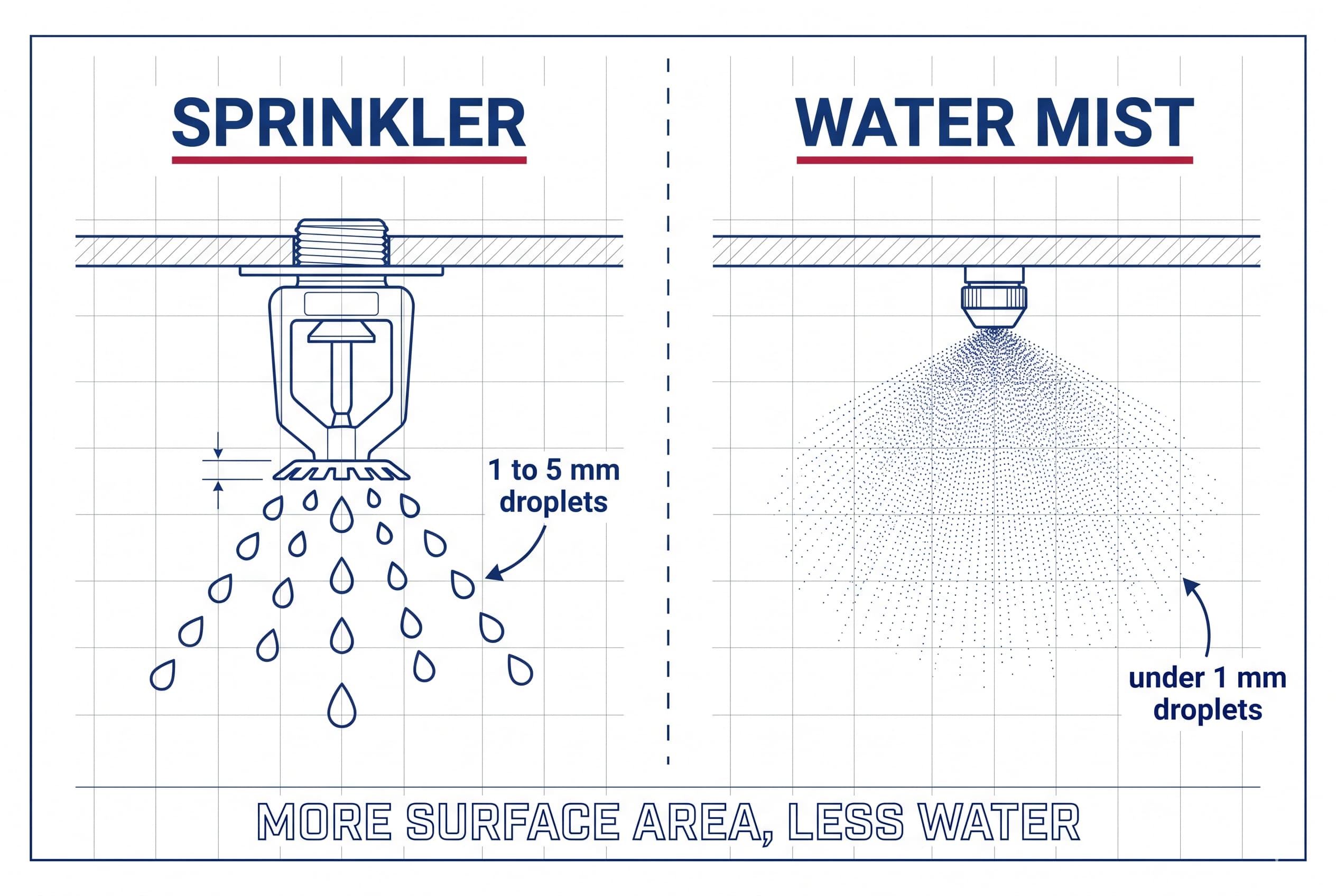
NFPA 750, the standard for water mist systems, defines water mist as a spray where the droplets are smaller than about 1,000 microns (one millimetre) across. For comparison, a conventional sprinkler produces droplets of roughly 1 to 5 millimetres.
Smaller droplets matter because water cools a fire by absorbing heat, and more surface area absorbs it faster. According to a code of practice from Fire Protection Association New Zealand, a litre of water in conventional sprinkler droplets exposes about 1 to 6 square metres of surface. The same litre as high-pressure mist exposes roughly 30 to 250 square metres.
In practice, water mist works through three effects:
- Cooling. The droplets absorb heat from the flames and the hot gases and evaporate quickly.
- Oxygen reduction. The droplets turn to steam, which thins the oxygen close to the fire. Smaller droplets turn to steam faster, so this effect is stronger.
- Heat shielding. The mist blocks radiant heat, which helps stop the fire spreading to nearby items.
How well it works depends on the match between the spray and the fire. That includes droplet size, the amount of water delivered, the size of the fire, whether the fuel is shielded, and the ventilation in the room.
The Three Pressure Classes
NFPA 750 groups water mist systems by operating pressure. Higher pressure generally means a finer mist.
|
Class |
Operating pressure |
Typical droplets |
Typical use |
|
Low pressure |
12.1 bar (175 psi) or below |
Coarser, up to 1,000 microns |
Wider range of building applications |
|
Intermediate pressure |
12.1 to 34.5 bar (175 to 500 psi) |
Medium |
Commercial and industrial applications needing more performance without high-pressure equipment |
|
High pressure |
34.5 bar (500 psi) and above |
Very fine |
Data centres, engine rooms and tunnels where minimal water use and fast suppression matter |
NFPA 750 also classifies the mist itself into three classes by droplet size. Class 1 is the finest, with droplets of 200 microns or less. Class 2 covers 200 to 400 microns, and Class 3 is anything larger.
Droplet size depends on the nozzle too. Impingement nozzles tend to make coarser mist for low and intermediate systems. Pressure-jet nozzles can produce very fine mist across all three classes. Twin-fluid nozzles use water and a gas such as nitrogen together to make fine mist at lower water pressures.
What's in the System
A water mist system is more specialised than a sprinkler network. The main parts are:
- Specialised nozzles or spray heads
- Pumps or a stored-pressure unit, and high-pressure pumps for high-pressure systems
- A control panel
- Pipes and fittings suited to the pressure
- Detection and activation devices
Component testing is done to product standards such as UL 2167, and installation requirements are set in NFPA 750.
Where Water Mist Fits
Published guidance lists data centres, engine rooms and tunnels among the typical high-risk, enclosed places for high-pressure systems. In an industrial site like those around Hosur, similar spaces include generator and diesel pump rooms, cable galleries, machinery enclosures and control rooms.
It's also a sensible option when water supply is limited, or when you want to avoid the water damage a full sprinkler discharge would cause.
Comparing the Options
|
Factor |
Sprinklers |
Water mist |
Gas suppression |
|
Water used |
High |
Low |
None |
|
Room sealing needed |
No |
Less critical |
Yes, tightly |
|
Residue or damage |
Water damage likely |
Limited water damage |
None |
|
Best for |
General buildings, storage |
Enclosed, high-value or machinery spaces |
Server rooms, electrical rooms |
For spaces where stopping ignition altogether is the goal, see our guide to Oxy-Reduct fire prevention, and for flammable liquid hazards, our guide to foam fire suppression.
Approval Is Specific to the Hazard
This is the point to take seriously. Water mist systems are generally pre-engineered and approved against specific fire tests, so each comes with limits. One intermediate-pressure product's datasheet, for example, restricts protected volume to about 260 cubic metres and limits which flammable liquids it can cover. Using a system outside its approved limits means it hasn't been proven for your hazard.
So the questions to ask a supplier are:
- Is the system approved for my type of hazard, room size and ceiling height?
- Is it tested for the equipment in the room, such as electrical panels or generators?
- What are its limits on volume, ventilation and openings?
- Who supplies the test and approval documents?
Looking After a Water Mist Fire Suppression System
The very small nozzle openings that create the fine mist can block if the water is dirty or the pipework corrodes. Systems normally specify clean water, filters and corrosion-resistant pipework for this reason. Regular checks of nozzles, pumps and filters belong in your maintenance plan. The checks fit into an AMC, as we explain in our guide to Fire Protection System AMC. Testing at handover is covered in our guide to fire protection system commissioning.
Why Facilities in Hosur Choose Technique Engineers
Technique Engineers designs and installs water mist fire suppression systems for factories, generator and pump rooms, data rooms and control rooms across Hosur and Krishnagiri. We start from your hazard and room, choose an approved system that fits it, and commission and maintain it afterwards. We'll also tell you when another option, like gas or sprinklers, is the better answer.
Frequently Asked Questions
Is water mist safe for electrical equipment? Only if the system is approved for it. Water mist systems are tested and listed against particular hazards, and electrical equipment is a specific case. Ask for the approval documents for your equipment type, and don't assume any system will do.
Does water mist use less water than sprinklers? Yes, generally. Fine droplets make better use of the water, so the demand is much lower. The exact figure depends on the system and the hazard.
Can people be in the room when it discharges? A discharge is cold and wet and reduces visibility, so people should leave. That said, mist systems don't create the toxic or oxygen-depleting risk that some gases do. Confirm the occupancy rules with the supplier and your designer.
Is water mist better than gas suppression? Neither is better in general. Gas leaves no water at all but needs a well-sealed room. Water mist tolerates openings better and cools the area, but uses some water. The right choice depends on the room and what's in it.
What's the main risk with a water mist fire suppression system? Choosing it for a hazard it isn't approved for, or letting nozzles and filters clog through poor maintenance. Both are avoidable with the right specification and an AMC.
Technique Engineers designs and installs water mist fire suppression systems and complete fire protection solutions for industrial and commercial facilities across Hosur and Krishnagiri. Contact us to find out whether water mist suits your facility.


