
CCTV and Access Control for Factories: What to Plan
Planning CCTV and access control for a Hosur factory? See camera and lock choices, fire-alarm release rules, privacy duties and maintenance.
A factory security system has to answer three questions. Who came in? What happened? And can everyone get out if there's a fire? CCTV and access control answer the first two. The third is where security and fire safety meet, and it's the one most often missed. Any electrically locked door on an escape route must open freely and release when the fire alarm sounds. This guide explains how to plan CCTV and access control for a factory in Hosur, how to link them to your fire alarm safely, and what to look after once they're installed.
The Problem: Security Gets Planned Without Fire Safety
Security systems are often specified by one team and fire systems by another. The result shows up in predictable places.
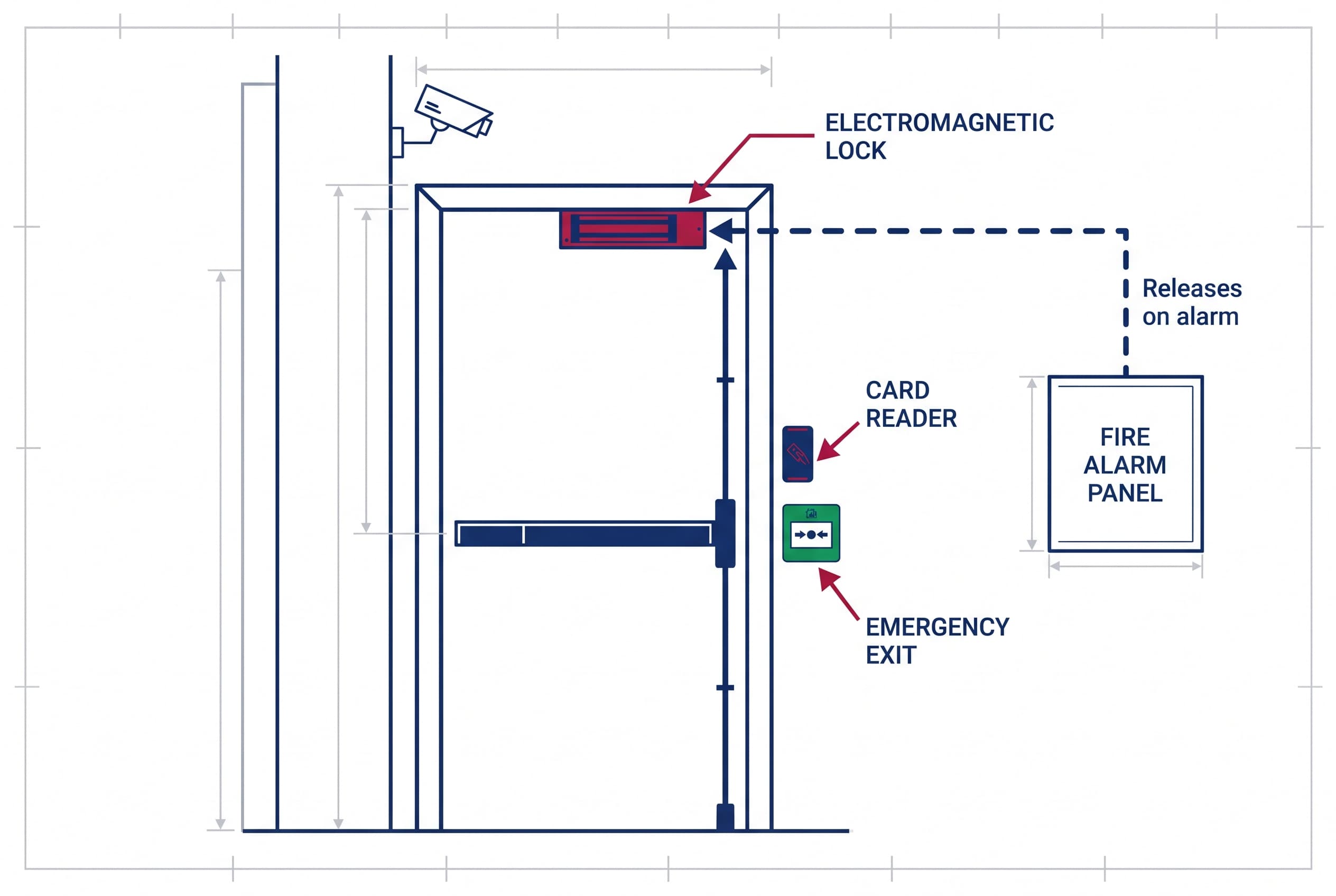
A card reader and an electromagnetic lock go onto a stairwell door, and nobody wires the lock to the fire alarm. In a power cut or fire, the door stays locked. Cameras cover the gate but miss the loading dock. Footage is stored for a few days, then overwritten before anyone notices a loss. Readers stop working and nobody's responsible for them.
Each of these is cheap to avoid at the planning stage and awkward to fix later.
Planning CCTV for a Factory
Start with the places where something can go wrong, not with the number of cameras.
|
Area |
What you need to see |
Planning point |
|
Main gate and vehicle entry |
Faces and vehicle plates |
Good lighting and the right camera angle matter more than resolution alone |
|
Perimeter and boundary |
Movement along fences and walls |
Night vision and weatherproof housings |
|
Loading and unloading docks |
People, vehicles and goods |
Cover the whole bay, not just the door |
|
Stores and high-value areas |
Everyone who enters or leaves |
Cover the door and the stock area |
|
Production floor |
Safety and process events |
Mount high enough to avoid vibration and forklift impacts |
|
Control and server rooms |
Entry and exit |
Pair with access control logs |
Decisions That Are Easy to Get Wrong
- Storage and retention. How long you keep footage should be a deliberate decision. Storage size depends on the number of cameras, the quality and the days you keep. Size it for your chosen period, not the default.
- Power backup. Cameras and recorders should ride through short power cuts on a UPS, or you lose the footage you most need.
- Lighting. A good camera in poor light gives poor footage. Check lighting at night before choosing hardware.
- Network. Keep the camera network separate from the office network and protect it with strong passwords.
- Checking the footage. If nobody ever reviews it or tests retrieval, it's of limited use.
Planning Access Control
Access control means a chain of parts: a credential, a reader, a controller, a lock and software that keeps a record. The credential can be a card, a PIN or a biometric such as a fingerprint or face. Cards are cheap and easy to replace. Biometrics can't be lent or lost but involve more privacy duties, which we cover below.
The Most Important Choice: Fail-Safe or Fail-Secure
This choice decides what the door does when the power fails. A fail-safe lock unlocks when power is lost. A fail-secure lock stays locked.
|
Door |
Egress role |
Typical choice |
Why |
|
Stairwell, final exit, fire door |
Escape route |
Fail-safe |
Must open freely in a fire or power cut |
|
Main production entry |
Often part of the escape route |
Fail-safe |
Controlled in normal use, open in an emergency |
|
Server room or store |
Usually not an escape route |
Fail-secure |
Protects assets, but people inside must still be able to leave freely |
Even where a door is fail-secure, a person inside must be able to leave without a key or card, for example through a request-to-exit device or a mechanical release.
The Fire Safety Link: Rules You Can't Skip
Published guidance on access control in India is consistent on this. The National Building Code, 2016 expects escape-route doors to allow free egress, and electrically locked doors on those routes should unlock when the fire alarm activates and when power fails.
Practically, that means:
- Fail-safe hardware on escape doors, so power loss unlocks them
- A hard-wired release from the fire alarm panel, using a relay that drops the lock power on alarm. Software links are fine as an extra, but the wired connection should be there as well
- A manual emergency release (break-glass or exit button) beside the door
- A proper test. Integration between the fire alarm and the access system should be tested at commissioning, not assumed
- Care with door holders. Magnetic devices that hold a fire door open and release it on alarm are often wired incorrectly. A door that stays open in a fire defeats its purpose, as we explain in our guide to fire doors
This work involves the lock hardware, the fire alarm and the electrical supply, so it's a job for the security installer, the fire protection contractor and an electrician working together. It also ties directly to the alarm system, which we describe in our guide to fire alarm systems in Hosur, and to handover testing, covered in our post on fire protection system commissioning.
Privacy: CCTV and Access Control Collect Personal Data
CCTV footage, access logs and biometric records are personal data. India's Digital Personal Data Protection Act, 2023 doesn't prohibit workplace monitoring, and the Government notified the DPDP Rules in November 2025. Commentators note that the main obligations are being phased in, so check the dates that apply to you with a lawyer.
Good habits to adopt now:
- Tell staff and visitors what's recorded and why
- Collect only what you need and keep it for a set period
- Secure the footage and the biometric data
- For biometric attendance, offer a non-biometric alternative
This isn't legal advice, but these habits are sensible whichever way the rules develop.
Looking After the System
Security systems fail quietly. A camera drifts out of focus, a hard drive fails, a reader loses its connection, or a lock stops aligning with the door. Regular care catches these early. A good CCTV and access control maintenance plan includes:
- Checking every camera's view, focus and night image
- Testing that recordings are saving and can be retrieved
- Checking readers, controllers, batteries and lock alignment
- Testing the fire-alarm release on escape doors with every alarm test
Our guide to Fire Protection System AMC explains how maintenance contracts work, and the same approach applies to CCTV and access control. The security checks can also be included in a wider review such as a fire safety compliance checklist.
Why Factories in Hosur Choose Technique Engineers
Technique Engineers installs CCTV and access control systems for factories, warehouses and commercial buildings across Hosur and Krishnagiri, alongside fire protection. That means the fire-alarm release, the door hardware and the testing are planned together instead of by separate contractors. We also provide AMC for CCTV and access control, so cameras, recorders, readers and locks are checked on a schedule.
Frequently Asked Questions
Can I put a card reader on a stairwell door?
Yes, but only if the door can always be opened freely from the escape side and releases on the fire alarm and on power loss. A door that locks people in during a fire is both unsafe and non-compliant.
Should a server room door be fail-safe or fail-secure?
Often fail-secure, because it protects equipment and isn't normally an escape route. People inside must still be able to leave without a card or key, and the design should be checked against your escape plan.
How long should we keep CCTV footage?
There's no single right answer. Choose a period based on your risk, how quickly incidents are noticed and your data policy, then size the storage for it. Keep it no longer than you need, because footage is personal data.
Is biometric attendance allowed?
The DPDP Act doesn't ban it, but it raises duties around notice, purpose, security and retention. Offering a non-biometric alternative is a sensible safeguard. Confirm the details with a lawyer.
How often should we test the fire release on access doors?
Include it in your regular fire alarm tests so the doors are checked every time the alarm is tested. Also test after any change to the door, the lock or the alarm wiring.
Technique Engineers installs and maintains CCTV and access control systems, alongside complete fire protection solutions, for industrial and commercial facilities across Hosur and Krishnagiri. Contact us to plan security and fire safety together


