
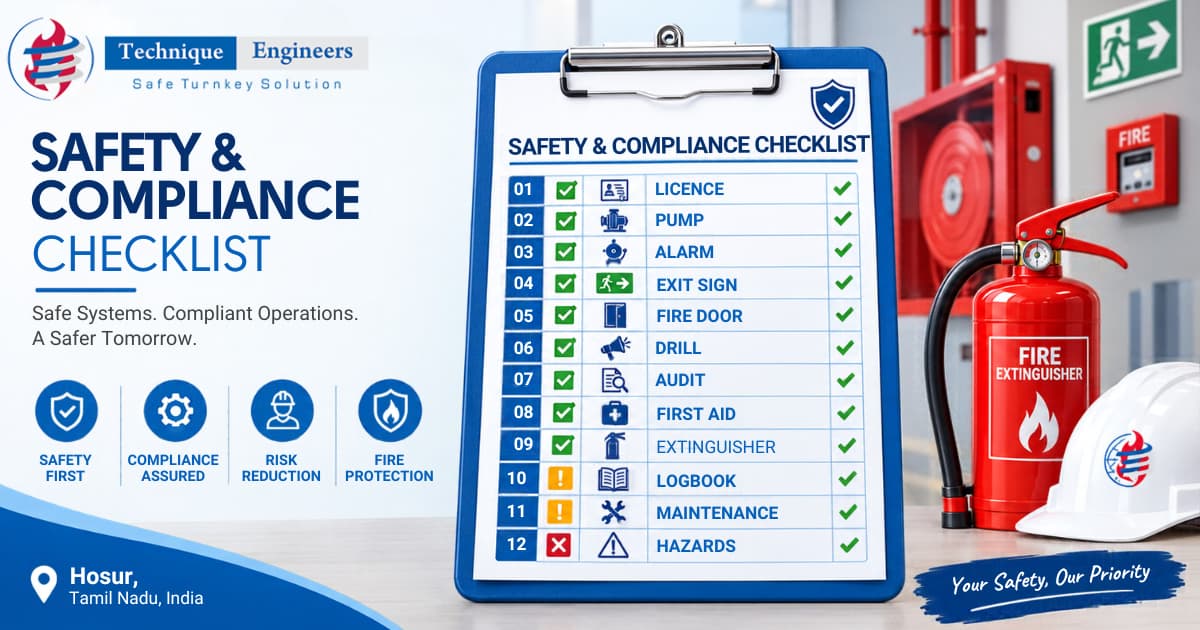
Fire Safety Compliance Checklist for Factories in Hosur
Use this 12-point fire safety compliance checklist for factories in Hosur, plus what Tamil Nadu’s new 2025 fire law means for licences and renewals.
Fire safety compliance in a factory comes down to three things: documents that are valid, systems that work, and people who know what to do. This guide gives you a 12-point fire safety compliance checklist you can score yourself against in an hour. It also flags a change you should know about. Tamil Nadu has passed a new fire law, the Tamil Nadu Fire and Rescue Services Act, 2025, that replaces the 1985 Act and changes how buildings are licensed. Until you've confirmed how it applies to your plant, keep your existing licence and renewal dates exactly as they are.
The Problem: Compliance Lives in Someone's Head
In many factories, fire safety compliance is tracked informally. One person knows when the licence expires. Someone else remembers when the pump was last tested. Records sit in different folders, and the whole thing gets pulled together in a rush before an inspection.
That's how gaps appear. A licence lapses. A layout changes and nobody reports it. A valve stays closed after a service visit. Each one is small, and each one is what an inspector or an incident finds first. A written fire safety compliance checklist, owned by a named person and reviewed on a schedule, is the simplest cure.
The Solution: A 12-Point Fire Safety Compliance Checklist
Mark each item green (done and documented), amber (partly done) or red (missing). Fix the reds first, starting with anything that affects escape or water supply.
|
# |
Check |
What good looks like |
Read more |
|
1 |
Fire licence or NOC |
Valid, displayed, renewal date in the calendar |
|
|
2 |
Design matches the building |
Systems designed for your actual layout and hazards, to NBC 2016 Part 4 |
|
|
3 |
Commissioning records |
Flushing, pressure and pump test certificates on file |
|
|
4 |
Water-based systems |
Pumps, hydrants and sprinklers tested on schedule |
|
|
5 |
Detection and alarm |
Panel fault-free, devices tested, nothing isolated |
|
|
6 |
Special hazards |
Gas, foam or aspirating detection fitted where the risk needs it |
|
|
7 |
Exits and signage |
Exits clear and wide enough, signs visible, emergency lighting working |
|
|
8 |
Passive protection |
Fire doors close properly, openings in fire walls sealed |
|
|
9 |
Maintenance contract |
AMC in place with a visit record after every service |
|
|
10 |
People and drills |
Wardens appointed, staff trained, drills recorded |
|
|
11 |
Audit |
Audit in the last 12 months, with actions closed |
|
|
12 |
Change control |
Protection reviewed whenever layout, stock or process changes |
Item 12 is the one most plants skip. Fire protection is designed for what the building holds on the day it's designed. If you add racking, change what you store, or install a new process, ask your fire protection provider to check the design before the change goes live.
What's Changing in Tamil Nadu
This is a moving area, so read it carefully and confirm the details with the fire department.
- A new Act. The Tamil Nadu Fire and Rescue Services Act, 2025 (Act 37 of 2025) received the Governor's assent on 6 June 2025. It repeals and re-enacts the Tamil Nadu Fire Service Act, 1985. It comes into force on a date the government notifies, and it was amended again by an Act passed in 2026.
- Three categories. Every building is to be classified as Category A, B or C. Category A buildings need a fire licence, Category B a fire safety certificate, and Category C a self-certified fire safety protocol. Each must be renewed within the time prescribed.
- Who certifies. According to published summaries, Category B certificates come from empanelled private fire safety audit agencies and are valid for three years, and Category C is a self-certified protocol generated through the TNFRS portal.
- Fire safety officer. The Act requires owners or occupiers to appoint a fire safety officer, who must be trained.
- Existing licences. For existing buildings that need a licence, the Act gives a window to apply: by the expiry of the current licence or 180 days from commencement, whichever is later.
- Small industrial plots. Separately, an amendment to the Tamil Nadu Combined Development and Building Rules exempts buildings approved under the self-certified industrial building scheme (plots up to 7,500 sq. ft) from getting a Fire NOC from the fire department.
What we couldn't confirm is the exact commencement date, and which factories fall into which category. Those details are set by rules and notifications. Ask TNFRS or an empanelled audit agency which category your plant falls into, and don't rely on old fee quotes.
A Simple Calendar to Keep Fire Safety Compliance Alive
|
How often |
What to do |
|
Weekly |
Run the diesel fire pump, check valve positions, walk the exits |
|
Monthly |
Check the alarm panel, extinguisher condition and electric pump run |
|
Quarterly |
Review valves, test alarm devices, check the AMC visit record |
|
Twice a year |
Run an evacuation drill and record it |
|
Yearly |
Full audit, review the training plan, check licence and renewal dates |
|
Every 3 to 5 years |
Deeper tests such as internal pipe checks, as in our guide to fire protection system inspection |
Treat the frequencies as a baseline. Your own design, insurer and local authority may ask for more.
How to Use This Fire Safety Compliance Checklist
Give it to one named person and set a date. Score each item, list the reds, and agree who will close each one and by when. Repeat every quarter. When something is amber or red, ask whether it affects escape, detection or water supply. Those come first.
Why Factories in Hosur Choose Technique Engineers
Technique Engineers designs, installs, tests and maintains fire protection systems for factories across Hosur and Krishnagiri. We can audit your plant against this checklist, rank the gaps by risk, and close them with design, installation, AMC and training. The result is one set of fire safety compliance records you can show to an inspector, an insurer or a client.
Frequently Asked Questions
Does my factory in Hosur still need a Fire NOC?
Keep your existing licence or NOC valid and renew it on time. The new Act will change the licensing structure, but it comes into force on a notified date, and the rules defining the categories matter. Check the current position with TNFRS, and ask whether your plant may be exempt under the self-certified industrial building scheme.
Who can certify a Category B building?
According to published summaries of the new system, empanelled private fire safety audit agencies. Confirm the current list and process with TNFRS before you appoint anyone.
How often should we review this checklist?
A quick self-review every quarter, and a formal audit once a year. Also review it whenever the plant changes, such as an extension, a new process or a change in storage.
Who should own fire safety compliance in the plant?
One named person, with a backup. The new Act refers to a trained fire safety officer, so it's sensible to name and train someone now.
We've expanded our plant. What should we do?
Have your fire protection design reviewed against the new layout and stock, and ask the fire department whether an addendum or updated approval is needed. Don't assume the old approval covers the new area.
Technique Engineers provides fire protection design, installation, AMC, audits and training for industrial and commercial facilities across Hosur and Krishnagiri. Contact us to run a fire safety compliance review of your factory.


