
Warehouse Fire Protection in Hosur: A Practical Guide
Planning warehouse fire protection in Hosur? See why rack storage needs storage-rated sprinklers, how to match design to stock, and what to review.
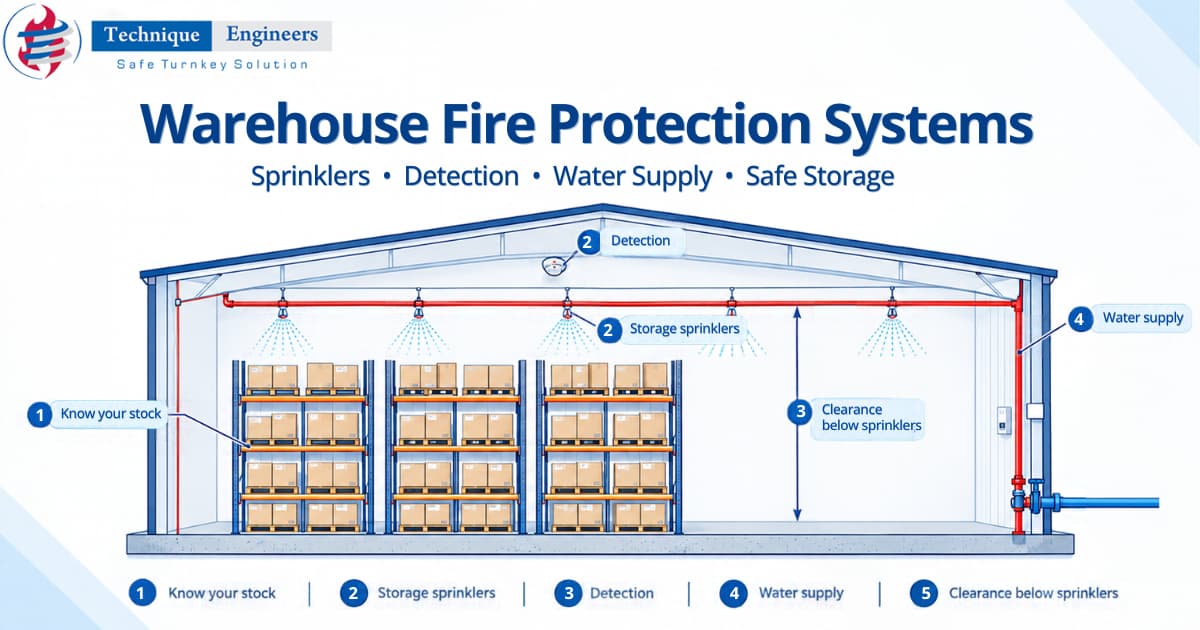
A warehouse doesn't burn like an office. Tall racks, packaged goods and big open spaces let a fire climb and spread quickly, and ordinary sprinklers are often not enough. Good warehouse fire protection starts from what you store and how high you store it. Five layers are built around that: detection suited to high ceilings, storage-rated sprinklers, a strong water supply, passive protection with clear escape routes, and regular upkeep. This guide walks through those layers for a warehouse or logistics facility in Hosur and shows how our other guides fit together.
The Problem: Storage Height and Packaging Hide a Fire
In a warehouse, the fuel is stacked in the air. A pallet of packaged goods on a rack gives a fire a vertical path, and the space between racks works like a chimney. Sprinklers sit on a ceiling that may be many metres above the fire, so water has a long way to fall and a lot of stock to get through.
Packaging makes it worse. NFPA 13 notes that encapsulated goods, such as pallets wrapped in plastic, stop sprinkler water from wetting the fuel, which lets a fire spread more easily. For that reason, it asks for more water flow and limits how high such goods can be stacked.
Warehouses also change. A tenant leaves, a new product arrives, racks go up another level. The fire protection stays as it was designed. That mismatch is behind many warehouse fire protection failures.
The Solution: Five Layers of Warehouse Fire Protection
Layer 1: Know What You Store
Everything else depends on this. NFPA 13 sorts goods into four commodity classes, with separate groups for plastics. It also treats storage arrangement in detail: solid-piled, palletised or rack storage each have their own protection rules. A fire protection designer needs the following from you.
|
Question |
Why it matters |
|
What is stored (paper, plastics, liquids, electronics)? |
Sets the commodity class and the water demand |
|
How is it stored (floor stack, pallets, racks)? |
Rack storage needs different protection from solid piles |
|
How high is the storage? |
Height drives sprinkler type and whether in-rack sprinklers are needed |
|
Is it wrapped or encapsulated? |
Wrapped goods need more water and may limit stack height |
|
Will any of this change soon? |
The design should cover the planned stock, not only today's |
Layer 2: Storage-Rated Sprinklers
Standard sprinklers are usually not adequate for storage. Warehouses typically need sprinklers with a larger K-factor and special deflectors, designed to push enough water through to the fire.
There are four main approaches for storage occupancies:
|
Type |
What it does |
Where it tends to fit |
|
CMDA and CMSA |
Control the fire until it's put out or burns out |
Moderate storage heights and standard commodities |
|
ESFR (early suppression, fast response) |
Aims to suppress the fire rather than just control it |
High-piled storage; can remove the need for in-rack sprinklers |
|
In-rack sprinklers |
Place sprinklers inside the racks |
Very flammable goods, high ceilings, or racks that block water |
ESFR is popular because in-rack sprinklers are costly and easily damaged by forklifts moving stock in and out. But ESFR has strict rules on ceiling height, storage height and clearance, so the choice comes from a design review, not a catalogue.
Clearance matters too. NFPA 13 testing found sprinklers work better when they're positioned a short distance above the top of the storage. Stacking goods up toward the ceiling can defeat a good design.
Layer 3: Detection for Tall Spaces
At high ceilings, smoke spreads out and thins before it reaches a detector. Spot detectors alone can be slow in a large, tall space. For high or hard-to-reach ceilings, aspirating systems are often used. Class B is intended for high ceilings and airflow where smoke is diluted, and Class C is often used in warehouses and cold stores where access is limited. Our guide to aspirating smoke detection explains the classes, and our guide to fire alarm systems in Hosur covers the basics.
Layer 4: A Water Supply That Matches the Demand
Storage sprinklers use a lot of water, so warehouse fire protection depends on a strong supply. The pump, tank and mains must be sized for the storage design, not for an ordinary building. Start with our guide to choosing the right fire pump, then see how the yard is laid out in our post on external fire hydrant systems.
Layer 5: Passive Protection and Escape
Fire doors, compartment walls and sealed openings limit how far a fire and smoke can spread, as we cover in our guide to passive vs active fire protection. High-piled storage may also need smoke and heat removal in some designs, so ask your designer. Exits must stay clear and marked, which is the subject of our post on fire safety signage.
Day-to-Day Habits That Support Warehouse Fire Protection
- Keep aisles and exits clear, and keep clearance below sprinklers
- Control hot work, and manage forklift charging areas and electrical panels carefully
- Don't store in front of hydrants, valves or panels
- Tell your fire protection provider before you change stock type or add racking
- Train staff, including night shifts, as we describe in our guide to fire safety training
Keep Warehouse Fire Protection Working and Approved
Warehouse fire protection only works if it's maintained, which we cover in our guides to Fire Protection System AMC and fire protection system inspection. For new buildings or changes, see how approvals work in our guide to fire protection approvals. If your insurer asks for a particular standard, read our post on NFPA vs FM Global.
Why Warehouses in Hosur Choose Technique Engineers
Technique Engineers designs and installs warehouse fire protection for warehouses and logistics facilities across Hosur and Krishnagiri. We begin with your stock, rack heights and layout, then design detection, sprinklers, pumps, hydrants and escape provisions as one system. Afterwards we handle commissioning, AMC and training, so the protection stays matched to what you actually store.
Frequently Asked Questions
Will ordinary sprinklers protect a warehouse?
Usually not on their own. Storage areas typically need sprinklers designed for storage, and the right type depends on your commodity, storage height and arrangement. Ordinary sprinklers designed for offices can leave a gap in a tall, packed warehouse.
Should I choose ESFR or in-rack sprinklers?
It depends on your ceiling height, storage height and what you store. ESFR can avoid the cost and damage risk of in-rack sprinklers where it suits the building, while in-rack sprinklers are used for harder cases. A design review should decide.
We changed what we store. Do we need to redo the system?
Possibly. The design is based on the commodity, packaging and height at the time. If those change, ask your fire protection provider to check whether the design still fits before the new stock goes in.
How much clearance should I leave below the sprinklers?
It depends on the sprinkler type and design, so follow the figure in your own design documents. The important point is not to stack goods up to the ceiling or against the sprinklers.
Where do I start with warehouse fire protection for a new building in Hosur?
Share your stock list, rack heights and layout plan. Those three things let a designer size the sprinklers, pumps and detection and flag approval need early.
Technique Engineers designs, installs and maintains warehouse fire protection for logistics and storage facilities across Hosur and Krishnagiri. Contact us to review your warehouse's fire protection.


